
A season named by a calendar
Hemanta is often rendered in English as late autumn or early winter, but those English phrases do not map perfectly onto the lived weather of every part of Odisha. One commonly used Odia calendar table pairs Hemanta with Kartika and Margasira. It is a calendar convention, not a forecast: Odisha’s official climate profile uses four meteorological seasons and describes regional variation in rainfall and climate. The State Disaster Management Authority places the post-monsoon period in October and November and the winter period in December through February. These are useful ways of talking about different things. A traditional six-season calendar offers a cultural vocabulary for the year; an official climate classification helps describe broad meteorological conditions. Neither can tell a farmer exactly what is happening in a particular field on a particular day.
This distinction gives the story its first image. Hemanta is not a door through which all of Odisha passes at once. It is a name people use to notice a turning of the year, and that turning appears differently on the coast, in the river plains and in upland districts. One village may meet an early fog while another wakes to a mild, bright morning. A field’s crop stage depends on local conditions and decisions made earlier. A poem can make room for this variety instead of forcing one picturesque image onto the whole state.
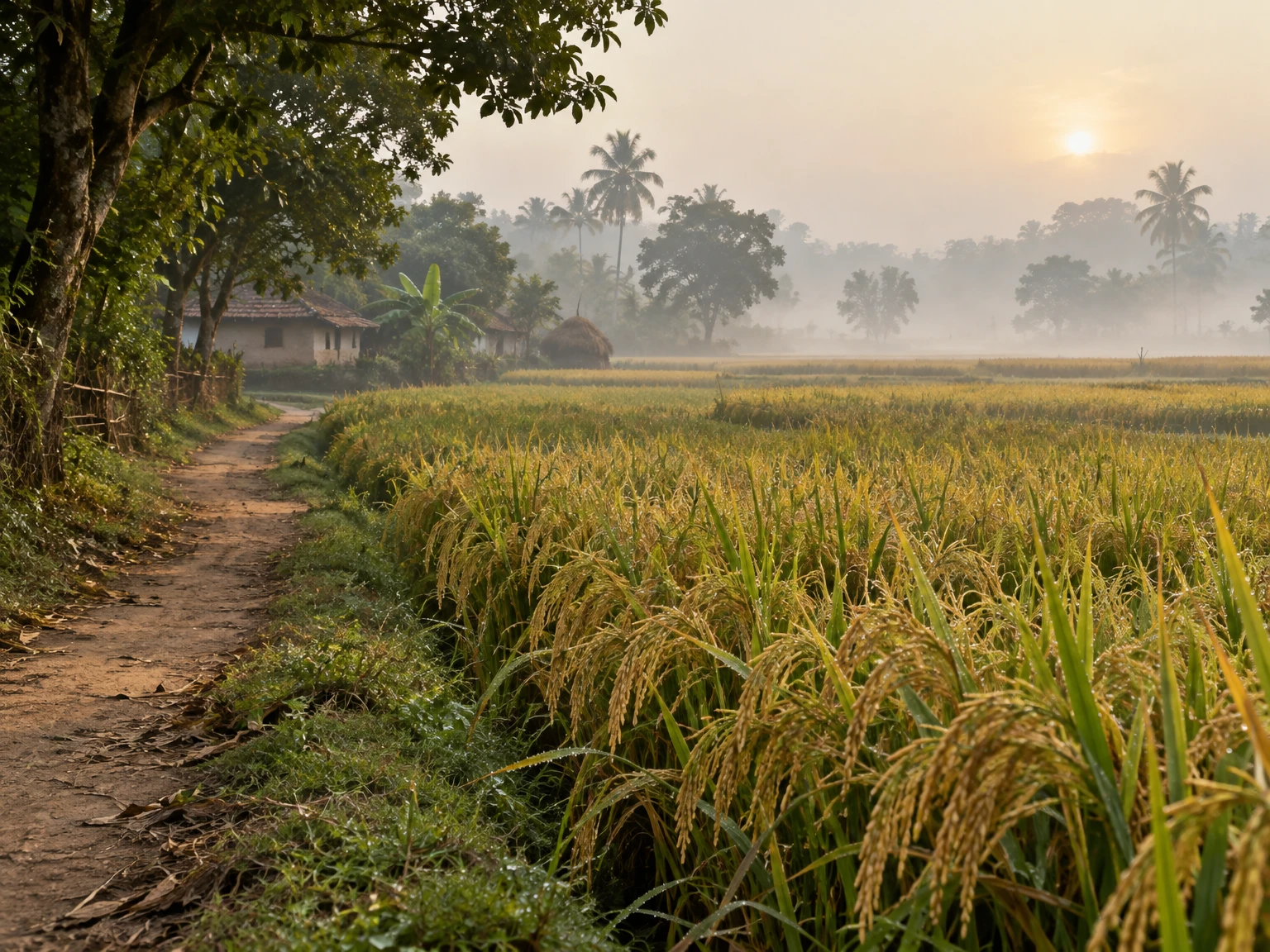
The title’s “golden canopy” is therefore a figure of attention, not a claim that every field turns gold together. It can mean a wash of low light across a landscape, the color of ripe grain in a particular place, or the warmth of a memory. The article follows that image while separating what a source documents from what an observer imagines.
Between rain and the cooler months
Seasonal change is usually a sequence rather than a scene change. The State Disaster Management Authority describes Odisha’s climate as influenced by the monsoon, notes that most rainfall arrives during the southwest monsoon, and emphasizes that rainfall distribution is uneven. It also describes the monsoon’s withdrawal around the middle of October. That account explains why a calendar season cannot be treated as a statewide guarantee of clear skies, mist or a fixed temperature. A post-monsoon interval can contain wet days, dry intervals, warm afternoons and locally different conditions.
A carefully written nature essay can nevertheless attend to the shift without overclaiming it. After rain, the surface of a lane may darken, then dry unevenly. Water can linger in a shallow depression long after the nearby path has turned dusty. A low sun may give a field a warmer color than it had under the high clouds of the monsoon. These are small, observable changes. They are not proof that winter has arrived everywhere or that the same scene recurs at the same date each year.
The original essay describes a pearl-colored mist, dew on webs and grass, and the first coolness in the air. These details are attractive but not independently established as universal Hemanta conditions. In this retelling, mist and dew appear as possibilities in an individual morning scene. The narrator does not claim that a named local expression is used across Odisha or that every reader will recognize the same weather. A personal observation can remain vivid while being honest about its limits.
The changing light is enough to carry the passage. A courtyard may be shaded when a nearby road is already bright; a damp wall may hold the night’s coolness; a pond may reflect the sky and then lose the reflection when a breeze passes. None of these details needs a grand seasonal claim. Their meaning comes from patient observation, and from allowing one place to remain one place rather than turning it into a statewide symbol.
The field as a place of work
The essay’s central rural image is a paddy field approaching harvest. Paddy is important in Odisha, but crop cycles vary with geography, rainfall, variety, planting date and agricultural practice. An official state climate profile cannot establish the exact harvest date for every crop. Current agricultural advisories are issued with local and crop-specific conditions in mind; they should be consulted for practical decisions. This article therefore does not state that Hemanta is the harvest season in every district or that all fields are golden during Kartika and Margasira.
Instead, it asks the reader to imagine one field at one moment in the year. A farmer walks along a raised boundary, studies the crop, considers water and weather, and decides what attention is needed next. The field is not an illustration made for a poem; it is an economic and ecological space, managed with knowledge that the outsider may not possess. Its color alone cannot disclose the farmer’s plans, the cost of labor or whether a crop has suffered from weather.
The harvest image is still meaningful. Where harvesting is underway, the work includes decisions about maturity, weather, labor, cutting, transport, threshing, drying and storage. The exact method and equipment vary. It would be misleading to present sickles, bullock-drawn carts, threshing floors or mechanical harvesters as a single timeless sequence shared by all families. A responsible story can name these as possible practices only when a particular place and source support them. Without that evidence, the image should remain general: hands and tools at work, grain being gathered, and people assessing what the season has yielded.
This qualification does not diminish the labor. It makes it visible. Harvest is not simply nature handing over abundance; it is the result of seed, soil, water, weather, care, labor and risk. A crop can be abundant in one plot and disappointing in another. The phrase “the earth’s gift” may express gratitude, but it should not conceal the people whose decisions and effort shape the outcome.
Grain, memory and what a harvest cannot promise
The word “harvest” often gathers more than one meaning. It can name a crop being cut, the grain brought into storage, a market transaction, a family meal, or the memory of a year’s work. These are related events, not a single moment. A field can be ready while transport or storage is still uncertain. A household may celebrate a new crop while facing expenses or losses. No seasonal essay should presume that every granary is full or every farmer shares the same feeling of relief.
The supplied narrative evokes granaries, new rice and a village economy organized around agriculture. Those ideas can inspire a reflection on food, but specific storage structures and terms should be verified locally before being stated as fact. A traditional name for a container may vary by region and language. A phrase used in one household cannot be generalized across the state without evidence. This version avoids unverified Odia terms and does not present an invented seasonal custom as a historical record.
Food nonetheless gives the seasonal story a human scale. Grain begins as a plant in a field and becomes nourishment through a chain of work: cultivating, harvesting, processing, storing, trading and cooking. Different people participate at different points. A meal can bring those stages together, even when the people eating it do not see the field where the crop grew. The story of a season can honor that connection without pretending that one meal or recipe represents all of Odisha.
A writer may remember the smell of straw or the sound of a market and still need to label the recollection as personal. A factual article can distinguish an individual memory from an official source or a documented custom. That distinction protects both the reader and the people whose lives are being described. It also invites other people to add their own accounts, rather than asking them to accept one account as universal.
The season’s abundance is not measured by a metaphor alone. It is measured in actual yields, access to markets, food security and the circumstances of particular households. Those subjects require current, specific evidence. This essay does not offer numbers or claims about procurement, prices or rural incomes; the available sources here do not establish them. Instead, it reflects on the human relationship to harvest while leaving policy and agricultural reporting to sources that can support them.
A calendar of observances, carefully placed
A season essay often turns toward festivals. Odisha’s public calendars include many observances, but their dates, meanings and local forms differ. The Government of Odisha’s festivals page describes Durga Puja in September–October and identifies public celebrations in Cuttack. Odisha Tourism documents other events and their locations. These sources can support a place-specific description, but they do not prove that every festival belongs to Hemanta or is celebrated identically throughout the state.
Nuakhai is an important observance in western Odisha, but the supplied essay’s placement of it within Hemanta should not be repeated without a calendar source establishing the relevant year and local reckoning. A seasonal mapping can shift with the calendar system, and observances may be tied to a specific lunar date rather than a broad English season. The article therefore does not present Nuakhai as a Hemanta-wide festival. Nor does it claim that a particular festival is the “climax” of the season.
The same care applies to Lakshmi worship and Prathamastami. These are culturally significant observances in Odisha, but the article would need reliable sources for their dates, locations and described practices before linking them to a particular seasonal span. A statement that people clean homes, draw rice-paste designs, wear new clothing or prepare a certain food should be tied to a source or described as one documented local practice, not as the behavior of every family. The relevant official festival page can be consulted if a future, more specific account is written.
A useful rule for cultural writing is to give each custom a place. “A government page describes this observance in this town” is more precise than “Odisha celebrates this way.” A named source, a named district and an approximate date make the reader’s picture clearer. They also prevent the state’s many communities from being collapsed into a single story.
There is room in this article for the anticipation that often accompanies an event: lights being prepared, a market becoming busier, a family making plans. But where the scene is imagined rather than documented, the writing says so. The emotional truth of a festival can matter without being turned into a claim about every household’s ritual practice.
Harvest celebrations and local meaning
An agricultural calendar and a festival calendar sometimes meet, but they do not always coincide in the same way. Some observances are associated with crops, seasonal transitions, religious narratives or community gatherings. A writer should not assume that a festival is simply a harvest celebration because it occurs near a harvest, or that a harvest custom has one meaning across regions. The relationship should be supported by a source that speaks to the particular place and tradition being described.
This caution is especially important when describing “Lakshmi Puja” as a universal welcome into granaries. The original prompt presents that image as a broad tradition, yet no specific source was supplied to confirm the exact practice, timing or prevalence. This article does not repeat it as a statewide fact. It also avoids setting out a supposed historical timeline in which a village economy was entirely agrarian or in which particular technologies arrived in a defined decade. Such claims need archival or regional evidence, not an evocative tone.
A more grounded way to write about cultural life is to begin with evidence and then interpret it. If an official festival notice identifies an event, its date and place, the article can describe those facts. If a scholarly or community account explains a ritual’s meaning, that interpretation can be attributed to the source. If the writer has only an image of lamps, music or decorated streets, the image can remain an image, without claiming what participants believe or how society changes because of it.
A public event may involve worship, commerce, performance, family visits and craft. Which of those elements appear depends on the event and its location. Festival writing becomes richer when it names artisans, organizers, performers, vendors and visitors as people with distinct roles instead of presenting a crowd as one undifferentiated group. It becomes more respectful when it does not assume that attendance is universal or that everyone experiences the event in the same way.
Hemanta can still be a frame for thinking about how communities mark time. The frame is not a catalog of fixed practices; it is an invitation to ask what a particular community does, when it does it and how its members describe the meaning. That question is more open, and more useful, than declaring a practice timeless without evidence.
The city and the village are not opposites
The original essay contrasts village harvest life with urban tea stalls, sweaters and festival lights. This can be an appealing literary device, but it risks flattening both places. Villages are not frozen in a pre-modern past, and cities are not detached from food, weather or rural labor. People move between them; markets connect producers and consumers; families may have ties across districts. A careful story does not use the village as a symbol of authenticity and the city as a symbol of alienation.
There are also many kinds of rural places: coastal settlements, river plains, irrigated areas, dry zones and upland communities. Each has different conditions and work patterns. There are many kinds of urban neighborhoods too. A tea stall can be a gathering place in one street, a business in another, or simply a point on someone’s route. A sweater in the evening is a detail of a particular temperature and person, not a statewide sign that winter has arrived.
Rather than setting up a contest between tradition and modernity, we can look at how people adapt to the circumstances around them. A mobile phone may accompany a person in a field; a tractor may be present in one landscape and absent in another; an older tool may remain useful alongside newer machinery. These examples require local evidence if presented as reporting. The essay does not establish a statewide chronology of mechanization, electricity, digital procurement or transport. It therefore does not assert one.
The landscape can connect rather than divide. A city meal depends on agricultural systems; a village market may sell goods made in a town; public festivals can draw visitors from many places. These are broad observations about interdependence, not claims that every person follows the same route. The aim is not to romanticize a rural scene but to see how many kinds of knowledge and labor sustain everyday life.
A writer’s own point of view matters, too. Someone who passes through a harvest landscape as a visitor sees only a small portion of it. They may notice light and sound, while a resident sees weather risk, work schedules, transport or crop prices. The visitor’s impressions can be beautiful, but they are not a substitute for the experience of those who live and work there. A thoughtful essay knows where its viewpoint ends.
The science of seasons and the language of feeling
The word “season” can refer to a conventional calendar period, a recurring meteorological pattern, a crop stage or a felt change in daily life. Confusing these meanings creates false certainty. The six-season structure is culturally and historically meaningful in Indian seasonal thought; the state’s climate agency uses a four-season meteorological model. These classifications do not need to be forced into one identical schedule. They answer different questions.
The State Disaster Management Authority’s account is especially useful for a literary writer because it makes regional differences explicit. Odisha’s rainfall is concentrated in the southwest monsoon, but its distribution varies. This means that a general essay should avoid declaring that the monsoon ends everywhere on the same day, that every Hemanta morning is misty, or that every district receives identical winter temperatures. The broad dates in a calendar can help readers orient themselves; local observation and current advisories are needed for practical decisions.
The given text names a mist term and plants such as wild kasia and malati. Without a reliable botanical or linguistic source confirming the intended species and local usage, those labels are not repeated as fact. Common plant names can refer to different species in different languages or places, and seasonal flowering can vary with rainfall and habitat. If a future edition identifies a particular plant, it should cite an authoritative flora or a verified local source and include the correct scientific name where useful.
Likewise, the statement that migratory birds begin arriving in Hemanta is too broad without a species, site and date. Odisha Tourism’s official material on the Chilika bird festival describes winter birding and identifies particular wetland locations. That is a good reason to write about Chilika as a winter destination in a separate, sourced passage; it does not prove that cranes appear in a V formation over every village pond or that all migration begins at one uniform point in Hemanta.
Poetry has a different freedom. It can say that the sky seems to open, or that the field appears to hold the last warmth of the day. The wording makes clear that the narrator is interpreting what they see. Metaphor becomes misleading only when it is used to make factual claims about weather, plants, birds or people that the evidence cannot support.
The discipline of not inventing the past
The supplied essay refers to “classic 1980s Odisha Board Sahitya” and describes what children supposedly learned. It does not provide a textbook title, class, edition, publication date, page or archival reference. The claim therefore cannot be treated as established history. This article does not assert that a particular lesson appeared in a textbook, that a certain poem was memorized, or that school lessons created the philosophical understanding attributed to children of that period.
A historical question is worth researching on its own terms. A reliable account would begin by locating actual textbook editions, reading the relevant pages, verifying their publication and curriculum context, and separating the text’s wording from later interpretation. It would also check whether a schoolbook was used statewide or only in a particular class, district or school. Memory can point toward a source, but it cannot replace one.
The same standard applies to details of rural life. Statements about bullocks, sickles, songs, threshing floors, cow-dung plaster, rice-paste designs or the arrival of tractors in the 1980s might be accurate in a particular family or location. That does not make them universal, and no evidence provided here supports a single statewide account. This essay avoids presenting them as historical facts. It also avoids language that turns a past decade into a picturesque tableau where every household lived the same way.
For cultural writing, restraint is not a refusal to tell stories. It makes room for better stories. A future, locally researched article could interview residents, consult photographs and records, name the village and date, and document how practices changed. A statewide article could compare regions and acknowledge disagreement. Until such evidence exists, it is more honest to write about the scene as a contemporary imagined landscape and keep claims about the past out of it.
The difference between “I imagine” and “this happened” is small in wording but large in responsibility. A reader may take an asserted historical fact as a record. The writer should not ask the reader to trust an invented memory simply because it sounds plausible. This article treats the supplied essay as creative inspiration, not as proof of a textbook or social history.
A harvest is also a question of stewardship
A field’s yield depends on the interaction of natural conditions and human decisions. A story can express gratitude for grain and still recognize uncertainty: rain may arrive late or heavily, water access may vary, pests and disease may affect crops, and prices and transport shape whether a harvest provides security. The article does not claim particular crop losses or market conditions; those require current, district-specific sources. The wider point is that harvest is never a simple guarantee of prosperity.
Stewardship describes attention, but it should not be used as a moral judgment on farmers. A person’s agricultural choice may be constrained by land, labor, debt, access to irrigation, market conditions and available information. It is easy for a visitor to say that a field teaches patience. It is harder, and more useful, to remember that the field is a workplace and that choices carry material consequences.
When a field is ready, the work of gathering it is also the work of planning what follows. Grain may need drying and safe storage; straw may have uses; soil may be prepared for another crop or left fallow according to circumstances. Not every practice occurs in every farm. The article does not prescribe a method or offer agronomic advice. It suggests only that the visible image of harvest contains a longer sequence of decisions than a single photograph can show.
The relationship between people and land is not exclusively agricultural. Wetlands, forests and rivers carry their own ecological and social histories. Odisha’s landscape cannot be reduced to rice fields. A seasonal story about harvest is one window into the state, not a complete portrait of it. The window becomes more truthful when it shows its frame.
There is a poetic lesson here, but it is modest. A person can give thanks for what has been gathered while remaining attentive to what remains uncertain. A field may offer plenty; another may ask for care. The work of stewardship is not control over every outcome. It is the ongoing practice of responding to conditions with knowledge, collaboration and respect.
Looking at water, wetlands and birds
The original essay places migratory birds along the edges of Chilika and village ponds. Odisha Tourism’s material on the National Chilika Bird Festival provides a firm basis for discussing winter birdlife at Chilika, including the wetland and birding locations such as Mangalajodi. The source describes seasonal arrivals during the winter months; it is specific to this ecosystem and a tourism context. It does not establish a particular bird species in an unspecified village or prove that every local pond has migratory birds.
A responsible description can therefore say that Chilika is recognized as an important winter birding landscape and invite readers to learn about it through official tourism information. If an article names a species, a count or a migration route, it should cite a current conservation or ornithological source and explain the scope of the data. Promotional figures are not interchangeable with a field survey, and annual conditions can differ.
Wetland visitors should also remember that wildlife is not a performance arranged for a photograph. Keep distance, do not disturb roosts, follow current site rules and use local guides where appropriate. These are general principles of responsible observation, not a substitute for the specific rules of a protected area. A source that provides the current regulations should be checked before publishing detailed visitor instructions.
For the Hemanta image, birds remain an understated possibility rather than a declared spectacle. A still pond can be meaningful even when no bird appears. A seasonal landscape does not owe a visitor a checklist. It is enough to notice how water, sky and light change together, while acknowledging that the animals present depend on place and time.
This passage also shifts the meaning of “abundance.” The land’s richness is not only the grain in a field or the food on a table. It includes wetland habitats and the living communities they support. Conservation is part of the story of seasonal change, but it should be discussed with evidence rather than with an unverified count or a romantic claim that humans and nature always coexist harmoniously.
The metaphor of ripening
The supplied essay offers a philosophical image: grain bends as it ripens, and that bending becomes a lesson in humility. It is a compelling metaphor, but it is the writer’s interpretation, not a scientific conclusion or a universal moral. A reader may see humility in a heavy stalk; another may see the weight of a harvest, the value of labor or the vulnerability of a crop. The image opens a question rather than delivering a rule.
One way to understand ripening is as a process that takes time. A seed does not produce a harvest at the moment of planting; the result depends on many conditions and cannot be guaranteed by intention alone. Human projects can feel similar. Care, effort and time matter, but outcomes also depend on circumstances beyond our control. This is a reflection, not a promise that patience always yields success.
Another way to understand the season is through change in attention. During one part of the year, people may pay close attention to rainfall; in another, to crop maturity, storage or the next planting decision. Different tasks call for different kinds of knowledge. A season’s rhythm can remind us that work has phases. Yet it should not become a prescription that people must be productive in one period and restful in another. People’s lives do not all follow a single agricultural clock.
The image of release can be helpful too, but it should be offered gently. A tree’s changing leaves do not prove that every person must detach from a past experience or abandon something they value. Metaphor is an invitation to think, not an instruction. The story can suggest that letting go may sometimes make room for renewal, while recognizing that grief, memory and change are personal.
These reflections are deliberately modest. The article does not claim that ancient school lessons transmitted one philosophy to all children, or that a crop’s shape proves a doctrine of karma. It simply places a human interpretation beside the landscape and allows readers to take what resonates. The season remains larger than any one lesson we draw from it.
Poetry, attribution and the work of a new voice
The Government of Odisha’s literature overview provides a broad account of Odia literary history and identifies literary traditions and authors. A separate Odisha Review article discusses seasonal imagery in Jayadeva’s Sanskrit poem Gita Govinda. Such sources help establish that seasons have long been a subject of literary attention. They do not establish that the specific lines or poet attributions in the submitted essay are authentic. This article therefore includes no invented quotation and does not attribute seasonal verse to a named Odia poet without a primary text or reliable edition.
A new poem can be written without borrowing authority from an old one. Here is an original prose fragment: At daybreak, the field is still more shadow than color. A line of light reaches the bund, then travels slowly across the stubble. Somewhere beyond the frame, someone is preparing for the day’s work. The observer cannot know what the field will yield, but can recognize the patience required to wait for the next decision.
This passage is written for this article. It is not a translation, a folk verse or a recovered textbook quotation. That label matters because readers deserve to know whether they are encountering inherited words or new writing. It also keeps the literary voice honest: a contemporary reflection can be valuable without being presented as ancient.
Seasonal poetry often uses familiar contrasts—light and shadow, wetness and dryness, stillness and motion. These devices can help a reader feel a transition. The writer need not claim that every Odia poet used the same symbols, or that one season has a single emotional meaning. Literature is not a census of community feeling. Individual works and writers have their own contexts, language and purposes.
If a later article quotes a poem, it should identify the edition, translator if any, publication details and rights basis. Short quotation may still require careful assessment under applicable law; an educational purpose or a disclaimer does not automatically remove copyright obligations. When rights or provenance are unclear, paraphrase the idea in original words and cite the source rather than reproducing a long passage.
The city at the edge of evening
A modern seasonal essay may include a street market, a bus stop, a tea stall or a lit public square. These details can connect the calendar to present-day life, but a writer should not invent a statewide urban mood. People experience weather differently according to work, housing, health and access to public space. A cool evening may feel pleasant to one person and uncomfortable to another. The story can notice this difference without making assumptions about everyone’s response.
Markets are useful points of connection between countryside and town. They can bring crops, prepared foods, household goods and social exchange into one place. But any claim about a specific winter market, price, crop abundance or festival crowd needs a source that describes that site and time. The submitted text’s statements about street food stalls and urban fashion are plausible images, not verified facts. This article presents them as possible observations, not as a measured trend.
The same principle applies to travel. A visitor looking for a seasonal landscape should verify current access, weather, road conditions and local guidance rather than rely on a generic seasonal essay. An official tourism page can point to a place or event, but it does not guarantee that a route is open on a future date. The article makes no real-time claim about a destination’s availability.
The city and the field are linked by work and exchange. A person carrying rice to a market, a vendor preparing a meal, a driver moving goods and a customer choosing what to buy all occupy different parts of a chain. Their experiences are not identical, but a seasonal story can bring the chain into view. The “golden canopy” then becomes more than a view from the road; it becomes a reminder of the many hands and decisions connected to what we eat.
In the evening, light leaves the field gradually. A street lamp replaces the sun; a shop closes; someone returns home. No single scene defines Hemanta, yet each can help someone tell what the year feels like from where they stand. The essay’s job is not to prescribe that feeling but to make room for it.
A practice of careful noticing
This story proposes three habits for writing about seasons. First, state the scope of a source. An official climate profile describes broad regional patterns, not one field’s weather. A calendar page describes one convention, not a universal date. A festival page may describe one place, not every community. Second, distinguish observation from interpretation. “The light fell across the field” is an observation; “the field taught humility” is a personal reading. Third, leave space for variation and unknowns. A writer who says what is not established is not weakening the story; they are showing the reader where fact ends and reflection begins.
These habits are especially useful when writing about rural life. A vivid scene can easily become a stereotype if it turns one image—bullock cart, mud wall, lantern, harvest song—into a universal rural past. People’s homes and livelihoods change across time and place. A village is not a museum, and residents are not characters whose lives exist to confirm a visitor’s nostalgia. Description should respect people’s agency and contemporary complexity.
A source list is not a decoration. It lets a reader follow the factual trail and understand which claims are supported by which pages. In this article, the state climate profile supports the broad climate distinction; the calendar source supports one seasonal-month pairing; government and tourism pages support only the specific event or site they describe. None of these sources supports the submitted essay’s claims about 1980s textbooks, universal rural practices or a single harvest pattern. Those claims are deliberately omitted.
The same discipline applies to future updates. If someone from a village shares a local name for a plant or a particular harvest custom, that account can be cited as a personal or community perspective, with the speaker’s permission and context. If a public agency publishes a current notice, it can support a time-bound statement. If a researcher identifies a species, the species can be named with the appropriate source. Evidence need not be grand to be useful; it needs to be clear about what it establishes.
Closing: what the field keeps and what it lets go
Hemanta can be understood as a threshold in a six-season calendar, a transition after the monsoon in a climate account, a time of agricultural activity in some places, or a metaphor for ripening and change. These meanings overlap, but they are not interchangeable. Their differences make the season richer: one word can hold calendar, weather, memory and imagination without pretending that they are the same kind of knowledge.
The golden canopy may be a real field in afternoon light, a reflection on grain, or a new image made by a writer. It need not be proof of a universal harvest, a specific folk practice or an old school lesson. It can simply ask us to look more carefully: at the people whose work sustains food, at the weather that shapes their choices, at the places where festivals are held, and at the uncertainty hidden behind a beautiful landscape.
A season does not promise abundance. It gives people a set of conditions to meet, a calendar to interpret, and a place in which to work and remember. The crop may ripen; the weather may change; the next day may bring a different task. To watch well is to resist the urge to fill every gap with a familiar story. To write well is to leave the reader with both the image and its honest limits.
Perhaps that is the quiet grace of Hemanta: not a perfect scene that belongs to everyone, but a moment when the year’s turning invites attention. The field is real, the labor is real, the calendar is one way of naming time, and the metaphor is ours to make. Held together carefully, they can form a story that is beautiful without pretending to be complete.
Sources and further reading
- Odisha State Disaster Management Authority, “State Profile” (climate seasons and regional variation): https://www.osdma.org/state-profile/
- Shreekhetra, “Odia Calendar” (one common seasonal-month mapping; notes calendar variants): https://www.shreekhetra.com/oriyacalendar.html
- Government of Odisha, “Fairs & Festivals” (specific state-listed observances): https://odisha.gov.in/en/explore-odisha/fairs-festivals
- Government of Odisha, “Literature” (overview of Odia literary traditions): https://odisha.gov.in/en/about-odisha/literature
- Odisha Tourism, “National Chilika Bird Festival” (winter wetland and birding context): https://odishatourism.gov.in/en/national-chilika-bird-festival
This content is a collection of ancient history,books and various articles and collection of library and news and other post ; all details may not be the same. Readers are requested to verify the information themselves. Readers are not allowed to take any disciplinary action; content is only for educational purposes. If readers do not agree about the contents, they may send a personal comment to my personal email ID: achary.purna@gmail.com
