
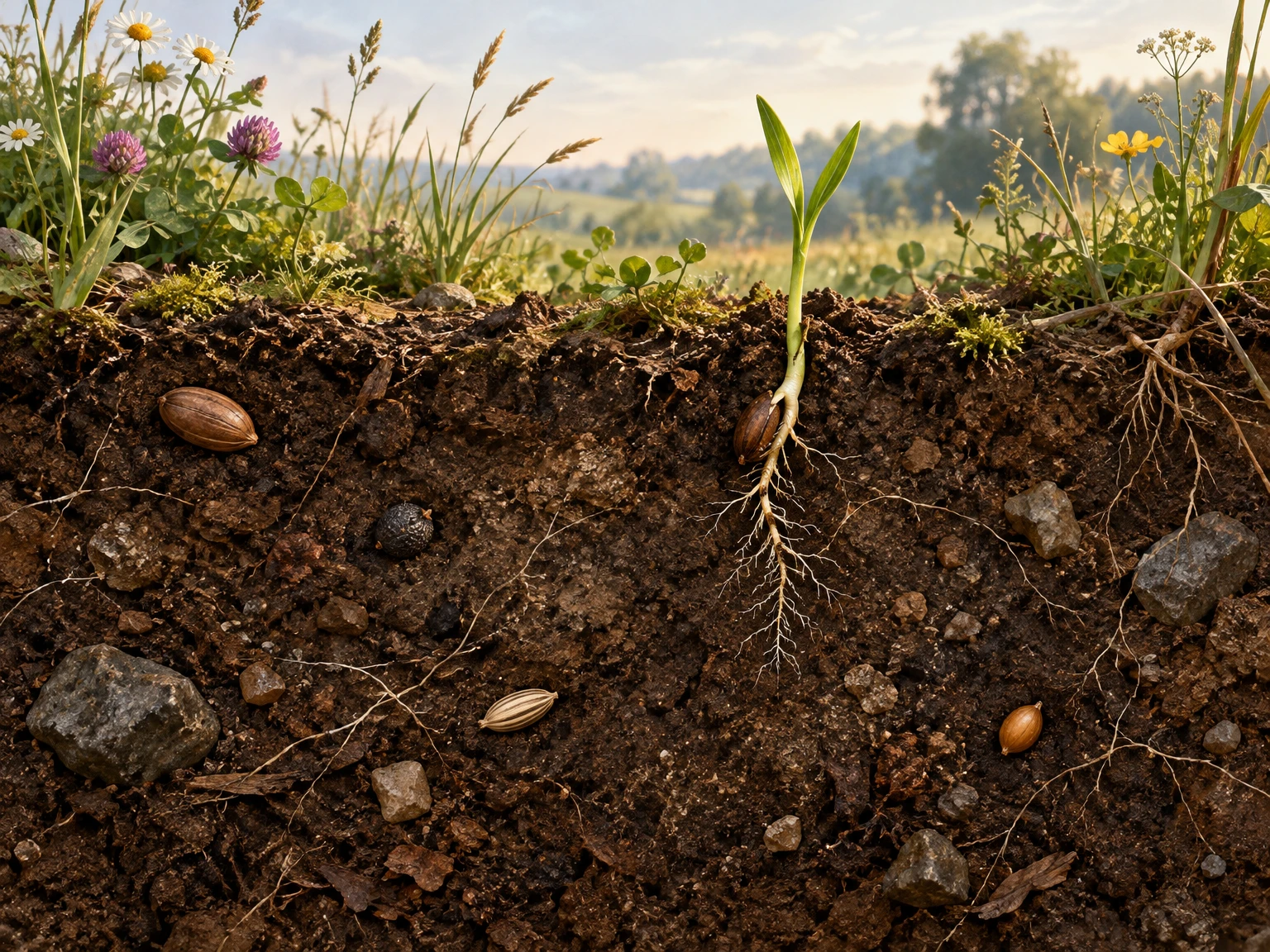
A patch of soil can look quiet while holding a history of plants that are no longer visible above ground. Seeds arrive from nearby flowers, are buried by soil movement or animals, and may wait through seasons that are unsuitable for germination. Some sprout quickly; others remain dormant, and some lose viability before the next favourable season. Together, the living seeds in soil form a soil seed bank: a shifting reserve of potential plants, not a miniature copy of the vegetation that currently grows there. Understanding that difference helps ecologists interpret recovery after disturbance, helps restoration practitioners decide what a seed-bank survey can and cannot tell them, and gives gardeners a more patient view of germination. The same word “seed bank” is also used for conservation collections that store seeds under controlled conditions. Those collections are valuable, but they are not the same thing as a natural seed bank beneath a field or forest.
What is a soil seed bank?
In ecology, a soil seed bank is the collection of viable seeds present at or within the soil at a particular place and time. “Collection” should not suggest a fixed inventory. Seeds are continually added, moved, eaten, damaged, buried, exposed and germinated. A survey therefore records a snapshot of a dynamic system. It may include seeds on the surface, in litter, or at several depths, depending on how researchers define and sample the bank. The boundary matters: if one study includes leaf litter and another does not, their totals are not directly comparable. Nor is every seed found in a soil sample alive. A seed may be empty, insect-damaged, mouldy or already dead. Viability requires a suitable test, and even a viable seed may not germinate during a short experiment if it is dormant or the test conditions are wrong.
Soil seed banks are often discussed alongside seed rain, the flow of seeds arriving from plants, and the standing vegetation, the plants visible at the time of observation. These are linked but distinct parts of a landscape. A plant community can produce abundant seeds yet leave few viable seeds in soil if seeds are short-lived, are quickly eaten, or germinate soon after falling. Conversely, the soil can retain seeds from species that are now uncommon above ground. The visible vegetation is therefore not a complete list of what might emerge, while a soil seed bank is not a guarantee that all its species will return. Each measure answers a different ecological question.
Dormancy is a timing strategy, not a defect
Germination begins a vulnerable stage of a plant’s life. Once a seed germinates, a seedling must find suitable moisture, temperature, oxygen, light and space, then survive competitors, grazing and disease. Dormancy is one way seeds avoid beginning that journey at the wrong moment. A dormant seed is alive but does not germinate even when some immediate conditions appear favourable. Dormancy can be maintained by a hard or impermeable seed coat, an immature embryo, chemical inhibitors, or internal physiological processes. Some species combine more than one mechanism. The precise mechanism and the conditions that release it vary among species, populations and seed lots; one recipe cannot be applied to all seeds.
Environmental cues can help a seed interpret the season. Temperature sequences, periods of cold or warmth, changing day length, rainfall, fire-related signals, light exposure and abrasion may each matter for particular plants. A cue does not necessarily predict the future perfectly. It is an evolved response that, on average, has helped a species place germination in a useful window. Research at Kew on UK tree seeds, for example, has examined whether changing winter conditions affect dormancy and germination responses in black alder and birches. Such findings illustrate a question to test elsewhere, not a universal rule that every tree needs a cold winter. Tropical, dryland, coastal, alpine and temperate species encounter different seasonal patterns and use different strategies.
In practical terms, a seed that fails to sprout in a few days is not automatically dead. It may need a period of after-ripening, moisture, alternating temperatures, light, darkness, scarification, smoke-related compounds or another species-specific signal. Some treatments can damage seeds if misapplied. Researchers therefore identify the species, consult reliable protocols and test small samples before treating a large collection. A germination trial should record the conditions and duration, not merely the final number of seedlings. “No germination under these conditions” is a narrower and more honest result than “the seed is non-viable.”
Persistence: transient, short-term and persistent banks
Ecologists often distinguish seeds that persist only briefly from those that survive in soil for longer periods. A transient seed bank is replenished and depleted within a relatively short time, often within a year; a persistent bank includes seeds that can remain viable across longer intervals. These are useful categories, but real persistence is a continuum, not a rigid label that can be assigned without evidence. The same species may behave differently in different climates, soils or depths. Burial can reduce exposure to light and some predators, yet deeper soil may also restrict oxygen or make it harder for a seedling to reach the surface. Moisture and temperature fluctuate at the surface, while pathogens and soil chemistry vary below it.
Longevity is not simply a property of the seed in isolation. It emerges from interactions between seed traits and the environment around each seed. A thick coat may protect some species from damage; for another it may mainly delay water uptake. Dry conditions can preserve some seeds but prevent germination; prolonged wetness may encourage germination, decay or fungal attack. Soil texture, organic matter, flooding, fire, compaction and disturbance can alter both survival and movement. The fate of a seed also depends on the organisms that encounter it. Ants and rodents may disperse, bury or consume seeds; insects may attack them; microbes can destroy them or influence germination. A seed bank is thus part of a food web and soil system, not just a storehouse.
Seed traits can shape the species composition of a bank. Plants that make many small, durable seeds may be well represented in soil even if they are not prominent in the current vegetation. Species with large, short-lived seeds may depend more on living adults, repeated dispersal or rapid establishment. This means the seed bank can favour some strategies over others. It may help explain why a disturbed site becomes dominated by a few opportunistic species rather than returning to its former community. But seed size or abundance alone cannot predict recovery. Dispersal distance, timing, soil conditions, herbivory, competition and the history of disturbance all matter.
How ecologists sample a hidden community
A soil seed-bank study begins with a question: Is the aim to estimate species richness, compare habitats, measure the effect of disturbance, or test restoration potential? The question determines where and when to sample, how many samples to take, what depth to include and which method to use. Researchers may collect small soil cores or quadrats across a site, with replicates in different microhabitats. Random or systematic sampling can help avoid choosing only the places that look interesting. The locations, dates, depth, surface litter treatment and sample dimensions should be documented so that later readers can understand what the result represents.
There are two broad approaches. In the seedling-emergence method, soil is spread in trays or pots under controlled conditions and emerging seedlings are counted and identified. This method gives direct evidence that at least some seeds germinated, but it may miss dormant seeds, species with slow or unusual germination requirements, and seedlings that die before identification. Frequent inspection, clean equipment, careful controls and a sufficiently long observation period improve interpretation. A tray that produces no seedlings cannot distinguish empty soil from a dormant or poorly tested seed bank without additional evidence.
In extraction approaches, researchers separate seeds from soil using sieving, flotation or other methods, then identify and assess them. Extraction can reveal seeds that did not germinate during an emergence trial, but tiny seeds may be lost, fragile seeds may be damaged, and visually similar seeds may be misidentified. Some protocols combine extraction with cultivation, or use additional viability tests. A review of seed-bank methods found substantial variation among studies and no single approach that is best for every question. Combining methods can broaden the evidence, but also costs time and requires transparent reporting. Method choice should follow the research question, available expertise and seed traits, rather than a belief that one technique produces a complete inventory.
Identification is a central source of uncertainty. Seedlings often look unlike mature plants, and many species are difficult to distinguish at an early stage. Researchers may grow plants until diagnostic features appear, compare seeds with reference collections, consult specialists, or use genetic methods where appropriate. Each method has limits and costs. Names should follow a stated taxonomic reference, and doubtful identifications should be retained as such rather than forced into a species label. A useful report can include confidence levels or broader taxonomic groupings for uncertain specimens. Explicit uncertainty makes later comparison more meaningful than a polished but unsupported list.
Viability: what a test does and does not show
Viability asks whether a seed is alive and capable of germination under suitable conditions. Germination is one kind of evidence, but the conditions must suit the species and the test must be long enough. Some seeds require dormancy-breaking treatment; others need light, darkness, fluctuating temperatures or a particular moisture regime. A tetrazolium test can indicate living tissue in some seeds, but it requires trained interpretation and does not itself demonstrate that a seedling will establish in the field. Cutting or X-ray inspection can reveal empty or damaged seeds, though these observations also need to be interpreted carefully. No single test answers every question about future field performance.
Seed-bank estimates should therefore distinguish seeds counted, seeds identified, seeds judged viable, seeds germinated and seedlings established. These are different denominators. If 100 seeds are recovered, a report should not imply that 100 plants will grow. Some seeds may be dead; some viable ones may remain dormant; some seedlings may fail after emergence. Conversely, an emergence trial may underestimate the number of viable seeds because its conditions were too narrow. Researchers can improve estimates with complementary tests and controls, but no finite sample completely captures every seed in a patch of land.
Sampling itself introduces error. Seeds are unevenly distributed: a patch near a parent plant can differ sharply from a patch a few metres away. The surface, litter and deeper layers may contain different communities. Small samples can miss rare species, and collecting at one time can miss seasonal input or recent germination. Replication and adequate sample sizes help describe variability, but conclusions should remain bounded by the sampled area and date. A strong study reports both its method and its limitations, including the possibility that rare or dormant species were overlooked.
From natural soil banks to conservation seed banks
A soil seed bank is a natural ecological feature. A conservation seed bank, often called a seed bank or genebank, is a managed collection in which seeds are collected, documented, dried and stored under controlled conditions. The purpose may be long-term conservation, research, restoration or safeguarding crop diversity. The two systems should not be confused: a soil bank is exposed to local ecological processes, while a conservation collection aims to slow deterioration and preserve identified samples. Conservation storage can complement habitat protection, but it cannot preserve every ecological relationship or replace the ecosystems from which seeds came.
Many seed collections focus on orthodox seeds, which tolerate drying and low-temperature storage. Kew’s Millennium Seed Bank describes a process that includes documenting collection location and habitat, identifying material with voucher specimens, cleaning and processing seeds, assessing quality, and storing suitable seeds at low moisture and around minus 20 degrees Celsius. The Food and Agriculture Organization’s practical guidance for orthodox seeds similarly emphasizes low moisture and low temperature for long-term storage, with viability monitoring over time. These are collection protocols, not instructions to place any seed packet in a household freezer. Moisture content, packaging, seed biology and temperature changes all matter.
Not all seeds tolerate these conditions. Recalcitrant seeds are sensitive to drying and often cannot be stored by standard dry, frozen methods; some seeds have other physiological or practical constraints. Many species also have complex dormancy or short storage life. Ferns reproduce by spores rather than seeds, so seed-storage approaches do not apply to them in the same way. Conservation institutions investigate alternatives such as living collections, tissue culture or cryopreservation for some difficult material. A responsible account says plainly that seed banking is powerful for suitable seeds, not a universal substitute for protecting habitats and populations.
Good conservation practice is more than putting seeds in a cold room. Collections need reliable identification, provenance and collection records, careful sampling that avoids harming wild populations, processing procedures, duplicate safety collections where feasible, and scheduled monitoring. Kew’s public description notes that seed collectors record site and habitat information and limit the proportion of ripe seeds taken from an individual plant or population. Such safeguards reduce risks of over-collection and retain information that makes a sample scientifically useful. A packet with no reliable name or origin may be much less valuable than a smaller, well-documented sample.
Monitoring matters because stored seeds age. A sample can lose viability gradually, and the rate varies by species and storage conditions. Germination tests are repeated according to a collection’s protocol; a decline may prompt regeneration or recollection, if ethically and practically possible. Regeneration is not a simple photocopy of the original collection: growing plants and collecting their seeds can change representation through unequal survival, flowering and seed production. Records should preserve the original collection identity and document later generations or interventions. Conservation is a continuing management responsibility, not a one-time act of storage.
Disturbance and recovery: potential is not a promise
Fire, flooding, cultivation, construction, grazing, invasive species and soil movement can all alter a soil seed bank. Disturbance may expose buried seeds to light, change temperature at the surface or create bare ground. It may also destroy seeds, remove soil, increase erosion or favour a few aggressive species. A disturbance that triggers germination can be beneficial for some plants and harmful for others. The outcome depends on the disturbance’s intensity, timing, recurrence, local species and follow-up conditions. A site’s response cannot be inferred solely from the general statement that “seeds are waiting in the soil.”
Restoration practitioners sometimes use soil seed-bank surveys to ask whether local native species may regenerate without reseeding. If desirable species are present and viable, protecting soil structure and allowing suitable conditions may support recovery. If the bank is dominated by weeds or lacks target species, additional steps may be needed, such as controlling invasive plants, restoring hydrology, reducing repeated disturbance, or introducing locally appropriate seed. Those choices require site-specific assessment. Soil transfer can move seeds and soil organisms but may also spread weeds, pathogens or unwanted material; it should not be treated as a casual shortcut.
A seed bank may retain a signal of earlier vegetation, but it does not necessarily preserve the exact former community. Species that depend on repeated seed rain, vegetative growth, animal dispersal or special habitat conditions may be absent from the bank. Long-lived trees, for instance, may be missing as seeds even where mature trees once stood. Conversely, species that were rare above ground may persist as seeds. The vegetation that emerges is filtered by soil, light, water, competition and herbivory. Restoration planning therefore combines seed-bank evidence with historical records, current vegetation, landscape context and realistic management capacity.
Monitoring recovery should follow several stages: seed availability, germination, seedling survival, growth to reproductive maturity and persistence of populations. A successful emergence after rain is encouraging but not a completed restoration. Researchers can establish permanent plots, photograph them from fixed points and record species cover and survival across seasons. They can compare untreated reference areas, restoration treatments and controls where appropriate. The purpose is not to promise a predetermined result; it is to learn whether actions are producing the intended ecological trajectory and to adapt if they are not.
Climate change and changing seasonal cues
Seeds use environmental cues that historically helped time germination. Climate change can alter temperatures, rainfall patterns, drought duration, flooding, fire regimes and the timing of seasons. A cue that once reliably preceded favourable conditions may become less dependable. For species whose dormancy is released by a particular sequence of temperatures or moisture, shifts can change when seeds germinate, whether they germinate at all, or how many seedlings encounter suitable conditions. These are plausible mechanisms, not a single forecast applicable to every species. Local experiments and long-term observations are needed to establish which species are changing and how.
Climate responses can also interact with other pressures. A warmer dry season may affect seeds differently in bare, shaded or organic-rich soils. Repeated fires may exhaust a seed bank that depends on adults surviving long enough to replenish it. Invasive plants can alter seed rain and competition; altered grazing can change litter and soil exposure. A study that attributes a change solely to temperature may overlook these linked factors. Researchers can test mechanisms through controlled germination experiments, field observations and comparison of seed sources, but each approach has different strengths and limitations.
Seed sourcing for restoration raises another question: should seeds come from nearby populations or from a wider range of climates? Local provenance can preserve adaptation to local conditions, but a very small or isolated source may have limited genetic diversity. Wider sourcing may increase diversity or introduce traits useful under future climate, but it can also introduce poorly adapted material or disrupt local genetic patterns. Kew’s work on native seeds and climate illustrates why these decisions need evidence for the particular species and restoration setting. Germination performance alone does not prove that a seedling will survive or that a population will be ecologically appropriate.
There is no universal distance rule that solves seed sourcing. Practitioners should consult regional guidance, conservation authorities and species-specific research, and document the source of every batch. In some projects, a carefully designed mix of local and more distant sources may be considered; in others, strict local provenance may be essential. The decision should consider ecological risk, genetic evidence, legal requirements and the purpose of the project. If evidence is weak, a small monitored trial is more responsible than treating an uncertain strategy as settled science.
Practical lessons for gardeners and field observers
For gardeners, observing germination can be a lesson in patience and variation. Seeds from different species need different conditions, and even a packet of one species can contain variation in timing. Follow reliable species-specific guidance rather than applying extreme heat, freezing or abrasive treatments based on a generic online tip. Label seed trays with species and date, keep clean tools, and note watering and temperature conditions. If no seedlings appear, review whether the seed is fresh, whether the protocol matches the species and whether the test has run long enough before deciding the seed is dead.
In natural areas, avoid digging or collecting seeds simply to satisfy curiosity. Soil disturbance can damage roots, organisms and habitat, and collection may be restricted. If a field study is planned, secure relevant permissions, minimize sample size, avoid sensitive populations and follow biosecurity guidance for cleaning equipment between sites. Researchers should also consider whether transporting soil could move invasive plants, pests or pathogens. A photograph, observation log or consultation with local botanists can often answer an initial question without removing material.
People restoring a small patch can begin by recording what is already growing, how the site is used, where water moves and what disturbance occurs. Keep dated photographs and note seasonal changes. Before sowing, identify the goal and match species to the local habitat and provenance guidance. A seed mix marketed as “native” may not be appropriate everywhere, and labels do not substitute for checking the actual species and source. Avoid assuming that a bare patch is empty; it may contain dormant seeds or underground plant parts that will respond to changed conditions.
When comparing observations across years, keep methods as consistent as possible. Sample the same depth and season, use similar plot sizes and record changes in weather or management. A simple count without methods can be difficult to interpret later. For community projects, agree on a small set of clear measures—species observed, flowering dates, seedling survival, bare ground and invasive cover—and record who collected the data and how identifications were made. Local knowledge can help explain site history, but it should be recorded alongside, not substituted for, ecological measurements.
Common misconceptions
“Every seed in soil will eventually grow” is false. Some seeds are dead, some are eaten or decay, some remain dormant for a long time, and some germinate but fail as seedlings. “A seed bank shows exactly what used to grow here” is also too strong. It can preserve traces of past vegetation, but the sample is incomplete and filtered by seed production, longevity, movement and sampling method. “No seedlings in a tray means no viable seeds” is not justified unless suitable dormancy and germination conditions have been established and tested. These distinctions are important because they affect restoration decisions and how results are communicated.
Another misconception is that a conservation seed bank can replace habitat conservation. Stored seeds may preserve genetic material and support future research or restoration, but they do not sustain pollinators, soil communities, water cycles, ecological interactions or the continuing evolution of wild populations. Collections are an insurance and research resource, not an excuse to destroy the living system. The same applies at a local scale: a soil seed bank may offer natural regeneration potential, but it cannot compensate for every lost species, altered hydrology or repeated disturbance.
Finally, there is no universal “best” germination treatment or soil-seed-bank method. Protocols should be based on the species and purpose. Published studies may differ in sample depth, timing, storage of soil, tray conditions, observation period and identification effort. A result can only be compared fairly when these details are known. When methods differ, the right conclusion may be that the studies describe different slices of a complex process, not that one team must be wrong.
A careful way to think about hidden potential
The soil seed bank is best understood as possibility shaped by history. It carries some of the effects of past seed production, burial, survival and disturbance, but it is neither a complete archive nor a guaranteed future. Dormancy lets some seeds wait for cues; persistence varies; sampling and testing reveal only part of the picture. Conservation seed banks extend the idea of safeguarding seeds through deliberate collection and controlled storage, while facing biological limits and continuing responsibilities. These ideas meet in restoration, where seed-bank evidence can help set expectations but must be combined with knowledge of living vegetation, site conditions and long-term care.
For anyone studying or managing land, the most useful question is not simply “Are there seeds here?” It is: Which species are present, how confident are we in their identification and viability, what conditions could allow them to germinate, and what would happen to the seedlings next? Asking those questions turns a hidden store into testable ecological evidence. It also encourages humility: a seed is a possibility, not a promise, and recovery depends on the relationships among species, soil, season and stewardship.
Sources and further reading
- Royal Botanic Gardens, Kew, Seed Collection: https://www.kew.org/science/collections-and-resources/collections/seed-collection
- Royal Botanic Gardens, Kew, Seed collecting at the Millennium Seed Bank: https://www.kew.org/read-and-watch/seed-collecting-msb
- Royal Botanic Gardens, Kew, Climate change and sleeping seeds: https://www.kew.org/read-and-watch/climate-change-sleeping-seeds
- Food and Agriculture Organization of the United Nations, Genebank Standards for Plant Genetic Resources for Food and Agriculture: https://www.fao.org/agriculture/crops/thematic-sitemap/theme/seeds-pgr/gbs/en/
- FAO, A guide to the seed handling and storage of orthodox seeds: https://openknowledge.fao.org/server/api/core/bitstreams/62d6d5d3-f7a3-47f3-abaf-9d2d5e230e51/content
- iForest, 2022 review of methods for sampling and assessing soil seed banks: https://iforest.sisef.org/contents/?id=ifor3850-015
- Royal Botanic Gardens, Kew, Native seeds and climate change: https://www.kew.org/read-and-watch/native-seeds-climate-change
This content is a collection of ancient history,books and various articles and collection of library and news and other post ; all details may not be the same. Readers are requested to verify the information themselves. Readers are not allowed to take any disciplinary action; content is only for educational purposes. If readers do not agree about the contents, they may send a personal comment to my personal email ID: achary.purna@gmail.com
