
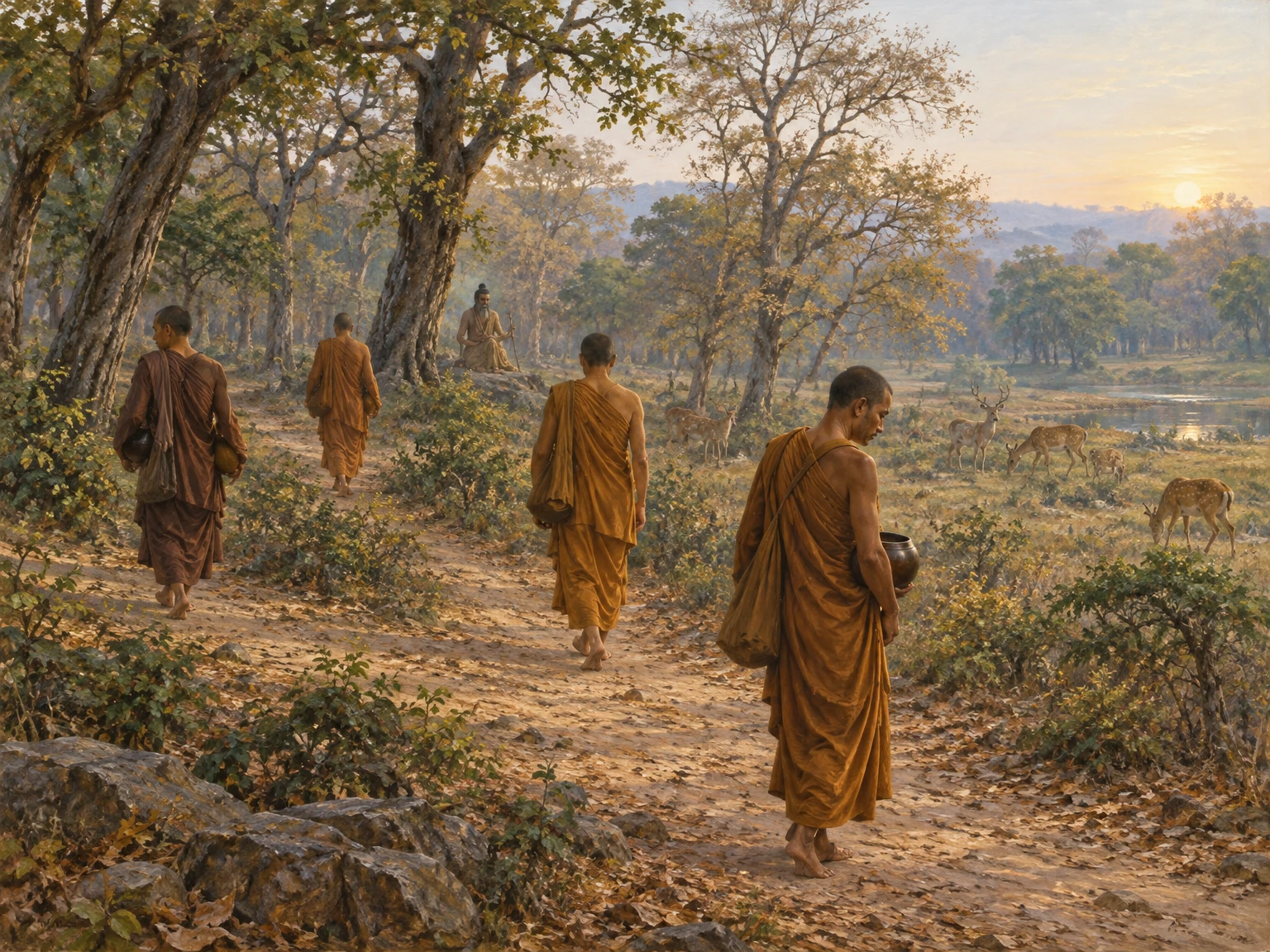
A story after the first teaching
After Siddhartha Gautama’s renunciation and awakening, Buddhist tradition remembers a small circle of disciples gathering around him. The previous episode followed the search and the turning away from extreme self-mortification; a separate account of awakening and the first teaching already tells of the five ascetics at Isipatana. This chapter moves forward from those beginnings. Its subject is Yasa, a young man from Vārāṇasī, and the widening community that the Vinaya calls the first sixty disciples sent out to teach.
The main narrative is in the Mahāvagga, the “Great Chapter” of the Pali Vinaya. The Vinaya is a collection concerned with the Buddhist monastic community and its discipline, and its opening chapters tell a life-story sequence while explaining how ordination and communal rules arose. It is a primary source for what the Theravāda Vinaya tradition preserves about the early community; it is not a contemporary diary or an independently verified census. So this account distinguishes “the Vinaya narrates” from “history can independently establish.” The distinction lets us read the story respectfully without mistaking literary and religious memory for a dated administrative record.
Isipatana and the five monks
In the Vinaya’s sequence, the Buddha has taught the five former companions at the Deer Park of Isipatana, near Vārāṇasī. The narrative describes them as having understood the teaching and entered the monastic life. It then says the Buddha remains in the area while a new encounter begins. Isipatana is also known in later Buddhist geography as Sarnath. The story places a developing community at a recognizable region, but the episode’s account of its earliest days comes through scripture, not from an inscription naming each participant.
This setting matters to the structure of the story. The first group consists of renunciants who had practiced with Siddhattha before his awakening. Yasa’s account introduces a different social setting: a young man of a prosperous household, his father, women of his family, and friends from Vārāṇasī. The Vinaya is not simply presenting a succession of private spiritual experiences. It is explaining how people entered the community, how lay supporters first appear in the story, and why a small group of monks soon becomes a travelling teaching community. These are narrative functions as well as religious themes.
Yasa hears a call to leave
The Mahāvagga describes Yasa as the son of a wealthy householder. The text gives him fine surroundings, ornaments and a comfortable life; the contrast with wandering mendicancy is part of the episode’s design. One night, while the household is asleep, he sees the people around him in disarray and feels distressed by the scene. He leaves the house and goes out into the night, repeating words of weariness and distress. The old translation renders his cry as “Alas! what distress! Alas! what danger!” That is the Vinaya’s dramatic opening, not a documented quotation from a recoverable conversation.
The story does not say that Yasa is escaping a battle, a criminal threat or a political conflict. His unease is presented as an inward response to the life around him. This is different from the earlier renunciation narrative, which follows Siddhartha’s departure, teachers and austerities. The Yasa episode gives another literary portrait of going forth: a person who has known wealth recognizes that luxury has not removed dissatisfaction. The text does not supply a modern psychological diagnosis, and it does not invite us to infer one. It tells a religious story about the limits of sensual comfort and the possibility of a different way of life.
A meeting in the night
The narrative places the Buddha near Vārāṇasī at the time Yasa wanders. Hearing him, the Buddha calls him over and offers a contrast: here, he says in the Vinaya’s familiar wording, there is no distress or danger. He invites Yasa to sit and teaches him. Yasa’s movement from the dark streets toward the Buddha is a vivid literary image, but the text’s focus is not a miraculous chase or supernatural rescue. It is a conversation in which the young man is given an account of a path he can understand and test.
The Vinaya tells the meeting as part of the Buddha’s remembered teaching activity. It does not provide a date, a transcript verified by a court recorder, or an independent witness account. We can say that the Buddhist canonical tradition associates Yasa’s going forth with this encounter at Vārāṇasī; we should not claim that every spoken sentence has been preserved word-for-word from a night in the Buddha’s lifetime. Careful attribution does not make the episode less meaningful. It tells readers what sort of evidence they are reading and keeps the boundary between an early Buddhist text and a modern historical reconstruction clear.
The gradual instruction
Before setting out the central teaching, the Vinaya says the Buddha instructed Yasa in a gradual way. It names generosity, ethical conduct, the results of good actions, the limitations of sensual pleasures and the value of renunciation. Only when the listener’s mind was considered ready, clear and receptive does the narrative say the Buddha taught the Four Noble Truths: suffering, its arising, its cessation and the path leading to cessation. This progression gives the scene a humane rhythm. The teacher does not begin with an abstract formula; he develops a conversation from familiar moral and practical concerns toward a deeper diagnosis of suffering.
The passage’s account is a valuable witness to how the Vinaya imagines teaching. It presents instruction as responsive: the listener’s readiness matters, and the teaching is organized so that one point prepares for the next. This is not a universal lesson plan that every Buddhist school has always followed in exactly the same sequence. Nor does the text provide a verbatim curriculum for every conversation. It is the narrator’s report of Yasa’s encounter. The story connects ethical generosity and restraint with liberating insight, rather than treating insight as detached from how people live.
Yasa’s understanding and the meaning of awakening
As the discourse unfolds, the Vinaya says Yasa’s mind becomes free of the “dust” of defilements and he gains the vision of Dhamma. Later in the episode, the narrative says he attains arahantship, complete liberation in the Theravāda account. These words belong to Buddhist doctrinal language. They describe a religious understanding within the text; they are not measurements available to modern archaeology or a clinical test that can be retrospectively applied to a historical person.
The story gives the moment a particular significance: awakening is not restricted to someone born into a renunciant household or already practicing with the Buddha. Yasa comes from comfort and enters the teaching through listening. Yet the text does not suggest that a single sermon automatically produces the same result for every listener. Its sequence includes preparation, attention, understanding and further practice. Readers can notice that the Vinaya frames the teaching as both compassionate and demanding: it meets the person where he is, but points beyond temporary pleasures toward a fundamental change in understanding.
The father’s search and the first lay refuge
When Yasa does not return home, his father sets out looking for him. The Vinaya uses the search to bring the household into the story. The father follows Yasa’s tracks and reaches the place where the Buddha is staying. The Buddha has Yasa seated nearby but uses a teaching power described in the narrative to keep the father from seeing him at first. He then teaches the householder, who is said to understand the Dhamma and declare refuge in the Buddha, Dhamma and Saṅgha. The Vinaya remembers him as the first male lay follower to take the three refuges.
That “first” is a claim within the narrative’s sacred chronology, not a count checked against surviving enrollment records. The scene also shows that the early community is not portrayed as a group cut off from households and lay people. Yasa’s father is not required to become a monk in order to support the teaching. In the canonical telling, he becomes a lay follower, while Yasa continues in monastic life. The relationship between household supporters and renunciants becomes one of the story’s central themes: distinct ways of living can participate in a shared religious community.
Women in the household story
The narrative does not stop with Yasa’s father. The Mahāvagga says the women of Yasa’s household, including his mother and former wife, are brought to the Buddha and hear the teaching. They too gain the vision of Dhamma and take refuge. The Vinaya presents them as the first women lay followers in this remembered sequence. Their presence is important: the episode’s account of early Buddhist support is not only about male monks and a male donor.
At the same time, this episode should not be confused with the later establishment of an order of fully ordained Buddhist nuns. It describes women becoming lay disciples; it does not record the formal founding of the Bhikkhunī Saṅgha. That separate history has its own textual narratives and questions of chronology. Keeping the categories distinct avoids turning a brief episode into a claim about institutions that it does not establish. The women are not merely a detail in Yasa’s departure story: they are represented as listeners and supporters in their own right, while the form of participation described here remains lay rather than monastic.
Friends follow Yasa
Yasa’s change of life attracts the attention of his friends. The Vinaya first names four companions—Vimala, Subāhu, Puṇṇaji and Gavampati—who come to the Buddha, listen to the teaching and enter the monastic community. The story then describes fifty more friends from prominent households who follow. In this way, the Vinaya’s total reaches fifty-four companions in addition to Yasa. The names and numbers are precise in the text, but precision in a transmitted narrative is not the same as independent verification of every individual’s existence.
The sequence also changes how the episode reads. Yasa is not portrayed as persuading his friends through a campaign or argument. They hear the teaching for themselves. The narrative emphasizes encounter and understanding rather than pressure. That detail is worth preserving: a religious community may grow through personal relationships, but the canonical story still gives each listener a moment of hearing and responding. It offers no basis for claims about forced conversion, political sponsorship or an organized recruitment drive. Those would be additions, not facts supplied by this passage.
From a circle of companions to sixty monks
By the Vinaya’s count, the five earlier monks, Yasa and his fifty-four companions make sixty disciples. The text says these disciples become arahants. The Buddha then addresses them as monks and sends them out in different directions for the welfare of many, instructing them not to travel two by two on that mission. The story thus links liberation with teaching activity: the disciples do not remain gathered only to celebrate their own attainment; they are asked to carry the Dhamma onward.
The familiar English wording “Go forth, monks, for the welfare of the many, for the happiness of the many” comes from a translation of the Mahāvagga. It should be cited as the Vinaya’s mission passage, not presented as a verbatim recording independently confirmed by another source. Within the story, the instruction is practical as well as inspirational. The community has grown enough that its members can travel separately. In the narrative’s sacred chronology, the spread of teaching begins with a small group dispersing from the region around Vārāṇasī. The passage gives no route map for each monk and does not establish that every later Buddhist mission followed this exact pattern.
What the story says about the early Saṅgha
The episode introduces several forms of participation. The Buddha teaches; monks go forth and travel; lay supporters take refuge and offer support; new listeners hear the teaching in their own settings. “Saṅgha” can refer to the community of monks in this Vinaya context, while in broader Buddhist use it can also name the community of noble disciples or the wider Buddhist community. The word’s range depends on context. In the story of the first sixty, it is safest to follow the immediate narrative rather than assume every later institutional meaning is already fully developed.
The Vinaya also presents ordination as a community practice with a history. The Buddha is shown admitting disciples through the “come, monk” formula, known in Pali as ehi bhikkhu. Later in the same opening chapters, the Vinaya explains a more general ordination procedure for candidates. These passages are not a full legal history of every monastic rule, but they show the text linking institutional forms to remembered events. The community is narrated as growing from a teacher and a few companions into an organized body whose members can receive newcomers and travel.
Textual source and historical caution
The Mahāvagga is part of the Vinaya Piṭaka, the collection that preserves rules and stories concerning monastic life in the Theravāda tradition. Its opening section, the Mahākhandhaka, places awakening, teaching, ordination and early community growth in sequence. Modern editions translate and segment the material differently. For exact passage references, this article points to the Mahāvagga’s first Khandhaka, especially the sections on Yasa and the first disciples; numbers and headings may not align perfectly across editions. This is one reason to provide both a text name and a stable source link.
A Vinaya origin story can serve several purposes at once. It remembers a sacred past, explains why a procedure exists, and offers a model for how the community understands itself. The Yasa story presents a reason for the first lay refuges, an account of early ordination, and a mission instruction. Historians can study such texts as evidence for Buddhist memory and institutional ideals, while asking separate questions about when particular passages took shape and what they can establish about the fifth century BCE. No surviving contemporary attendance sheet verifies the count of sixty, and the story’s literary setting does not by itself settle dates or exact dialogue.
A community on the road
The image of sixty monks leaving in different directions is a powerful way for the Vinaya to express a turning point. Earlier episodes concentrate on the Buddha’s own search, awakening and first teaching. Yasa’s narrative moves from one household to a wider circle and then outward across the landscape. The community is no longer only a handful of companions at one deer park. It is imagined as capable of carrying a teaching beyond its point of origin.
Still, it would be too simple to read this scene as a modern missionary organization with centrally managed districts, a membership database or a single fixed itinerary. The Vinaya supplies a religious instruction and a narrative count, not administrative details of that kind. “Do not travel two by two” belongs to the passage’s specific story and should not be generalized into a timeless rule for all Buddhist travel. The point is the text’s presentation of an expanding community and a teaching meant to be heard by many, not a reconstruction of a modern institution.
The story’s human scale
Yasa’s household gives the episode an intimate centre. The Vinaya begins with a young man unable to settle into his comfortable surroundings, then brings his father, mother, former wife and friends into the account. The story does not make family ties disappear when someone goes forth. Instead, it shows different responses: one person becomes a monk, others become lay followers, and friends join a travelling community. This mixture of separation and continued connection is one reason the episode has remained memorable in Buddhist storytelling.
We should not invent private feelings or conversations that the text does not record. The Vinaya offers a few narrative gestures—Yasa’s cry, his father’s search, the women’s hearing, friends who follow—and gives them doctrinal meaning. It does not preserve a detailed family biography, explain the former wife’s life afterward, or say what each friend thought in private. Respect for the story includes respecting those silences. A careful retelling can acknowledge the emotional stakes while resisting the temptation to supply dramatic scenes simply because they would make the story feel more complete.
Reading the first mission today
The canonical story’s image of teaching “for the welfare of many” can be read as an ethical ideal: knowledge is not kept as private prestige but offered to others. Yet the narrative does not say that every monk’s journey succeeded, or that every person who heard the teaching became a follower. It is a founding scene that describes the community’s aspiration in the language of the Vinaya. It should be understood as such, rather than used to make unsupported numerical claims about how quickly Buddhism spread through ancient India.
The account also offers a model of growth that does not depend only on royal patronage. In this episode, the new supporters are a householder and members of his family, while a group of friends joins the monastic community. Elsewhere in Buddhist literature, kings and wealthy donors become important. This one story does not establish the whole economic history of early Buddhism. It does, however, make visible the roles of householders, women listeners and wandering monks in the tradition’s own account of its beginnings.
What we can responsibly conclude
The safest conclusion is modest but meaningful. The Pali Vinaya remembers Yasa as a wealthy young man who heard the Buddha’s teaching near Vārāṇasī, went forth, and was followed by family supporters and friends. It tells of four named companions and fifty others, giving a total of sixty monk disciples alongside the Buddha. It then presents those monks as being sent out to teach. These are claims about what the Mahāvagga narrates and how the Theravāda tradition frames early community growth.
What the text does not provide is equally important: no secure calendar date for the encounter, no independent record confirming the people and numbers, no complete map of their journeys, and no proof that the episode happened in every detail exactly as written. We can study the account as a significant source for Buddhist memory, teaching ideals and the Vinaya’s explanation of early monastic life. We should not turn its sequence into a modern historical certainty. The story’s enduring force lies in its movement from personal unease to shared teaching, while the evidence remains clearly identified as a religious text’s account.
Sources
- Vinaya Piṭaka, Mahāvagga, Khandhaka 1, sections on Yasa and the first disciples, trans. I.B. Horner, SuttaCentral
- Vinaya Piṭaka, Mahāvagga, first Khandhaka, trans. T.W. Rhys Davids and Hermann Oldenberg, Sacred Books of the East 13
- Mahākhandhaka: Yasa’s Going Forth, Ancient Buddhist Texts
- The Great Chapter, Vinaya Mahākhandhaka sections 1–4, Ancient Buddhist Texts
- Buddhist Monastic Life: According to the Texts of the Theravāda Tradition, Mohan Wijayaratna, Cambridge University Press
- SuttaCentral, Introduction to Khandhakas 1–10
- The Vinaya Pitaka, Encyclopaedia Britannica
This content is a collection of ancient history,books and various articles and collection of library and news and other post ; all details may not be the same. Readers are requested to verify the information themselves. Readers are not allowed to take any disciplinary action; content is only for educational purposes. If readers do not agree about the contents, they may send a personal comment to my personal email ID: achary.purna@gmail.com
