
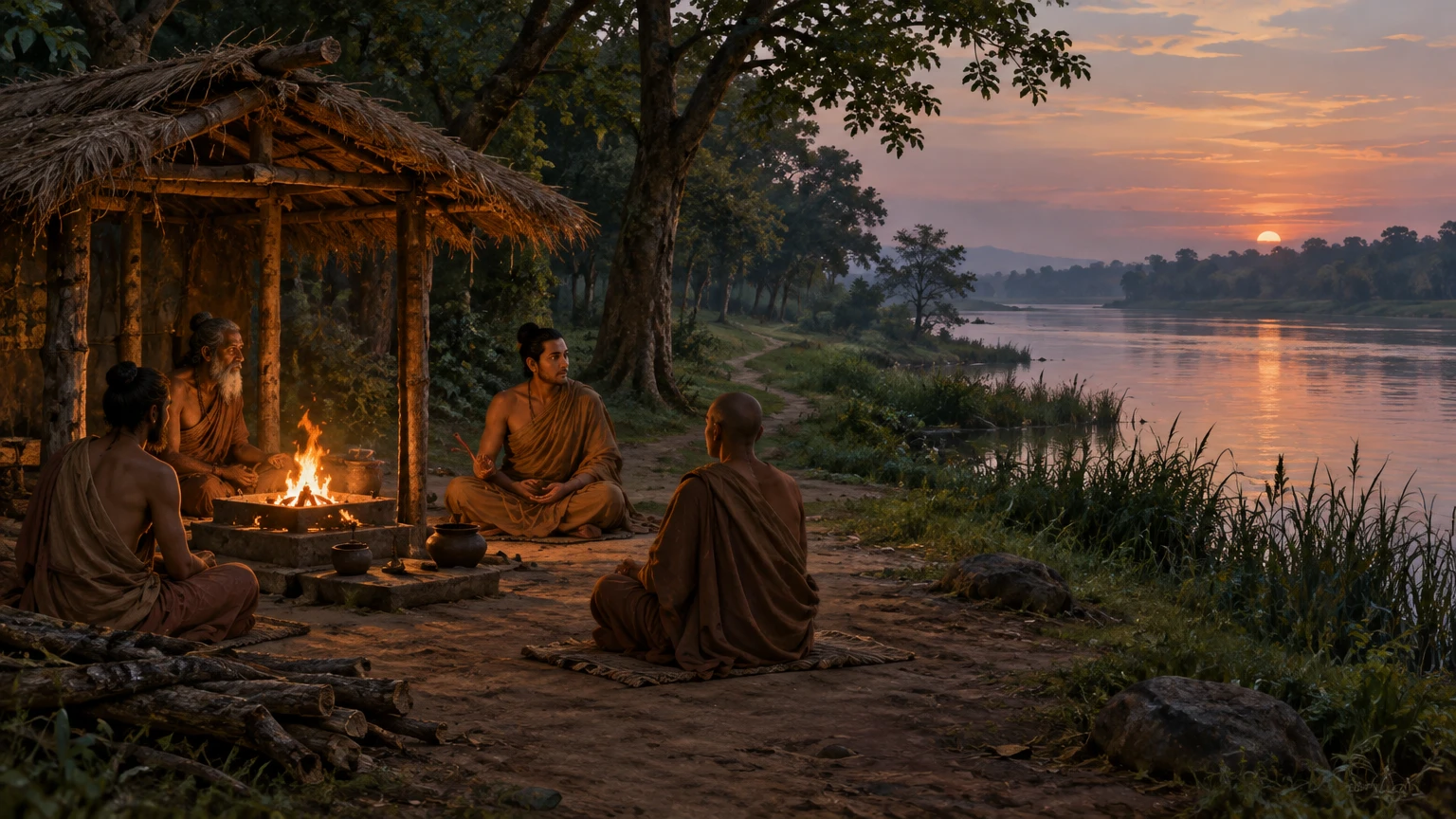
A story that moves from fire to insight
The story of the Buddha’s encounter with the Kassapa brothers begins with a striking setting: a wooded hermitage at Uruvelā, where ritual fire and ascetic discipline shaped daily life. In the Vinaya’s account, the Buddha arrives after sending his first disciples out to teach. His next major meeting is not presented simply as a debate. It is a gradual encounter between a respected religious leader, his followers, and a teacher who challenges the assumption that extraordinary powers alone amount to liberation.
The episode leads eventually to Gayā Head, where a separate discourse known as the Fire Sermon turns the image of fire inward. The Vinaya tells the conversion narrative; the Saṃyutta Nikāya preserves the sermon. These are related in the early Buddhist tradition, but they are not the same text. The narrative details below are attributed to the ancient accounts. They should be read as religious literature and remembered tradition, not as independently verified biography.
After Yasa and the first sixty
In the previous episode, the Vinaya recounts how Yasa and a growing group of disciples joined the Buddha, and how sixty arahants were sent in different directions to teach. The text then includes further rules and episodes before reaching the account of the Buddha’s visit to Uruvelā. It is therefore more accurate to say this is the next distinct story in the series than to imply that every scene follows immediately after Yasa’s departure.
The Mahāvagga places the new episode in a landscape associated with the Nerañjarā River and the villages around Uruvelā. The setting matters to the story: it is not a royal court or a public assembly, but a community organized around ascetic practice. The Buddha enters a world with its own teachers, loyalties, rituals, and understanding of spiritual achievement.
Three Kassapas and their communities
The Mahāvagga names three matted-hair ascetics: Uruvelā Kassapa, Nadī Kassapa, and Gayā Kassapa. Each is described as a leader among a group of followers. The text gives the numbers as five hundred, three hundred, and two hundred respectively, a total of one thousand. Those figures belong to the ancient narrative; they are not a census independently confirmed by other contemporary records.
Uruvelā Kassapa is the most prominent of the brothers in this episode. The account presents him as a teacher with considerable standing, not a caricature or a fool. He and his followers have a settled religious life and a recognized ritual discipline. The dramatic question is not whether their practice is sincere, but whether the signs they regard as spiritual mastery are enough to establish freedom from the deeper causes of suffering.
A night in the fire-room
The Buddha asks to spend a night in a fire-room used by the ascetics. Kassapa warns him that a powerful serpent lives there and that the place is dangerous. The Vinaya then tells of a confrontation in which the Buddha masters the serpent’s fiery power and contains it in a vessel. It is a vivid wonder story, central to the episode’s religious imagination.
A careful reading keeps two levels distinct. At the level of the text, the encounter signals the Buddha’s composure and mastery in a place where fire is the focus of ritual life. At the level of historical evidence, the supernatural details are not independently established facts. The episode can still be read for its literary purpose: Kassapa witnesses something extraordinary, yet the account says he continues to believe that he himself is the more accomplished ascetic.
Wonders—and the limits of wonder
The Vinaya continues with a sequence of miraculous events: radiant visitors, offerings, altered appearances, and the Buddha’s repeated demonstrations of power. These scenes build the story’s sense of wonder, but they also sharpen its central contrast. Kassapa is impressed; he is not yet persuaded that what he sees proves the Buddha has reached a different kind of understanding.
Again and again, the narrative describes Kassapa thinking that the Buddha is powerful, while still concluding that he is not an arahant like himself. That refrain is important. If the episode were only a contest of marvels, one display would settle the matter. Instead the text makes the gap between admiration and insight part of the teaching. A person can recognize unusual ability and still interpret it through an old measure of status.
The invitation and the thought behind it
At one point Kassapa invites the Buddha to a meal. The Buddha declines, saying that Kassapa has had a thought about the offering and that he will go himself on the following day. The account explains that Kassapa has wondered whether the Buddha’s presence will draw attention and offerings away from him. The moment brings the story from spectacle to motive.
The scene should not be turned into a general accusation against religious leaders. It is a literary encounter with one person’s private hesitation, as the Vinaya portrays it. Kassapa’s worry is humanly recognizable: the fear of losing standing or being overshadowed. The Buddha’s response in the narrative makes that unspoken motive visible, not to humiliate Kassapa, but to show that ritual achievement and public respect can coexist with attachment.
Kassapa admits what he does not know
The turning point comes when Uruvelā Kassapa acknowledges that he is not liberated in the way he had assumed. The Buddha tells him, in effect, to understand that his practice has not reached its goal. Kassapa then asks to go forth under the Buddha. The transformation is not described as an argument won in a single exchange; it is a relinquishing of the claim that visible austerity and ritual status are sufficient proof of release.
The Vinaya also portrays Kassapa as a leader responsible for many followers, so his decision has consequences beyond himself. He consults them, and the account says they choose to follow him. The text describes their matted hair and ritual belongings being set afloat in the river, where the other brothers see the signs and come to investigate. This is a memorable narrative device: change in one community becomes the signal that draws the next.
Nadī Kassapa and Gayā Kassapa follow
Nadī Kassapa and Gayā Kassapa come to learn what has happened. When they hear that their elder brother has entered the Buddha’s community, the Vinaya says that they and their own followers also join. The narrative gives the second and third groups as three hundred and two hundred people. In the story’s symbolic arithmetic, three communities associated with fire and matted-hair asceticism become one large community of mendicants.
The scene may be read as a chain of trust: the younger brothers do not encounter an unknown teacher in isolation; they investigate a change in someone whose judgment they know. The text’s account of their decision is not evidence that a thousand people can be counted historically. But its literary shape helps explain why the Kassapa conversion became a consequential episode in Buddhist memory: it depicts a shift in religious allegiance spreading through existing relationships.
Leaving the fire ritual behind
The story does not say that fire itself is evil, nor does it need to be read as a rejection of every ritual practice in every tradition. Its sharper concern is the belief that a particular rite, power, or status is by itself a guarantee of liberation. The fire-room, the ascetics’ ritual implements, and the repeated wonders create a setting in which that belief can be tested.
When the former fire worshippers leave the ritual life described in the narrative, the story shifts attention from controlling an external flame to understanding the conditions of experience. That change prepares for the Fire Sermon. The metaphor will not ask listeners to fear ordinary perception; it asks them to look closely at what happens when craving, aversion, and confusion shape what they see, hear, feel, and think.
From Uruvelā to Gayā Head
After the conversion, the Mahāvagga says the Buddha goes to Gayā Head with a thousand monks. The place is also known in Pali as Gayāsīsa. The Vinaya’s narrative frames the movement as a teaching journey after the Kassapa episode. The next passage is associated with a discourse also preserved separately in the Saṃyutta Nikāya as SN 35.28, the Ādittasutta, often translated as “The Fire Sermon” or “Burning.”
The two accounts should be compared without flattening their differences. The Vinaya provides the larger story of the brothers and their followers; SN 35.28 is a compact teaching discourse. The shared setting and the large community connect them in Buddhist tradition, but the sermon itself does not retell every wonder or describe each Kassapa’s conversion. Keeping those boundaries clear makes the sources more useful, not less meaningful.
“All is burning”
In the Fire Sermon, the Buddha addresses the monks with the image that all is burning. The discourse names the eye and forms, the ear and sounds, the nose and scents, the tongue and tastes, the body and touch, and the mind and mental objects. It also includes consciousness, contact, and the feelings that arise in dependence on contact. This is not a claim that the world is literally on fire; fire is the sermon’s image for experience bound up with greed, hatred, and delusion.
The teaching matters because it directs attention toward the whole process of experience. Seeing is not merely a picture arriving from outside; it is an encounter that can be shaped by attraction, resistance, and misunderstanding. Hearing, remembering, and imagining can be caught in the same pattern. The discourse invites the listener to examine these processes rather than treat them as a permanent self or as a reliable source of lasting satisfaction.
The fire of greed, hatred, and delusion
The sermon identifies what burns: greed, hatred, and delusion, along with the distress and suffering associated with birth, aging, death, sorrow, lamentation, pain, grief, and despair. In the Pali tradition these are the three unwholesome roots, forces that color perception and action. The fire image is therefore ethical as well as psychological. It points to how grasping and hostility can consume attention and shape the consequences of what people do.
This is not an invitation to condemn oneself for every desire or feeling. The discourse is a teaching about seeing causes and effects. A pleasant experience can become a source of clinging; an unpleasant one can feed resistance; a confusing one can lead to careless assumptions. The sermon’s force lies in noticing those tendencies while they are happening, not in pretending that a person can simply switch off perception or emotion by command.
Disenchantment as clear seeing
The discourse then describes a movement from seeing things as they are toward disenchantment, the fading of passion, and liberation. “Disenchantment” here need not mean cynicism or contempt for life. It is closer to a cooling of fascination with experiences that cannot provide permanent security. When a person sees the costs of clinging clearly, the grip of desire may loosen.
The sequence matters: the sermon does not recommend hatred of the senses. It describes a transformation in understanding. A listener recognizes that sights, sounds, thoughts, and feelings arise under conditions and pass away. From that recognition, the mind’s compulsion to own every experience can lessen. The discourse presents this as a path of release, not as a command to withdraw from ordinary compassion or responsibility.
A thousand listeners in the tradition
The Saṃyutta Nikāya’s version opens with the Buddha staying near Gayā, on Gayā Head, with a thousand mendicants. It concludes by saying that their minds were freed through not clinging. The number and setting are features of the text’s account; the discourse does not offer an independent attendance register. The narrative nevertheless imagines a large audience receiving a teaching that links sensory experience with the possibility of release.
That ending gives the story its human scale. The lesson is not restricted to the former fire ascetics or to a single famous teacher. It is presented to a community. Within the text, the listeners’ liberation is the result. For readers today, the account remains an invitation to examine how desire, irritation, and confusion affect experience, while recognizing that the source describes an idealized religious event rather than a modern historical report.
How to read this episode responsibly
The Kassapa story belongs to the Vinaya’s account of the early community, a text with religious, disciplinary, and narrative purposes. Ancient Buddhist biographies often preserve layers of memory and teaching, and scholars caution that narrative details cannot all be dated or independently checked. The exact wonders, dialogue, follower counts, and chronology should therefore be presented as what the tradition tells, not as facts verified by contemporary records.
The Fire Sermon is a separate early Buddhist discourse preserved in the Saṃyutta Nikāya. Its central image can be studied on its own even if a reader is uncertain about the surrounding biographical narrative. Reading both sources with care allows two things at once: respect for the tradition that preserved the episode, and honesty about what historical methods can and cannot establish.
The teaching’s enduring question
The episode begins with a fire-room that appears to test spiritual power. It ends, in the related sermon, with a different question: what is burning in the way we experience the world? The story’s movement from ritual flame to the fires of greed, hatred, and delusion makes the encounter memorable. Its teaching is not that every outward practice is worthless, but that no badge, performance, or extraordinary display can substitute for understanding.
In the Vinaya’s telling, Kassapa’s decisive step is admitting the limit of his certainty and being willing to learn. In the sermon, release begins with seeing the conditions of experience clearly. Together they offer a story about intellectual humility and a practical teaching about attention. The historical details remain bounded by the sources; the invitation to reflect belongs to the texts themselves.
Sources
- I.B. Horner, trans., Mahāvagga (Book of the Discipline), Khandhaka 1, especially 1.15–21 (SuttaCentral)
- SN 35.28 Ādittasutta, trans. Bhikkhu Sujato (SuttaCentral)
- “Buddhist Literature and the Historical Context,” The Oxford Handbook of Buddhist Practice and Philosophy
- The Great Chapter (Mahāvagga), English translation and sections (Ancient Buddhist Texts)
This content is a collection of ancient history,books and various articles and collection of library and news and other post ; all details may not be the same. Readers are requested to verify the information themselves. Readers are not allowed to take any disciplinary action; content is only for educational purposes. If readers do not agree about the contents, they may send a personal comment to my personal email ID: achary.purna@gmail.com
