
From Gayā Head to the roads of Magadha
The previous episode ended at Gayāsīsa, or Gayā Head, with the teaching known as the Fire Sermon. In the Pali Vinaya’s Mahāvagga, the Buddha then travels toward Rājagaha, accompanied by the former matted-hair ascetics who have entered the community. This is the narrative’s next turn: from a teaching delivered to a newly converted group to an encounter with the ruler and residents of a major city.
The story belongs to Buddhist textual tradition. It is not a contemporary travel diary, and the Mahāvagga’s account does not give a securely datable calendar year for the journey. We can follow what the text says, compare its sequence with other early discourses, and ask what its remembered places suggest. Those are related but different questions; none licenses presenting every scene or number as an independently verified historical event.
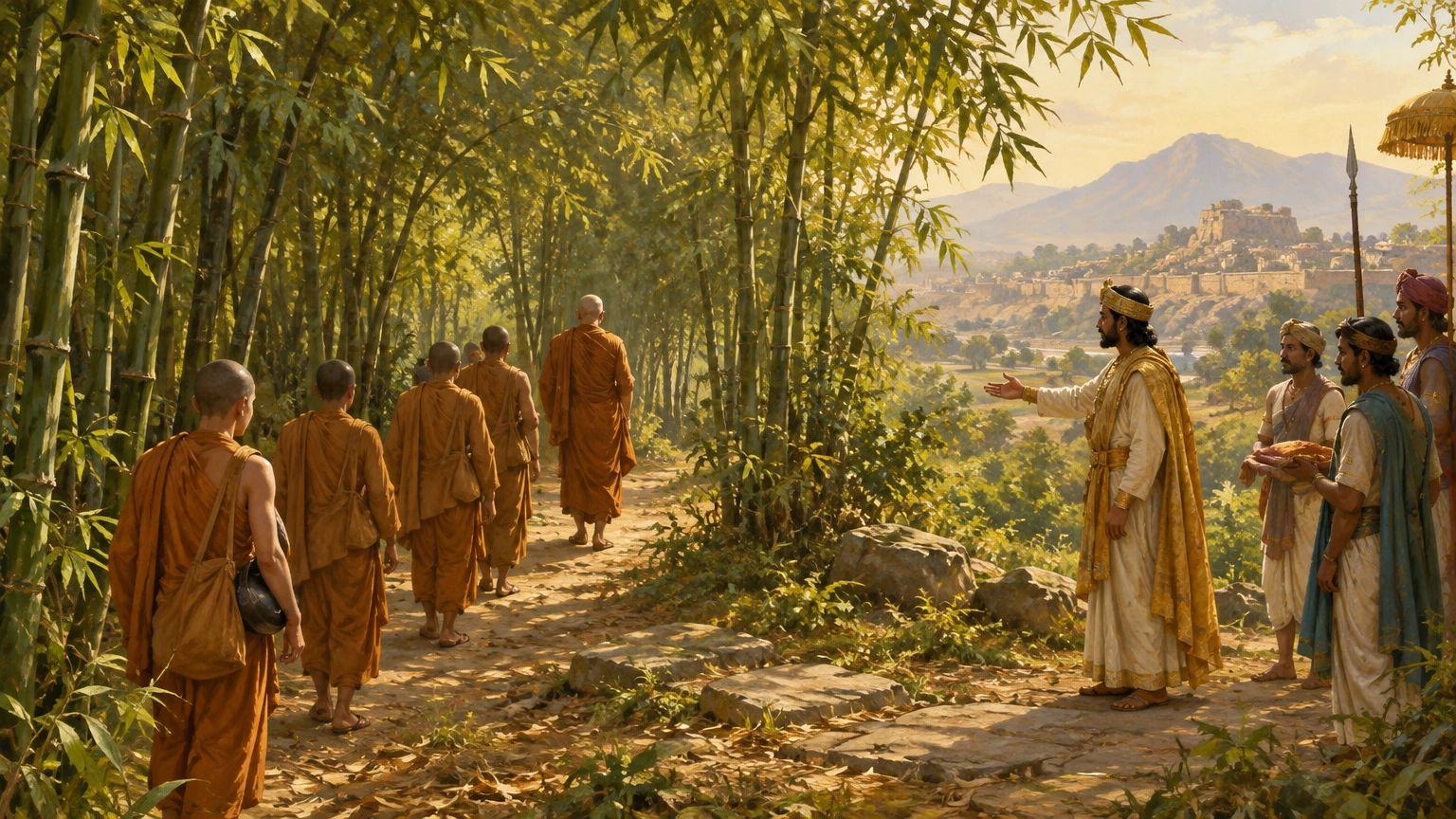
The account’s central movement is clear even where its details call for care. The Buddha and the Kassapa brothers arrive near Rājagaha; the public sees a leading ascetic among the followers; King Bimbisāra comes to meet the teacher; and the narrative ends with the donation of Veḷuvana, the Bamboo Grove. The episode links a growing monastic community with a place to stay and with a ruler who becomes a supporter.
What the Mahāvagga says about the journey
The Mahāvagga is part of the Pali Vinaya, the collection concerned with monastic discipline and community life. Its first chapter, the Mahākhandhaka, tells a sequence of episodes around the Buddha’s early community. The Rājagaha visit follows the Kassapa brothers’ conversion and the Fire Sermon. In the traditional telling, a large group of former ascetics accompanies the Buddha from Gayā toward the Magadhan capital.
The text describes the destination as Rājagaha, the city later commonly called Rājgir. It places the party first in Laṭṭhivana, rendered in English translations as a cane or palm grove, near a shrine. The story then brings the king and his people to the Buddha. This first stopping place is important: it should not be confused with Veḷuvana, which the narrative introduces later as a donated grove.
The Mahāvagga is a religious and institutional narrative, not a modern biography written from independent witnesses. It is valuable evidence for how a Buddhist community preserved and organized an account of its beginnings. Its details need to be read with that purpose in view. A careful retelling can report the traditional sequence while making clear that textual presence alone does not settle the historical accuracy of every detail.
The Kassapas and a moment of public confusion
The story’s dramatic hinge is not a battle or a royal contest. It is a question the assembled crowd is said to have asked: who is the teacher, the Buddha or the renowned ascetic Kassapa? The Mahāvagga presents Kassapa of Uruvelā as an established religious figure whose presence mattered to people in the region. The crowd could recognize him and wonder why he was now with the Buddha.
In the narrative, Kassapa makes his changed allegiance clear before the assembly. The text portrays him as acknowledging the Buddha as his teacher. That public act serves a purpose in the story: it explains the relationship between two figures whom the crowd might otherwise mistake for equals or think of in the opposite order. The former leader’s recognition makes the new teaching’s appeal visible to the listeners.
The scene should not be embellished into a verifiable transcript of what anyone said. The surviving text gives a shaped account, preserved through a tradition, not stenographic notes. It is reasonable to say that the Mahāvagga uses Kassapa’s conversion to establish the Buddha’s standing before a public audience. It is not reasonable to claim we can independently confirm the exact words, the crowd’s thoughts, or the full scene’s precise historical form.
Bimbisāra in the story—and in another remembered meeting
King Bimbisāra is the ruler associated with Magadha in this episode. The Mahāvagga depicts him approaching the Buddha with a large following. His appearance connects the new monastic community to political authority, but the story does not turn the Buddha into a king or military commander. The encounter is presented as one of teaching, respect and support.
There is another important Bimbisāra episode in the Sutta Nipāta’s Pabbajjā Sutta. It describes the king meeting Siddhattha while he is still a renunciant, before awakening, and offering him a position in the kingdom. That is a distinct encounter in a different textual setting. It should not be merged with the later Mahāvagga story of the Buddha’s visit to Rājagaha and the gift of Veḷuvana.
Keeping the two episodes separate prevents a common chronological confusion. The earlier Pabbajjā account presents a wandering seeker and a king’s proposal; the Mahāvagga’s post-awakening sequence presents the Buddha, the newly converted Kassapas and a community taking shape. Both belong to Buddhist literary memory. Their narrative order can be described, while exact dates and the historical circumstances behind each scene remain uncertain.
A teaching for a gathered city
The Mahāvagga describes Bimbisāra arriving at Laṭṭhivana with a large assembly. In the text, the Buddha gives a graduated teaching, beginning with themes that prepare listeners for deeper instruction. The episode’s order matters: the story places the teaching after Kassapa’s public recognition and before the meal and donation. It presents a ruler and ordinary householders as listeners rather than making the community’s growth depend only on ascetics.
The account assigns very large totals to those said to gain insight or take refuge. Such figures should be reported, if at all, as the text’s own numbers, not as a count independently established by inscription or archaeology. Large round totals are common features of religious narratives that convey scale and significance. They may tell us how the tradition wished to portray the gathering, but they are not a census that can be checked against surviving records.
The scene also broadens the story’s social frame. The Buddha’s teaching is depicted as reaching beyond the circle of former ascetics to people connected with the city and its ruler. That theme is central to the tradition’s account of Buddhism’s early expansion. The numbers and setting remain literary evidence; the broader image of teaching offered to laypeople is part of the historical memory the texts preserve.
A meal, then the offer of a grove
After the teaching, the Mahāvagga recounts Bimbisāra inviting the Buddha and the monastic group for a meal. The story then turns from hospitality to a more durable form of support. The king offers Veḷuvana, the Bamboo Grove, to the Buddha and the community. In the text, this gift gives the monks a place to gather and stay rather than relying only on temporary visits or improvised shelter.
The sequence is often summarized as the Buddha receiving the first monastery. That shorthand captures Veḷuvana’s significance in Buddhist tradition, but it should be qualified: the Mahāvagga tells of a royal donation of a grove for the community, not a modern deed, architectural plan or survey identifying every boundary. The narrative does not establish that the grove was immediately a built monastery in the later institutional sense.
The gift’s place in the story is nonetheless striking. A grove is a natural landscape, not a palace or fortress. The donation links the community’s mobility with a stable place for residence, teaching and collective life. In later Buddhist memory, Veḷuvana becomes one of the best-known settings associated with the Buddha. The tradition emphasizes generosity and access to a shared refuge, while the exact historical details remain beyond what this story alone can prove.
Why the grove matters to the early Saṅgha
The Pali word saṅgha can refer to a community, and in this context the story concerns the community of monks. A place such as Veḷuvana matters because an itinerant group needs somewhere to assemble, receive visitors and maintain its life together. A donated grove could serve as a setting for residence and teaching without implying that the early community already possessed the elaborate buildings of later monasteries.
The Mahāvagga’s narrative gives an institutional meaning to the gift. It places a ruler’s support within the account of the Saṅgha’s formation and portrays generosity as a way of sustaining renunciants. The story is therefore about more than a location on a map. It is also about how Buddhist tradition imagined the relationship between householders, rulers and a community that owned little and depended on offerings.
That relationship should not be made into a claim about every ruler or every Buddhist community. Nor does the story prove that Bimbisāra’s gift was the first donation of its kind in all history. It records a celebrated beginning in one textual tradition. Its continued prominence shows how later communities remembered patronage as part of the conditions that allowed teaching and monastic life to endure.
Laṭṭhivana and Veḷuvana are not the same place in the episode
Two groves appear in the story, and keeping them distinct is essential. Laṭṭhivana is where the Mahāvagga places the initial meeting and teaching outside Rājagaha. Veḷuvana is the grove offered afterward. Translations render the names differently, and English versions may use “cane grove,” “palm grove” or similar wording for Laṭṭhivana, while Veḷuvana is commonly translated “Bamboo Grove.”
The distinction helps preserve the narrative’s geography without pretending that ancient place-names map neatly onto modern visitor sites. The text gives its own sequence and names; later traditions and local identifications have their own histories. A contemporary grove or archaeological attraction may be associated with Veḷuvana, but that association should not be treated as proof that every detail of the ancient donation can be located there with certainty.
Rājagaha itself was a significant ancient city in Magadha, in the region of present-day Bihar. Archaeological and textual work has helped scholars study the city’s long history and its changing settlement landscape. That broader context can make the narrative intelligible. It does not independently verify that the Buddha stood at a specific present-day marker when Bimbisāra made the offering.
A brief source-critical pause
The Mahāvagga tells this episode as a connected narrative: the Kassapas’ conversion, the journey to Rājagaha, Bimbisāra’s visit, a teaching, a meal and the offer of Veḷuvana. Readers can follow that account as Buddhist tradition while recognizing that the text’s literary sequence is not the same thing as an independently dated chronicle. The Pali Vinaya was transmitted and organized by a community with religious and institutional concerns.
Some details carry a clearly religious or exemplary character: extraordinary numbers, idealized public recognition, and the spiritual results attributed to listeners. These details can illuminate what the tradition valued. They cannot be treated as modern empirical measurements. Even where a scene is plausible, plausibility is not proof that it occurred exactly as narrated.
This careful distinction is not a dismissal of the story. It helps us understand what kind of evidence it is. Texts can preserve memory, shape communal identity and communicate ideals. Archaeology can reveal settlement, material culture and patterns of religious patronage, but it does not ordinarily identify a specific spoken exchange. Each kind of evidence contributes something different, and the limits matter as much as the findings.
What can be said about the history
The Mahāvagga places the Buddha and his followers in the Rājagaha region and associates Bimbisāra and Veḷuvana with the early Buddhist community. That association became durable in Buddhist literary and pilgrimage traditions. It is historically useful evidence for the significance of the place and the way the community remembered patronage, even when it cannot independently authenticate every episode.
Modern scholarship has long debated the dates of the Buddha’s life and the formation of early Buddhist texts. The sources do not supply a calendar date for this meeting that can be confidently converted into a year in BCE. This article therefore uses the relative sequence preserved in the tradition—after the Fire Sermon and the Kassapa conversion—rather than inventing a specific date for the Rājagaha visit.
The same caution applies to exact geography. The ancient city and the tradition’s named groves are meaningful, but modern identifications are not all equally secure. Archaeological findings around Rājgir can illuminate the city’s history and religious landscape; they do not prove that a modernly marked plot is precisely the donated grove of the narrative. The responsible conclusion is neither certainty nor silence: the tradition is specific, and its historical limits should be stated plainly.
Bimbisāra as patron, not a proof of royal power over the teaching
In the story, Bimbisāra’s role is that of host and supporter. He comes to hear the Buddha, provides a meal and offers a grove. The episode does not portray the Buddha as seeking to take the throne, govern Magadha or command an army. The distinction matters because later popular accounts sometimes turn the Buddha’s royal connections into claims about battles or rulership for which this episode offers no evidence.
A ruler’s generosity can be significant without making the religious teacher a political subordinate. The Mahāvagga frames the gift as an act of support for the community, while the teaching itself is presented as the Buddha’s. The king’s presence signals that the movement is visible beyond the forest ascetics and has entered a relationship with urban society.
We should also avoid treating the text’s Bimbisāra as a complete biography of a historical monarch. The episode tells us how Buddhist tradition remembers him in relation to the Buddha. It does not supply a comprehensive political history of Magadha or verify every detail of the king’s reign. Such distinctions make the account more useful, not less: they let the story retain its meaning without giving it claims it cannot bear.
A narrative about belonging and refuge
The Veḷuvana episode closes a chain of transitions. A group once described as independent ascetics joins the Buddha’s community. A powerful public figure acknowledges the teacher. Townspeople hear the teaching. A meal becomes an act of welcome, and a grove becomes a place offered for shared use. The text gives a human and institutional shape to the expansion of the early Saṅgha.
There is an ethical dimension in the way the story is remembered. The grove is not described as a private royal possession kept for display; it is offered as support for a community of renunciants. Generosity, hospitality and the sharing of space become part of the story’s picture of religious life. These are themes the tradition invites readers to notice, even while the specific historical scene remains a textual account.
That invitation can be approached without flattening belief and history into a single category. A Buddhist reader may receive Veḷuvana as a sacred memory; a historian may ask how the text developed and what other evidence can establish; a visitor may encounter a modern site associated with the tradition. These perspectives can coexist as long as we are clear about what each one can and cannot demonstrate.
Reading the episode today
When retelling the story, it is tempting to fill gaps with imagined dialogue, precise dates or cinematic detail. This article avoids doing so. The Mahāvagga gives a sequence, names people and places, and attributes results to the teaching. Where the source does not establish a modernly verifiable detail, the article leaves it open rather than polishing uncertainty into fact.
The text’s grand totals and religious elements belong to the traditional narrative. They can be discussed as part of the source, not repeated as measurements that archaeology has confirmed. The distinction also applies to the identity of the groves: the names have a place in the story, while exact contemporary boundaries and archaeological identification require separate evidence.
A source-aware retelling can still be vivid. The scene has a public gathering, an honored ascetic stepping into a new role, a ruler listening, and a landscape being offered to a community. Those are the story’s meaningful elements. Careful language makes them accessible without pretending that a modern writer witnessed the event or can settle every historical question.
The next step in the chronological story
The earlier chapter of this series followed the mission of Yasa and the first sixty; the last one recounted the Kassapa brothers and the Fire Sermon. This episode continues that textual sequence with the arrival at Rājagaha and the donation remembered as Veḷuvana. It keeps the earlier pre-awakening meeting with Bimbisāra separate from this post-awakening account.
The story’s lasting significance lies in how it joins teaching and community. The Buddha is shown not only speaking to individuals but travelling with a growing group; Bimbisāra’s meal and gift place material hospitality beside spiritual instruction. In Buddhist memory, a grove becomes a durable symbol of refuge and support for the Saṅgha.
We can read the episode with respect and with historical care at the same time. Its place in the Mahāvagga is clear; its exact date, every number and each scene’s independent historicity are not. That distinction leaves the narrative intact while making the evidence more honest. It is a fitting next chapter: from a fire-side teaching to a community finding a home among the bamboo.
Sources
- Vinaya Piṭaka, Mahāvagga I.22 — Bimbisāra and the donation of Veḷuvana, Bhikkhu Brahmali translation
- Vinaya Texts, Mahāvagga I.22, Rhys Davids and Oldenberg translation
- Sutta Nipāta 3.1, Pabbajjā Sutta — the distinct pre-awakening meeting with Bimbisāra
- Internet Encyclopedia of Philosophy — The Buddha: dates and historical evidence
- Archaeology International — archaeological context of ancient Rajgir
This content is a collection of ancient history,books and various articles and collection of library and news and other post ; all details may not be the same. Readers are requested to verify the information themselves. Readers are not allowed to take any disciplinary action; content is only for educational purposes. If readers do not agree about the contents, they may send a personal comment to my personal email ID: achary.purna@gmail.com
