
District Overview & Geography
Raghurajpur is a small craft village in Puri district, Odisha, but its importance is larger than its size. Odisha Tourism describes it as India’s first heritage crafts village, known especially for Pattachitra painting and a cluster of related arts. The village lies near the Bhargavi River, around fourteen kilometres from Puri according to the state tourism description. That distance makes it possible to visit as a short cultural excursion from Puri, yet the best way to understand the place is not to treat it as a quick photo stop. The craft is not merely an attraction displayed for visitors: homes, workshops, inherited skills and local cultural practice form the setting in which the work is made. A visit is therefore most rewarding when it leaves time for looking, listening and asking before buying.
Raghurajpur’s landscape is part of its identity. The Puri district’s official tourism page situates the village near the southern bank of the Bhargavi, a riverine setting within the wider coastal region. The place is close enough to the pilgrimage and seaside centre of Puri to fit naturally into a larger itinerary, but it offers a different rhythm. Instead of a monumental temple complex or a ticketed museum, a visitor encounters village lanes, houses and small working spaces where different crafts may be practiced. The built environment does not need to be mistaken for a preserved stage set: it is a living settlement, and residents’ privacy and working routines matter. Keeping the visit calm, walking rather than rushing, and asking before photographing a person or workshop help preserve the distinction between a community and a display.
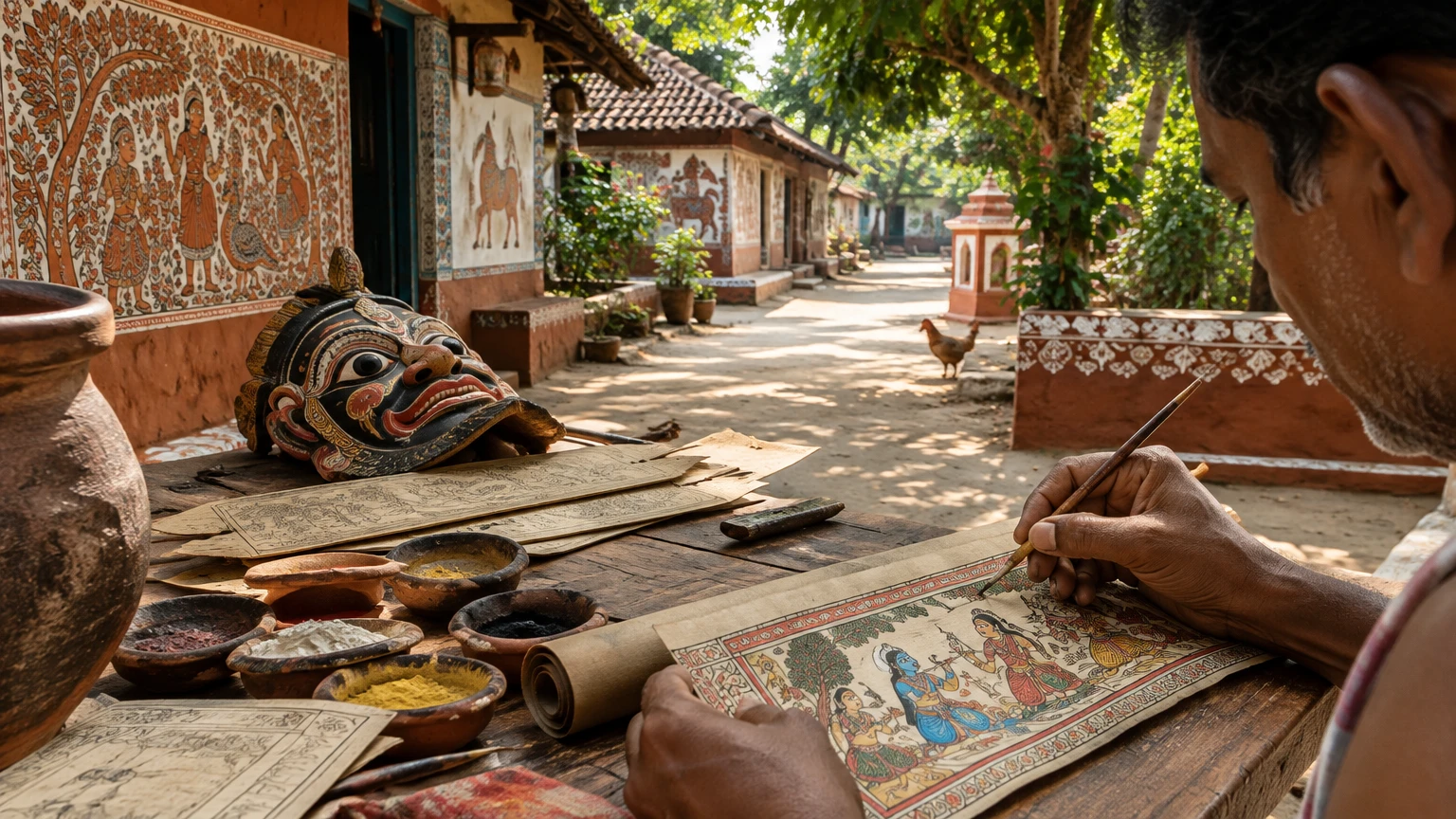
The official pages name several forms of work associated with the village: cloth-based Pattachitra, palm-leaf engraving, stone carving, papier-mâché, wooden toys and masks, and other small crafts. These are not interchangeable decorations. Each material asks for a different pace, set of tools and kind of design. A painted cloth may be planned with borders and dense narrative detail; an incised palm leaf depends on fine line work; a carved object is shaped through removal of material; a papier-mâché form is built up in layers. Not every household practices every craft, and an official destination page is not an inventory of who is working on a given day. The visitor should therefore approach variety as an invitation to discover what is actually being made, not as a guarantee that every art form will be on view.
Raghurajpur is also closely associated with Odissi and Gotipua performance traditions. Odisha Tourism identifies the village with the births of Odissi gurus Kelucharan Mohapatra and Maguni Charan Das, and its destination information notes occasional performances. This association is culturally significant, but it does not mean there is a performance on demand whenever a visitor arrives. Performance depends on people, schedules and local arrangements; a traveller should check with a reliable local or official source rather than assume that a show is available. The same care applies to claims about demonstrations in workshops. A craftsperson may be working, resting, receiving an order or attending to family matters. The village’s cultural value lies in living practice, not in a visitor’s entitlement to have every practice staged at a convenient time.
The scale of the village encourages close attention. In a large museum, an object may be separated from the maker by glass, a label and a gallery wall. In Raghurajpur, the relationship between material, skill and place can be more immediate, but it also requires respectful boundaries. A visitor might notice how a picture’s border frames a scene, how a palm-leaf panel organizes a story, or how a sculptural surface changes under daylight. These observations are more useful than trying to count how many shops were visited. If a workshop welcomes questions, ask what the object is made from, how long it takes, and what part of the process is most difficult. If the maker is busy or declines, accept that answer. The result is a more accurate encounter and a more humane form of cultural tourism.
Mythological & Historical Significance
Pattachitra is often discussed alongside the devotional culture of Odisha, especially the visual traditions associated with Jagannath. The word is commonly explained through pata, a prepared cloth surface, and chitra, an image or painting. Odisha’s official description explains a carefully prepared ground made from cloth treated with a mixture involving chalk and tamarind-seed gum, followed by drawing and the application of colour. This material process is important because it shows that a Pattachitra is not simply a modern illustration painted on any convenient fabric. Its appearance emerges from a sequence of preparation, design and finishing. The official material also describes religious and folk themes, including stories from epics and devotional subjects. A particular painting’s meaning, however, should be learned from its maker or a reliable description; a viewer should not assume that every figure or motif has only one interpretation.
Raghurajpur’s craft history is best understood as a network of practices connected to regional religious, artistic and household life, rather than as a single founding moment. State tourism calls it a heritage crafts village and highlights the number and variety of traditional arts. Such official labels indicate recognition and promotion, but they do not by themselves settle the exact age of every practice or the origin of every family workshop. A careful account distinguishes documented information from inherited narratives and contemporary interpretation. Craft knowledge is commonly transmitted through observation, practice and correction within families and communities; the public sources establish the village’s importance as a craft centre, while an individual artisan can explain their own lineage and training. Those are different kinds of evidence, and both are valuable when presented honestly.
Visual storytelling connects the craft to a broader world of performance and devotion. Pattachitra compositions may depict deities, episodes from epic narratives, ritual themes and folk subjects. Their strongly defined outlines, patterned borders and compact scenes make them legible as images even when the narrative is complex. The viewer can study how the border separates the story from the surrounding surface, how repeated forms help guide the eye, and how colour groups emphasize a figure or action. But there is no need to pretend to decode every symbol independently. Traditions vary, artists make choices, and a contemporary work may respond to the maker’s own aesthetic and customer. Asking the artist about a scene is more accurate than presenting a guess as fact, particularly where religious names, ritual associations or regional stories are involved.
Palm-leaf engraving offers a different visual language for narrative. Odisha’s official craft sources describe engraving and illustrated writing on palm leaves as part of the state’s arts-and-crafts heritage. Rather than building a painted surface with broad areas of colour, the maker works through fine incised lines and their contrast with the leaf. A sequence of panels can carry a story in a narrow format, and the support itself is part of the meaning: it belongs to a long manuscript culture in which text and image could share a surface. Visitors should avoid treating palm-leaf objects as curiosities without asking how they were made or whether the offered item is a traditional form, a contemporary adaptation, or a decorative reproduction. Clear answers help buyers understand what they are taking home.
Raghurajpur’s performance history is another strand of its cultural significance. Odisha Tourism links the village to the birthplaces of Kelucharan Mohapatra and Maguni Charan Das, important names in Odissi and Gotipua, respectively. That connection does not make dance a simple footnote to painting: movement, music, costume and storytelling are distinct arts, even when they share cultural and devotional worlds. Gotipua is especially known as a performance tradition involving boys, music and expressive movement, while Odissi is a classical dance form with its own history and vocabulary. A visitor can appreciate that the village’s legacy crosses media without collapsing them into one generic category called “folk culture.” If a performance is advertised, check its date, organizer and terms locally; do not infer a current event from a heritage association alone.
History is not frozen at the moment a craft became famous. Artists today may keep traditional subjects and techniques while adjusting scale, format, materials or themes for contemporary homes and collections. A smaller painting or a new subject does not automatically make a work inauthentic; nor does the word “traditional” guarantee that a piece follows one unchanging rule. The most thoughtful account recognizes continuity and change together. It also avoids romantic claims that every artisan works exactly as an ancestor did, or that tourism alone sustains a practice. Those claims require evidence beyond a destination listing. The more grounded conclusion is that Raghurajpur is publicly recognized for a living concentration of crafts, that the traditions are made by real practitioners, and that their future depends on skills, viable livelihoods, respectful audiences and the makers’ own decisions.
Tourist Destinations & Hidden Gems
The principal destination is the village itself. A useful visit begins with a slow walk through its lanes, noticing the contrast between an unfinished sketch, a prepared surface and a completed work when a maker is willing to show them. Odisha Tourism describes Raghurajpur as a heritage crafts village and lists painting, palm-leaf work, stone carving, wooden toys and masks among the attractions. The Puri district source adds crafts such as papier-mâché and tussar-related work. These sources establish a broad cultural range, not a promise that every art will be available for demonstration or sale at every hour. Ask permission before entering a work area, avoid blocking doorways, and let the craftsperson set the pace of conversation. A short, respectful exchange can be more illuminating than a hurried circuit of every lane.
Look closely at Pattachitra rather than only at its subject. The state craft description outlines preparation of the cloth ground, drawing, colour application and finishing. A finished work often draws attention through its controlled line, compact storytelling, border design and strong colour relationships. From a distance, the overall pattern may be the first thing the eye catches. Close up, the line work and small motifs reveal how much planning supports that effect. If the artist explains the process, ask which steps are done by hand, what materials are used, whether the work is entirely painted or includes other techniques, and how long this particular piece took. Do not demand a demonstration as part of a purchase; an explanation is already a gift of expertise, and time spent teaching is work.
Palm-leaf work rewards a different kind of looking. Its fine etched lines are easy to miss if the object is viewed only from across a counter. Notice how an image or narrative is divided into panels, how the maker balances empty and marked areas, and how the leaf’s elongated shape influences composition. The craft can make an intimate object feel like a book or scroll: the story unfolds through sequence, not just through a single central image. If a piece is sold as a manuscript or an exact historic reproduction, ask for an explanation of the claim and its source. A contemporary handcrafted object can be meaningful without pretending to be ancient. Transparent descriptions help collectors, students and visitors distinguish artistic value from unsupported age claims.
Other forms of making expand the visit beyond painting. Stone carving asks the viewer to notice mass, balance and the direction in which a form emerges from a block. Wooden toys and masks may depend on a different relationship between structure, colour and touch. Papier-mâché involves a built surface rather than a carved one, while a textile or tussar piece carries its own fibre and finishing choices. These descriptions are general guides, not a certification of how each object in a particular shop was made. Ask the seller or maker to identify the material and process, especially when a purchase is intended as a gift or collectible. An honest maker should be able to describe the work in their own terms; if details remain uncertain, buy for what you can see rather than for a dramatic claim.
Raghurajpur is also a place to think about what it means to visit a working community. A lane, courtyard or home workshop is not automatically a public gallery. A camera can make a stranger feel exposed, especially when a picture will be posted online without context. Ask before taking portraits or close-up images of a person’s hands and tools. Do not photograph children or private interiors without explicit permission. A refusal is enough; no explanation is owed. If you are invited to watch, stand where you are directed and avoid touching materials or partly completed work. These practices do not diminish the visitor’s experience. They make it possible to see the skill more attentively because the exchange is based on consent rather than extraction.
Buying directly can be a practical way to support a maker, but a visitor should not assume that the lowest price is always a fair one or that every object offered has been made in the home where it is displayed. Ask who made the piece, how it was produced and whether the price includes packing suitable for travel. Consider paying for the time and detail involved, not just the size of the object. If you are comparing pieces, compare like with like: material, dimensions, complexity and finish all affect work. A respectful buyer can negotiate courteously, but should not use a maker’s hospitality as leverage. If no purchase fits your budget or needs, say so plainly and thank the person for showing the work. Looking and learning are legitimate forms of visiting too.
Recent News & Tourism Developments
Raghurajpur has long been part of Odisha’s cultural-tourism promotion. Current official destination material presents it as a heritage craft village and lists a range of artistic traditions. The state tourism page supplies visitor-oriented guidance, including a suggested time of roughly two to three hours, a daytime window of 9 a.m. to 6 p.m., and the October–March period as a favourable season. It also lists no entry fee. These are statements on the official destination page, not a guarantee that every workshop is open, every artisan is available or every service operates identically on the day of travel. Before setting out, recheck the live official page and seek local confirmation for any special event, performance, demonstration or facility that matters to the trip.
The Puri district’s official tourism page describes facilities and connectivity as part of its presentation of Raghurajpur, while Odisha Tourism identifies the village as an established cultural destination. A listing of tourism facilities is useful, but should not be inflated into a claim that a particular new project has just opened, that every facility is currently operational, or that a service is available without advance arrangement. A careful traveller can distinguish a destination’s established recognition from a specific development milestone. When news reports mention a proposal, funding plan or improvement, look for an official completion notice, a dated visitor update or on-site confirmation before describing it as finished. In the absence of such evidence, call it a proposal or omit it. Accuracy matters most when readers may plan transport, timing or spending around the information.
The village’s value to tourism is not measured only in construction or visitor numbers. It also depends on whether makers can continue their work, explain it on their own terms and earn from it without losing control over their time and designs. Cultural tourism can create attention and potential customers, but attention alone is not proof of a fair livelihood. The official pages establish that crafts and performances are central to the destination’s identity; they do not provide a full economic survey of household income, work conditions or the distribution of tourism revenue. It would therefore be misleading to declare that tourism has solved every challenge for artisans. Better reporting asks who benefits, which kinds of work are visible, whether sales happen directly, and how community members describe the effects themselves.
Digital promotion has made it easier for a traveller to discover a place before arriving, but online descriptions can be uneven in their date and detail. State tourism and district-government pages are good starting points for destination identity and basic orientation. A social post or third-party travel guide may reveal a recent event or practical change, yet it should be cross-checked if it makes a strong claim about opening hours, ticketing, transport or a new facility. Search snippets can also preserve old wording after a page changes. Read the actual page, note its update date where available and avoid presenting a visitor’s isolated experience as a permanent rule. This article uses official destination and craft descriptions for its core claims; arrangements that may change are flagged as things to verify before travel.
Conservation and cultural continuity are related but not identical. A tradition can be recognized in official brochures while artists still make daily decisions about materials, design, teaching and sales. A heritage label may help a destination gain visibility, but it should not be treated as a substitute for the makers’ own account of their needs. Visitors can contribute by seeking accurate explanations, buying transparently described work and sharing photographs only with permission. Tour operators and institutions can improve a cultural visit by making clear whether a demonstration is scheduled, who is hosting it and how participants are compensated. Those are sound principles; they should not be presented as proof that a particular programme currently exists in Raghurajpur unless a current official source confirms it.
For the most reliable last-minute information, start with Odisha Tourism’s Raghurajpur page and the Puri district’s official tourist-place page. If a visitor needs a performance, workshop visit, group arrangements or accessibility details, the public pages may not answer every operational question; contact the relevant local or tourism office directly and confirm the date. Do not rely on a generic seasonal statement as a substitute for checking a specific opening. This practical caution is not a warning that the village is closed or inaccessible. It is a reminder that living craft practice has ordinary rhythms and that web listings cannot guarantee the availability of a person, event or service. A good trip plan leaves enough flexibility for that reality.
Traveler Essentials
Raghurajpur is close to Puri: Odisha Tourism gives an approximate distance of fourteen kilometres, while the district tourism page describes road approaches from the Puri area. Travel time depends on starting point, traffic and transport chosen, so do not turn a distance into an exact arrival promise. A taxi or locally arranged vehicle can make a short excursion straightforward; confirm the fare and return plan before leaving. If using public transport, verify current routes and the nearest practical drop-off rather than assuming that a bus stops at the workshop lane. Travellers with mobility needs should ask about the surface, walking distance and access to any particular site. The official pages give general orientation, not a detailed route-by-route accessibility assessment.
Odisha Tourism lists daytime visiting hours of 9 a.m. to 6 p.m., suggests two to three hours and marks October through March as a recommended season. The same destination page lists no entry fee. These are useful planning references, but the visitor should confirm current information before travelling, especially on a holiday, during heavy rain or when planning around a specific workshop or performance. “No entry fee” does not mean that goods, demonstrations, transport or other services are free. Keep a distinction between entry to the village and any separately arranged activity or purchase. If you are travelling with a group, ask whether a visit needs advance coordination so that artisans are not unexpectedly asked to host more people than they can accommodate.
Carry water, sun protection and comfortable footwear suited to village lanes. Keep belongings compact and respect the ordinary use of homes and streets. Ask before entering a courtyard or workshop; a sign, open door or displayed object does not always mean that a private space is open to all. If a resident offers an explanation, listen first and keep questions focused. Avoid handling wet paint, prepared cloth, tools, palm leaves or fragile objects unless invited. For photography, ask explicitly and clarify whether the image may be shared online. These small courtesies protect the maker’s time and the visitor’s relationship with the community. They are especially important in family-run workspaces where a workshop may also be part of someone’s home.
When choosing a craft object, consider its size, fragility, material and packing needs before purchase. Ask whether the item is an original handmade work, a print or a reproduction, what materials are used and whether the price covers safe wrapping. If a claim about age, ritual use or a famous maker affects your decision, request evidence rather than relying on an informal label. For Pattachitra, ask about the surface, pigments and finishing; for palm-leaf work, ask how the image was incised and protected. A maker’s description is valuable, but the visitor should not push for information the maker does not wish to share. If you buy, keep the maker’s contact or shop details only with permission, and handle the work according to any care advice given.
Plan the excursion with enough time to return to Puri or connect with another destination without rushing. If the village is one stop on a wider itinerary, avoid promising yourself a performance or a lengthy workshop unless it is confirmed for the date. The official page suggests a modest visit duration, but a serious conversation, an unexpected craft process or a group arrangement may take longer. A flexible schedule is kinder to residents and more useful to the traveller. If an activity is unavailable, the visit can still be rewarding through close observation of the work that is openly shared. Do not treat the absence of a demonstration as a failure by the village; it may simply reflect the fact that people are working on their own orders and daily responsibilities.
A thoughtful visitor leaves with more than a souvenir: an understanding of how many decisions sit behind a finished image. The sequence of preparing a surface, establishing a border, drawing, applying colour and finishing gives Pattachitra its disciplined character. The compact scale of a palm-leaf narrative asks for close looking; a carved or built object asks for attention to material and form. None of this requires specialist knowledge. It requires patience and a willingness to let the maker explain what matters. If you later describe the visit, identify the village and craft accurately, credit an artist only when they have agreed to be named, and do not claim permission to reproduce an image unless that permission was specifically granted. Respect continues after the journey ends.
Sources
- Raghurajpur Craft Village — Odisha Tourism; destination, crafts, visitor suggestions and cultural associations.
- Raghurajpur — Puri District Administration; location, craft forms and tourism description.
- Patta Chitra — Government of Odisha; materials, preparation and subject traditions.
- Art & Crafts — Government of Odisha; state craft context.
- Raghurajpur — Incredible India; rural tourism and village-craft overview.
- Arts, Crafts & Handloom — Odisha Tourism; craft context.
- Culture, Music & Dance — Odisha Tourism; performance context.
Disclaimer
This content is a collection of ancient history,books and various articles and collection of library and news and other post ; all details may not be the same. Readers are requested to verify the information themselves. Readers are not allowed to take any disciplinary action; content is only for educational purposes. If readers do not agree about the contents, they may send a personal comment to my personal email ID: achary.purna@gmail.com
