
A request that became a founding story
The Pāli Vinaya’s Cullavagga and the Aṅguttara Nikāya preserve one of Buddhism’s most consequential narratives about women entering monastic life. They tell of Mahāpajāpatī Gotamī, the Buddha’s maternal aunt and foster mother, asking that women be allowed to go forth. Repeated refusals, a journey by Sakyan women and Ānanda’s appeal lead, in the story, to the acceptance of a community of nuns under a set of rules. This account follows what the texts say without treating a religious narrative as independently corroborated biography.
The episode follows Day 15’s Cullavagga story about shared lodging, but the connection is thematic rather than a verified sequence in the Buddha’s life. Here the questions are admission, spiritual capacity, authority and institutional memory. The Pāli sources share a broad outline, while other Buddhist versions differ in sequence, dialogue and ordination procedure. Those differences are not noise to be edited away: they are evidence of how communities transmitted and framed a significant founding account.
Gotamī’s request in the Pāli account
In Aṅguttara Nikāya 8.51, the Buddha is at Kapilavatthu when Gotamī asks that women be permitted to leave household life and go forth in the Dhamma and discipline. The Buddha replies that she should not ask for this. She repeats the request and receives the same reply, then asks a third time. The text gives no calendar date for this exchange. It offers a compact narrative of persistence and refusal, not a dated entry in a modern biography.
The discourse remembers Gotamī as the woman who cared for the Buddha after his mother died. Ānanda later includes that care in his appeal, recalling that she nursed him and offered milk when he was young. In the narrative, remembered care and women’s capacity for awakening become grounds for reconsidering admission. These are claims made by the text; the discourse does not independently document the family history or provide a separate account in Gotamī’s own voice.
The women arrive at Vesālī
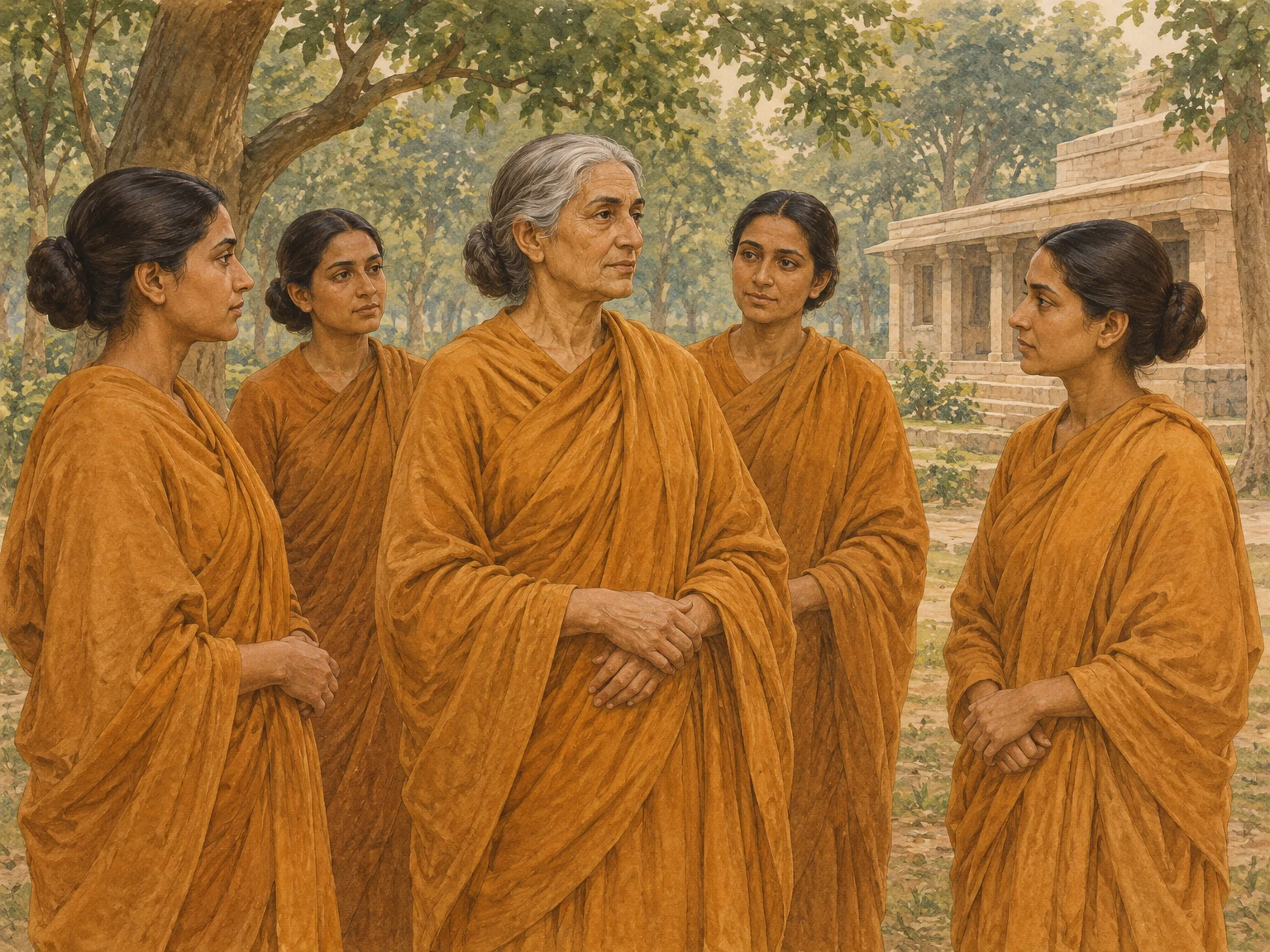
After the Buddha leaves Kapilavatthu for Vesālī, Gotamī and a group of Sakyan women shave their heads, put on ochre robes and follow him on foot. The accounts portray them as dusty and sore from travel, with Gotamī standing outside and weeping. Aṅguttara Nikāya 8.51 describes a large group; the Cullavagga’s wording does not give a precise headcount. Numbers in later retellings should not be silently substituted for the wording of a cited version.
The details make the scene vivid but do not amount to an independently verified itinerary. The women are largely unnamed, and the texts do not give individual biographies, their motives in their own words, or a dated record of their journey. We can describe what the narrative depicts—a group making a visible request after traveling together—while keeping clear that this is the form in which a canonical tradition preserves the episode.
Ānanda asks about spiritual capacity
Ānanda finds Gotamī outside and asks why she is crying. He approaches the Buddha and asks whether women may go forth; the Buddha refuses three times. Ānanda then asks whether women who have gone forth can realize the stages of awakening named in the teaching. In the Pāli discourse the answer is yes. The story therefore states women’s capacity directly rather than leaving it to implication.
Ānanda also recalls Gotamī’s care for the Buddha as a child. The appeal joins spiritual capacity with gratitude for a relationship described in the text. Importantly, the episode does not say that the earlier refusals were based on a belief that women could not awaken. The narrative puts that question to the Buddha and records an affirmative answer; assigning a different motive to the refusals would go beyond what this account tells us.
Acceptance of the eight principles
The Pāli narrative says Gotamī may be ordained if she accepts eight garudhammas, translated variously as “rules of respect,” “weighty rules” or “principles of respect.” She accepts them. Aṅguttara Nikāya compares this acceptance to taking a garland of flowers with both hands. The Cullavagga treats her acceptance as the means of her own ordination. In that Vinaya account, Gotamī’s admission is distinct from the later procedure authorized for her Sakyan companions.
The rules establish an unequal formal relationship between the communities of monks and nuns. They concern precedence, residence during the rains retreat, regular instruction, invitation for feedback after retreat, discipline for serious offenses, higher ordination and admonition. Their presence in a text is evidence of what that transmitted collection prescribes; it does not by itself establish when each rule first arose, how consistently it was applied, or how every Buddhist lineage interpreted it.
What the Pāli list contains
In the Pāli formulation, a nun ordained for a century is to show respect to a monk ordained that day. Nuns are to spend the rains near a residence where monks are available, ask the monks about observance and seek instruction every fortnight, and invite criticism or feedback before both communities at the end of the rains. Taken together, these provisions set out recurring contact and formal precedence, with monks given higher status in the stated arrangement.
The remaining principles address serious offenses, ordination and speech. A nun who commits a serious offense is to undergo discipline before both communities. A probationer trains for two years before higher ordination through both communities in this Pāli wording. The list also bars insulting monks and bars nuns from formally admonishing monks, while allowing monks to admonish nuns. This is a plain-language summary, not a full legal commentary or a claim that all schools used one identical list.
Gotamī and her companions: two procedures
The Cullavagga continues beyond Gotamī’s acceptance. She asks how her followers should be ordained, and the Buddha authorizes monks to ordain the Sakyan women. When a question later arises about Gotamī’s own status, the Buddha confirms that her acceptance of the eight principles constituted her ordination. The Pāli narrative thus distinguishes her admission from the procedure for the women who traveled with her.
That distinction is easy to lose in brief retellings, which may compress the events into one ceremony. Yet the procedural difference matters: this is a Vinaya collection explaining both a founding account and the handling of ordination. Other versions treat the relationship between the principles and ordination differently. What the Pāli sequence securely shows is how this text presents the institution’s origin, not that every historical community followed precisely the same steps.
Two Pāli collections, different emphases
Aṅguttara Nikāya 8.51 and Cullavagga X share the request at Kapilavatthu, three refusals, the journey to Vesālī, Ānanda’s intervention, the affirmative answer about women’s capacity and acceptance of the eight principles. But they belong to different collections with different literary and institutional purposes. The Aṅguttara discourse includes a prediction about the duration of the Dhamma; the Cullavagga proceeds into questions of ordination and community procedure.
The accounts should not be treated as duplicate transcripts of one event. Shared structure may reflect a related narrative tradition; variation and placement show how collections use the story. Neither source supplies a day-by-day chronology of the Buddha’s life. Reading them together helps explain what early Buddhist textual traditions chose to preserve, but does not turn their dialogue into independently witnessed speech.
The prediction in Aṅguttara Nikāya
The Pāli Aṅguttara account concludes with a prediction that admitting women will shorten the duration of the true Dhamma from one thousand years to five hundred. It uses comparisons involving a household, crops and an embankment. These are the discourse’s religious claims and images. They should be reported as what this particular text says, not as a historically verified forecast or proof about the actual course of Buddhist history.
Parallel versions do not present decline material in precisely the same way, and scholars debate how passages of this kind developed. We do not need to settle that debate to distinguish text from historical inference. A careful account can state the prediction, identify its source and leave open questions about its textual history rather than treating a doctrinal claim as an externally confirmed event.
A different sequence in Madhyama-āgama 116
The Chinese Madhyama-āgama discourse numbered 116 preserves a noticeably different account. In Bhikkhu Anālayo’s translation and analysis, Gotamī herself raises women’s capacity to attain the four fruits during her initial request. The Buddha still refuses, but the narrative adds an alternative: she may shave her hair, wear robes and live celibately while remaining at home. The account then places the later request after the Buddha’s journey to Nādika, rather than Vesālī.
This changes who first raises the question of spiritual capacity, adds a form of religious life outside ordination and shifts the location in the sequence. Anālayo considers the discourse’s school affiliation probable, not certain. It should not be called the definitive earlier version or used to claim a single school position. It is a witness to a related narrative circulating in a different form.
The rules vary across traditions
Madhyama-āgama 116 also differs in the order and wording of the eight principles. Its first rule concerns seeking higher ordination from monks, without the Pāli list’s two-year probationer wording and explicit two-community formulation. It includes provisions about approaching monks for instruction and asking doctrinal questions when permitted, and about exposing an offense. The seniority principle appears at the end rather than at the beginning.
Comparative work on other Vinaya collections finds further variations in how Gotamī and her companions are ordained. Some versions link the principles directly to ordination; others describe a separate procedure. These differences do not make the sources useless. They show that Buddhist communities transmitted related but non-identical accounts. A writer should not combine the lists into a supposedly original set unless the method and evidence for doing so are made explicit.
What history can and cannot establish
The surviving texts are important evidence for Buddhist memory and institutional thought. They show that canonical collections preserve a founding account for a community of nuns, discuss women’s capacity for awakening and regulate relations between monks and nuns. They also place Gotamī at the center of that account, remembering her as a petitioner and, in the Pāli version, as the Buddha’s foster mother.
That evidence is not the same as independent verification of a sixth- or fifth-century BCE biography. The sources do not provide a securely dated ordination, contemporary documentary corroboration for each journey and dialogue, or a complete life story. This limitation does not prove the episode did not occur; it defines what these texts alone can establish. “The Cullavagga narrates” is a firmer claim than “historians can independently confirm.”
Remembering Gotamī without inventing a biography
Within Buddhist canonical memory, Gotamī is represented as the Buddha’s maternal aunt and foster mother, a persistent petitioner and a founding nun. Other canonical material remembers her as foremost among nuns in seniority, and verses attributed to her in the Therīgāthā present a voice of liberation. Those sources preserve her significance within religious tradition; they do not supply verifiable details for every stage of her life.
The women accompanying her also matter, even though the narrative leaves most of them unnamed. Their group journey makes the request collective, but the texts tell us little about each person’s background, motives or later practice. We should neither erase their role nor fill gaps with invented biographies. A careful retelling respects the agency the source gives them while naming the limits of its account.
A founding narrative and its present questions
The eight principles have drawn modern attention because the Pāli versions encode hierarchy between the communities. Their asymmetry should be described plainly, not softened away. At the same time, textual variation complicates any claim that one wording was universally fixed or applied identically in every period. A text’s rule establishes what its collection preserves; it does not alone establish the rule’s origin date or universal practice.
Scholars have proposed that parts of the founding story and rule set may reflect institutional development over time. These are historical arguments drawn from comparison and transmission, not settled proof that a particular rule was invented at a known moment. The textual differences support careful questions; they do not license certainty where the evidence remains debated. Present-day interpretation is also a distinct matter from reconstructing ancient practice.
The next point in the series
This episode turns from Day 15’s shared-lodging narrative to another founding account in the Cullavagga: the admission of women and formation of the bhikkhunī community. The relationship is thematic, not a claim that the stories occurred next in a verified chronology. Vinaya collections organize narratives and rules around institutional concerns rather than supplying continuous modern biographies.
The central point is that Buddhist texts remember Gotamī’s request as decisive while preserving more than one account of its sequence and meaning. The Pāli narrative places an affirmative answer about women’s capacity beside a set of unequal rules; parallel sources complicate the details. Reading the story responsibly means holding its human importance, institutional content and historical limits together.
Sources
- Aṅguttara Nikāya 8.51, Gotamī Sutta, translated by Thanissaro Bhikkhu
- Cullavagga X, Pāli Vinaya, translated by I. B. Horner
- Anālayo, “Mahāpajāpatī’s Going Forth in the Madhyama-āgama,” Journal of Buddhist Ethics 18 (2011)
- Anālayo, The Foundation History of the Nuns’ Order (2016)
- Review of Anālayo, The Foundation History of the Nuns’ Order, Indo-Iranian Journal 62 (2019)
- Therīgāthā 6.6, Mahāpajāpatī Gotamī
This content is a collection of ancient history,books and various articles and collection of library and news and other post ; all details may not be the same. Readers are requested to verify the information themselves. Readers are not allowed to take any disciplinary action; content is only for educational purposes. If readers do not agree about the contents, they may send a personal comment to my personal email ID: achary.purna@gmail.com

1 Comment
Keeping the differences between the versions visible seems important for a founding story like this. It lets a reader distinguish what a particular text records from a later attempt to turn several traditions into one seamless biography.