
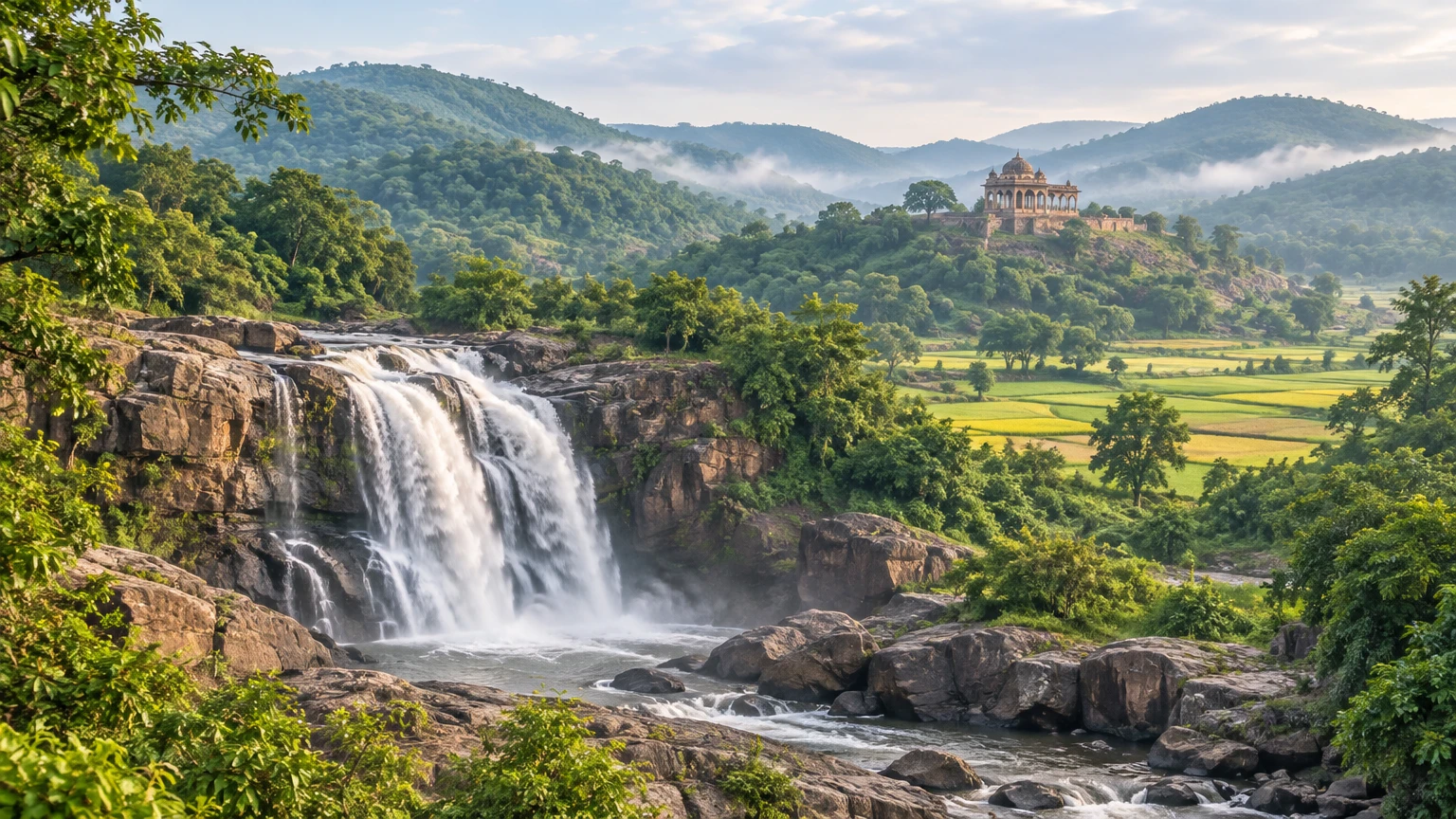
In Deogarh, water is never merely a view. A fall beside the district headquarters has supplied the town; another helped generate electricity in the princely era. Reservoirs hold water for agriculture, while old shrines and royal buildings give the surrounding hills a place in local memory. To travel here is to see how a small capital learned to live with its landscape—and how that relationship continues to change.
District Overview & Geography
Deogarh, also written Debagarh or Debagada, is a hill district in western Odisha. Its headquarters was the capital of the former princely state of Bamanda, also called Bamra. The present district was separated from Sambalpur on 1 January 1994. The historical kingdom and today’s administrative district are not interchangeable: their boundaries and institutions belonged to different periods. Deogarh’s agricultural research centre provides a useful starting point for that distinction.
Hills, valleys and cultivated land give the district its character. The Pradhanpat and Kaidanta ranges rise near the headquarters; elsewhere, forested slopes alternate with settlements and fields. The terrain is not a single uninterrupted wilderness. Roads, farms, waterworks and villages are part of the same landscape that visitors come to admire.
The Brahmani is the principal river associated with the district. The district gazetteer also identifies the Tikira and Gohira among its important rivers, with hill streams draining the intervening watersheds. These are working waters: reservoirs and irrigation have altered the landscape as well as supported cultivation. The gazetteer records displacement associated with the Rengali and Gohira projects, a reminder that a scenic expanse of water can also represent a difficult history for families who lived nearby. Its searchable text is available through the district gazetteer; the full file could not be opened during this check.
Deogarh’s climate is broadly hot and moist sub-humid. Summer can be demanding, the monsoon brings the rain on which streams and cultivation depend, and the cooler months are generally more comfortable for sightseeing. Odisha Tourism recommends October to March for Pradhanpat. That is a seasonal guide, not a guarantee of clear weather or safe access: rain can make stone paths slippery, and streams may remain hazardous after a downpour. Odisha Tourism
The forests include moist and dry deciduous vegetation. The district gazetteer’s indexed text names sal, kendu and mahul, as well as bamboo and amla; it also records elephants among the district’s wildlife. These are descriptions of habitat, not promises of sightings. Forests are places of livelihood and ecological connection, not an open invitation to leave a road or enter a reserve. Ask the forest authorities about permitted access, and give any wild animal space.
Fields, soils and seasonal livelihoods
Deogarh’s hills do not make agriculture a side note. A 2023 annual report from Krishi Vigyan Kendra Deogarh places the district in Odisha’s North-western Plateau agro-climatic zone and describes low-rainfall lateritic conditions and sandy-loam soils. It lists rice-pulse, rice-vegetable and rice-oilseed combinations, alongside mushrooms, fishery, dairy, goat rearing and backyard poultry. That is an institutional snapshot of systems and enterprises, not a census of every household or a guarantee of what any farm grows today.
The report’s district-level productivity table gives kharif and rabi rice yields as 1,925 and 2,650 kilograms per hectare; sesame, 427 and 408; and green gram, 325 and 377. It lists mango at 2,234 kilograms per hectare, litchi at 3,800, and sweet orange at 8,970. Those figures are useful for showing the mix of crops but are reported for 2023 and should not be mistaken for current prices, a season’s forecast or a promise of commercial scale.
Its village examples make the variety more tangible. For Koradapasi in Reamal, the report records trellised bitter gourd, introduction of a rice variety called Swarnashreya, mushroom cultivation using paddy straw, and beekeeping with five boxes; it also notes demonstrations for pulses, oilseeds and biofertiliser in cowpea. At Hinjilita in Barkote, it describes seed production and pulse demonstrations in rice-fallow fields. These are specific extension activities recorded in 2023, not proof that the same projects continue or that every farm uses these methods.
This agricultural picture sits beside the district’s reservoirs and hill streams. Water can support fields, while major projects also reshaped homes and local life; the gazetteer’s account of displacement around Rengali and Gohira is a reminder that infrastructure carries human costs as well as benefits. For a visitor, a conversation with a local grower or market seller can make the landscape feel less like scenery. Ask before entering a field or photographing work, and treat any seasonal crop as something to check locally rather than assume.
Mythological & Historical Significance
The name Deogarh is sometimes explained through an image of a divine stronghold. A 2013 Odisha Review account presents the idea that the landscape was dear to divine beings as a belief about the name, not as an established historical origin. That distinction is useful throughout the district: a sacred story can explain how a community values a place without serving as evidence for the date of a building. Odisha Review
Deogarh’s more readily traceable history lies in Bamanda’s institutions and surviving places. Local accounts connect the area with the Mathara family in an early period and with the later Ganga rulers of Bamanda. Precise early dynastic chronologies deserve caution; for a visitor, the better-documented late princely period offers a clearer framework. Capital locations shifted over time, with Purunagarh remembered as an earlier centre and Deogarh becoming the later capital.
Under Raja Basudeb Sudhal Deb, who ruled from 1869 to 1903, Bamanda became associated with education, literature and public communication. The Jagannath Ballav Press was founded in 1886, and the weekly Sambalpur Hitaishini followed in 1889. Print made it possible for a small inland court to participate in wider discussions about Odia language and literature. The story is not simply that a ruler sponsored writers; it is also about editors, contributors, readers and the circulation of ideas beyond the palace. Krishi Vigyan Kendra, Deogarh
This literary inheritance helps explain why the buildings around Pradhanpat matter. Basant Nivas and Lalit Basant are identified by Odisha Tourism as historic royal structures near the waterfall. In April 2026, The New Indian Express reported that a school lesson on Pradhanpat also drew attention to poems inscribed on marble pillars at Basant Nivas. The inscriptions connect architecture with literary memory, although their presence does not establish that the buildings are currently open for independent visits. The New Indian Express, 17 April 2026
Sacred places add another layer. The district’s indexed tourism description attributes the Jagannath temple at Purunagarh to Raja Pratap Rudra Deb and dates it to 1705, within the Ganga dynasty’s Bamanda heritage. For Jhadeswar, the district attributes construction to Deba Durllav Deb in 1854, during Raja Brajasundar Deb’s rule. It also recounts a dream in which Shiva directed that a temple be erected there. The construction account and the devotional story should be understood on their different terms: the latter is a tradition of faith, not independently verified evidence of the temple’s origin. Purunagarh temple; Jhadeswar temple Deogarh’s religious landscape is wider than royal patronage. The district’s festival material describes Nuakhai, Karamasani and many Hindu observances, alongside traditions associated with Adivasi communities and local deities. These practices are not interchangeable, and a festival performance is only one public expression of a community’s life. Visitors should ask before photographing worshippers or entering a sacred space, and should not assume that every shrine is intended for tourism. District festival page, indexed text
Tourist Destinations & Hidden Gems
Pradhanpat: The town’s waterfall
Pradhanpat is the natural first stop because it is so close to Deogarh town. Odisha Tourism describes a perennial cascade descending in stages through wooded hills, with landscaped paths and picnic areas around the site. The falls are often presented as a background for a photograph, but the more interesting perspective is to see them in relation to the town below: the district gazetteer describes Pradhanpat as a source of drinking water. Take time to look at the changing line of the cascade rather than trying to reach its base. Water levels and the condition of paths vary; rocks near falling water can be slippery, and a pool should not be assumed safe for swimming. Stay on routes that local authorities have opened, carry back litter and avoid soap or washing in the water. A water source used by a town deserves more care than a disposable picnic ground. The area is also a place of worship. Odisha Tourism names shrines associated with Maa Pradhani, Maa Pradhan Pateswari and Shiva near the falls. Treat the site as both a religious landscape and a public attraction: dress respectfully, keep music low and follow the directions of caretakers. Do not assume that all paths or shrines are accessible whenever the waterfall can be seen. Odisha Tourism
Basant Nivas and the royal landscape
Near Pradhanpat, the historic structures of Basant Nivas and Lalit Basant suggest how the Bamanda court made the hill setting part of its cultural world. A 2013 government tourism essay describes them as guest houses used by the royal family. Their association with the waterfall and with inscriptions makes them especially relevant to a visit focused on Deogarh’s literary past. Odisha Review The buildings should not be treated as ruins available for exploration. Ownership, conservation and access may change; ask locally whether a particular exterior or interior can be visited. If access is unavailable, the district’s story remains legible through the relationship between the falls, the old capital and the printing culture that flourished under royal patronage. Deogarh Rajbati, the former royal palace, belongs to the same historical itinerary. The district’s indexed heritage page attributes the present palace to Basudeb Sudhal Deb in 1896 and says it remains in use by the former royal family. It is therefore especially important not to assume public entry. A view from an ordinary public place, where permitted, is different from entering a residence. District heritage page, indexed text
Kurudkut: Water and early electricity
Kurudkut, also spelled Kurodkote or Korodkot, offers a different way to understand the hills near Deogarh. The district gazetteer identifies a hydroelectric installation there in 1916 that supplied the town. The 2013 Odisha Review account likewise remembers the waterfall as an early source of power. Such evidence is more useful than an unqualified claim that it was the first scheme of its kind: rankings vary between accounts and depend on what is being compared. The idea is compelling even without a superlative. A hill stream was part of a technological network serving a princely capital, just as Pradhanpat was part of its water supply. Do not assume that historic machinery survives, that it can be inspected, or that a forest route to the fall is open. Check with local authorities before planning a visit; if access is uncertain, use the story to enrich a town-based itinerary instead.
Purunagarh and Jhadeswar: Places of worship
Purunagarh offers a link to Bamanda before Deogarh became its later capital. Its Jagannath temple is associated with an older royal centre, and the 2013 tourism essay records a Rath and Bahuda Yatra there, with a ceremonial role traditionally performed by representatives of the former royal family. The essay is historical evidence for the practice, not confirmation of a current programme or a future festival date. Jhadeswar is a Shiva temple associated with a natural lingam in local belief. The district’s indexed description identifies its architecture with the Kalinga temple tradition and dates its construction to the nineteenth century. A visit is best approached as participation in a living place of worship, not as an inspection of a museum object. Ask about customary conduct and photography, and make room for devotees. Odisha Review; district temple page, indexed text
Kailash and Ballam: Royal retreats and managed water
Kailash, on the road towards Sambalpur, is another reminder that the Bamanda rulers used the hills for retreats. The district’s indexed heritage account attributes Kailash Palace to Raja Dibya Shankar Deb, between 1916 and 1919. A 2013 state publication also identifies Kailash as a heritage and scenic location. Neither source establishes present-day opening or permission to enter; check locally before adding the palace to a route. Odisha Review; district heritage page, indexed text Ballam adds a quieter historical theme: the relationship between worship, gardens and water management. The 2013 account dates its Madanmohan temple to 1892 and the Kalajira irrigation work and Godavari tank to 1891. It associates the waterworks with paddy fields and mango cultivation. Rather than imagining a fixed royal panorama, look for how tanks and irrigation continue to shape settlement and farming—and respect any boundaries around working infrastructure.
Gohira and Deojharan: Beyond the headquarters
Gohira Dam, in Reamal block, brings the scale of water management into view. The district tourism listing describes the reservoir as a scenic place, while the older Odisha Review account identifies irrigation as one of its functions. Their stated distances from town differ, so use a current map and local directions rather than relying on a single published figure. Do not walk onto dam infrastructure or approach the water unless the responsible authority permits it. There is no verified basis here for recommending boating or swimming. District Gohira listing, indexed text; Odisha Review Deojharan is described in the district’s indexed tourism listing as a spring and waterfall in the forest of Reamal block. That listing also records a local story that Bamanda forces camped there during a conflict involving Rairakhol. The account is folklore attached to a place, not proof of a particular military event. Forest conditions and permissions matter more than a tantalising story: confirm access with the forest department and local administration before setting out, and do not treat an old tourism listing as a trail licence. District Deojharan listing, indexed text These lesser-known sites reward a slower journey, but they are not “secret” places waiting to be discovered. They are landscapes known and used by residents. Ask before crossing private land, avoid disturbing wildlife, and leave if a route is closed or unsafe.
Recent News & Tourism Developments
The most clearly verified recent heritage development in the material reviewed is educational rather than a new visitor facility. On 17 April 2026, The New Indian Express reported that Pradhanpat had been included in the Class V language textbook Bhasa Mahak for the 2026–27 academic session. The reported chapter discusses the waterfall, nearby religious sites and the inscriptions at Basant Nivas. Inclusion in a textbook is not a change in visitor access, but it shows how the district’s natural and literary heritage is being presented to a new generation. Report On 14 February 2025, the same newspaper reported proposals to renovate Pradhanpat and convert the old collector’s office into a museum. At that time, tentative project estimates were ₹12.20 crore and ₹4 crore respectively; the collector said further project preparation would follow approval. The proposed waterfall facilities included visitor amenities, while the proposed museum would display local history, art and culture. These were plans, not evidence that construction was approved, completed or open. No later completion of either project was verified in this research. Report Utsav Pradhanpat is a further link between culture and place. A district event-management notice indexed in search described a proposed five-day 2026 edition at Bada Bagichha from 18 to 22 January 2026. The notice establishes planning, not by itself that every event took place. Odisha Tourism’s general description calls the festival three days; durations can differ between editions, so neither account should be used to predict the next schedule. No forthcoming festival dates were verified for this edition. District notice, indexed text; Odisha Tourism
Traveler Essentials
Getting there and planning a route
For air travel, Odisha Tourism identifies Veer Surendra Sai Airport at Jharsuguda as an approach to Pradhanpat. For rail, it identifies Sambalpur station; Deogarh’s agricultural centre also lists Jharsuguda, Bamra and Rourkela as railheads for the district. Each requires an onward road journey, and the best choice depends on the train or flight actually available to you. Verify connections and arrange the final leg before departure. Odisha Tourism; district profile By road, the Sambalpur–Deogarh approach is a practical way to understand the district’s relationship with western Odisha. Odisha Tourism identifies national and state highways serving the town; older sources use earlier highway numbers, so follow current road signage and a current map rather than an old number alone. Allow extra time for weather, roadworks and local travel. No bus frequency or journey time should be assumed from these sources. A measured first day can centre on Pradhanpat and the town’s historical setting, with a temple visit where access and local custom permit. A second day can be planned towards Ballam, Kailash or Reamal after checking conditions and permissions. These are suggestions, not a claim that every property or forest site is open. If travelling beyond Deogarh, confirm district boundaries: similarly named Debrigarh Wildlife Sanctuary is not Deogarh district and should not be confused with it.
Seasons, food and respectful travel
The cooler October–March window is generally convenient for walking and road travel. In the monsoon the hills may be greener and falls fuller, but heavy rain can make roads, slopes and stream crossings more hazardous. In summer, plan outdoor activity around the heat and carry drinking water. Check current weather and local notices shortly before travel; a seasonal recommendation is not a safety clearance. For food, ask what a household or eatery is preparing that day rather than seeking a supposedly exclusive district dish. Odisha Tourism describes pakhala, rice served with water or fermented rice, and dalma, a lentil-and-vegetable preparation, among western Odia staples. Availability and preparation vary. The district gazetteer’s indexed text also records local fruit cultivation, including mango, litchi and oranges, as well as small local potatoes; these are agricultural products, not a guarantee of a particular market or season’s supply. Odisha Tourism’s western Odisha food descriptions; district gazetteer, indexed text Buy from local vendors where possible, ask permission before photographing people or craft work, and leave temples and picnic sites as you found them. Do not collect plants, feed wildlife or enter a forest because an older guide calls it scenic. Deogarh’s most rewarding journey is not a race between attractions: it is an attentive passage through a place where water, worship, literature and ordinary work remain connected.
Publishing Metadata & Tagging
- Group: Odisha Tourism
- Section/Category: Society And Culture
- Destination: https://pcachary.in
- District: Deogarh
- Edition: 2026-11-24
- Cycle: 2
- Tags: Odisha Tourism; Deogarh; Society And Culture
Sources & checks
Evidence checked for the 24 November 2026 edition. District-site pages and PDFs noted as indexed text were consulted through search excerpts; direct reads failed, so details and current access remain to be confirmed.
- Odisha Tourism, Pradhanpat waterfall, undated: landscape, nearby heritage and travel approaches.
- Krishi Vigyan Kendra, Deogarh, district profile, 2018: geography, history and transport.
- Odisha Review, “Deogarh: The treasure of tribal tourism and Gadjat culture”, November 2013: historical tourism, places and festivals. Historical distances and visitor information should not be treated as current.
- The New Indian Express, Pradhanpat in school textbooks, 17 April 2026.
- The New Indian Express, waterfall and museum proposals, 14 February 2025. Completion was not verified.
- Deogarh district government, indexed excerpts: gazetteer, geography and ecology; gazetteer, culture and agriculture; heritage; Purunagarh Jagannath temple; Jhadeswar temple; Deojharan; Gohira Dam; festivals; and Utsav Pradhanpat 2026 notice.
- Odisha Tourism, Nuapada destination page, undated: western Odia food descriptions, not evidence of Deogarh-exclusive dishes.
- Cover artwork: Original text-free illustration generated for this Deogarh article on 24 November 2026; it is interpretive, not a documentary reconstruction.
- Krishi Vigyan Kendra, Deogarh, Annual Report 2023 (January–December 2023), district farming systems, selected crop-productivity figures and village demonstrations; figures describe the 2023 report, not guaranteed current results.
Disclaimer
This content is a collection of ancient history,books and various articles and collection of library and news and other post ; all details may not be the same. Readers are requested to verify the information themselves. Readers are not allowed to take any disciplinary action; content is only for educational purposes. If readers do not agree about the contents, they may send a personal comment to my personal email ID: achary.purna@gmail.com
