
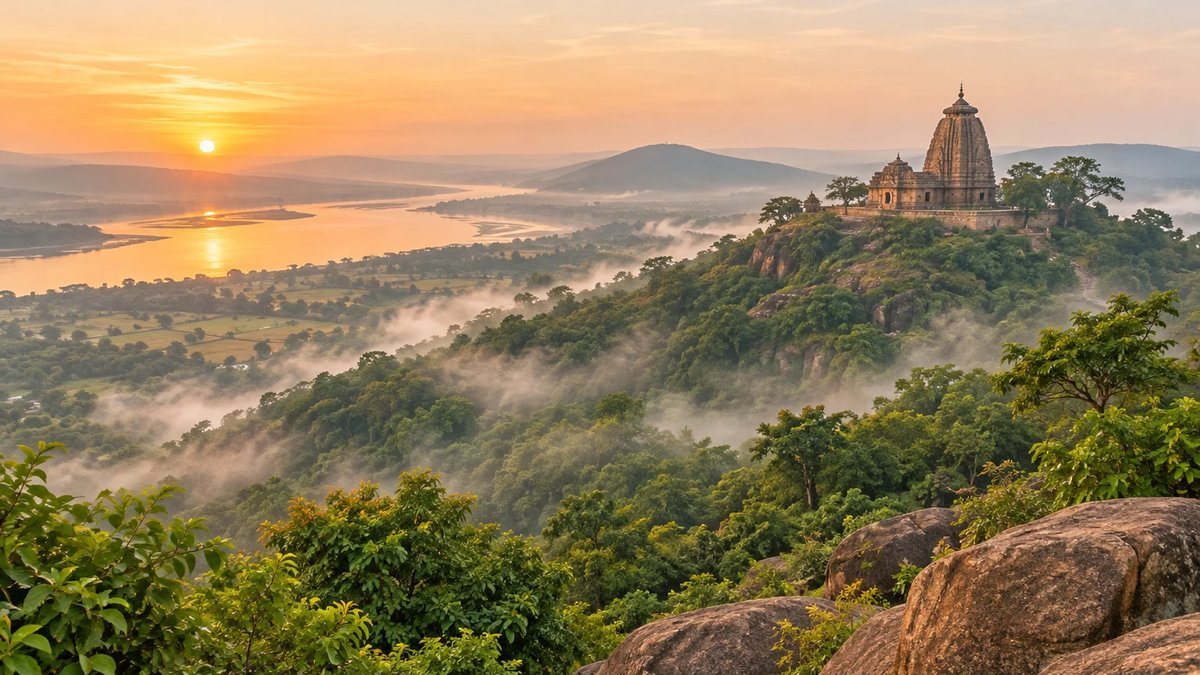
Dhenkanal is easy to reduce to a handful of familiar images: a temple above a forested hill, a gathering of white-clad ascetics at Joranda, a brass figure emerging from a clay mould. The district becomes more interesting when these are not treated as separate attractions but as parts of a lived landscape. Rivers feed farms and settlements; roads connect administrative towns with craft villages; stories travel beside inscriptions and archival records; religious traditions continue to shape the rhythm of public space. A thoughtful visit leaves time for all of these layers, and asks before turning a home, workshop, shrine or forest into a spectacle.
This guide takes a different route through Dhenkanal from a simple checklist of sights. It begins with the plateau and its water, moves through the histories that can be documented and those best described as tradition, then considers places, crafts, recent developments and practical choices. The district administration itself notes that the earliest written history is limited, so confident claims about remote antiquity deserve care. Where this guide uses a local legend, it calls it a legend; where information is a dated government or news report, its date matters.
District Overview & Geography
Dhenkanal lies in central Odisha, between the coastal plain and the uplands of the interior. Its terrain is a patchwork rather than a single dramatic wilderness: low hills, forested slopes, cultivated valleys, village settlements and the built-up town around the district headquarters. The government’s district overview describes a moderate climate with hot, humid months before the monsoon and cooler winter months. Odisha Tourism suggests October to March as a generally comfortable period to visit. These are broad seasonal guides, not a promise of weather on a particular day; rainfall, heat and local conditions still vary.
The Brahmani is the major river system associated with the district, joined by tributaries and smaller streams that shape local drainage and agricultural life. Water appears in Dhenkanal not just as scenery but as infrastructure and memory: irrigation projects, tanks, seasonal streams and river crossings connect places that otherwise seem unrelated. The official district pages describe Dandadhar as an irrigation project on the Ramial, while Saranga is known for a carved image of Anantashayi Vishnu on a rocky stretch of the Brahmani. These settings remind the visitor that a river can be simultaneously a working resource, a sacred landscape and a geological feature. None of those meanings cancels the others.
Dhenkanal town is the practical starting point for most visits. It has rail and road links, with the nearest major airport at Bhubaneswar according to the Odisha Tourism destination listing. Published distance figures vary between official pages and may use different starting points—town, railway station or bus stand—so treat them as planning estimates, not exact journey times. A road distance that looks short on a map can take longer if a route passes through settlements, if weather affects the road, or if the final stretch is narrow. Confirm transport and opening arrangements locally before setting out, especially for sites away from the main highway.
The district’s forested hills support a quieter kind of exploration than a high-altitude trek. Kapilash is the best-known hill landscape, but its sacred precinct, road access, stairway, nearby parks and caves have different uses and conditions. Dhenkanal’s official tourism pages describe a temple around 457 metres above sea level and a long flight of steps, as well as a ghat road; the number of steps differs slightly between the district’s own pages, so the useful point is the climb itself, not a falsely precise count. Choose the road or stairs according to your mobility, heat tolerance and the day’s conditions, and allow time for a slow ascent.
Agriculture is central to the district’s everyday geography. A 2023 annual report from Krishi Vigyan Kendra Deogarh, which reports district-level farming information for Dhenkanal, describes low-rainfall lateritic conditions and sandy-loam soil, with rice-pulse, rice-vegetable and rice-oilseed systems. It also lists mushrooms, fishery, dairy, goat rearing and backyard poultry. These are institutional descriptions of farming systems, not a current household census, and they should not be generalized into claims that all villages or seasons look alike. For a visitor, they help explain why water management and seasonality matter just as much as the visible hills.
The district is not a blank green backdrop. Towns, farms, workshops, shrines and forests are connected by people’s work and routines. A responsible itinerary avoids trespassing into fields, entering restricted forest areas or treating a working craft site as an exhibition without consent. Ask before photographing people or their work, buy directly when a craftsperson wishes to sell, and leave enough time for ordinary travel rather than racing through many distant stops in a single day.
Mythological & Historical Significance
The district administration says it is commonly believed that the name Dhenkanal derives from Dhenka, a Savara chief said to have ruled the area. The wording matters: this is a received explanation, not a fully documented origin story. The same official history acknowledges that the prehistoric past remains obscure because written documents are limited, while archaeology and inscriptions offer partial evidence. A careful account therefore resists stitching every ancient dynasty into an uninterrupted local chronology. Historical evidence often tells us who claimed authority or left an inscription; it does not automatically tell us how every community lived or what every place meant to them.
The official district history lists a sequence of ruling houses and names, including a Dhenkanal royal line beginning with Hari Singh Vidyadhar in 1530. The District Census Handbook adds a wider administrative context: the district was formed from former princely states including Dhenkanal and Hindol, alongside other former states and territories, and its boundaries changed over time. The two records are not interchangeable descriptions of today’s district. A palace, temple or administrative boundary may preserve one historical layer while belonging to a different political period than the modern district map.
Dhenkanal’s twentieth-century history includes the Prajamandal movement against princely rule. The District Census Handbook describes the agitation in Dhenkanal as especially serious in 1938–39, with deaths during police firing and volunteer satyagraha supported by wider political organizations. One of the best-known episodes is the death of Baji Rout, a twelve-year-old boatman at Nilakanthapur ghat. The handbook records that on 11 October 1938 he refused to ferry police across the river and was shot along with Laxman Mallick and Fagu Sahoo. The event is remembered in Odia literary and political culture, including through Sachi Routray’s poem. The record is not a decorative anecdote: it points to the risks borne by ordinary people in a struggle over power, taxation and forced labour.
The princely state of Dhenkanal merged into the Indian Union on 1 January 1948, according to the government’s district history and census record. The present administrative district was shaped through later reorganizations. When describing “Dhenkanal’s past,” it is helpful to identify whether a source means the former state, the present district or the town. That distinction avoids assigning every event in a larger former territory to the boundaries visitors see today.
Kapilash is both a religious place and a landscape of layered historical claims. The district’s tourism pages identify the Chandrasekhar temple with Shiva and describe the hill as a local counterpart to Kailash, Shiva’s legendary abode. That identification belongs to devotional geography, not a literal claim that the hill is the Himalayan Kailash. The pages also mention caves, a medieval fort ruin and traditions associated with sages and religious teachers. Their stories can be meaningful to pilgrims even where archaeology has not established every episode as historical fact. Visitors can appreciate the distinction without treating belief as something to mock or evidence as something to overstate.
Joranda offers a different spiritual history. Odisha Tourism describes it as the principal seat of Mahima Dharma, a nineteenth-century movement whose teachings emphasize simplicity, equality and devotion to the formless divine. The district account identifies Mahima Gosain’s samadhi and the sacred sites known as Shunya Mandira, Dhuni Mandira and Gadi Mandira. This is a living religious centre, not an empty architectural set. Visitors should follow local guidance on where to stand, when to enter and whether photography is appropriate. The annual Magha gathering draws devotees and ascetics, but crowd size, schedule and access can change from year to year.
At Saptasajya, the government tourism page explicitly frames the Pandavas’ stay in the hills during their incognito exile as legend. It also identifies a Raghunath temple built by Rani Ratnaprava Devi in honour of Rama, Lakshmana and Sita. The hill’s place in epic storytelling and the temple’s historical association need not compete: one belongs to sacred narrative, the other to a local account of patronage. Keeping those categories clear lets the site remain culturally rich without pretending all its layers can be verified in the same way.
Tourist Destinations & Hidden Gems
Kapilash is a strong first stop for visitors drawn to a hill shrine and a broad view over wooded slopes. The Chandrasekhar temple sits above the foothills, reached by a stairway or a road that winds up the hill. The climb is part of the experience, but it is not obligatory: people with mobility limits, young children or health concerns can choose the road and check the current transport arrangements. Carry water, wear footwear suitable for uneven steps, and avoid treating a busy festival day as a quiet sightseeing window. Mahashivaratri is an important pilgrimage time, which can mean intense crowds and altered movement. Respect worshippers and do not obstruct ritual paths for photographs.
Kapilash has more than one layer of interest. The official district listing mentions caves and remains associated with a medieval fort, while nearby foothill attractions include a deer park and a science park. The history and conservation status of individual structures should be read from on-site signs or current local authorities rather than inferred from a brief tourist description. A temple visit can be combined with a slower look at the hill’s ecology, but visitors should stay on permitted routes and not collect plants, disturb wildlife or enter unstable ruins. The broader value of Kapilash lies in seeing how a sacred summit, local stories, forest and public facilities occupy the same landscape.
Joranda is best approached as a living religious centre. The Mahima Gadi complex and its shrines are the reason many people travel there, and the annual Magha Mela draws followers for collective observances. If you arrive outside the fair, the place can feel calmer, but that quiet does not make it an unrestricted tourist zone. Dress modestly, keep voices low and ask before taking photographs. The layout, ritual calendar and access rules belong to the community that uses the site. Odisha Tourism lists a general daytime visiting window and no entry fee, but confirm current arrangements locally, as festival practices and site operations may differ.
Saptasajya, around eleven kilometres south of Dhenkanal town according to the district tourism page, offers a forested hill setting, a spring and the Raghunath temple. It works well as a half-day outing rather than a rushed stop between distant destinations. The story of the Pandavas is presented as local legend; the temple tradition and its association with Rani Ratnaprava Devi add a separate historical layer. The small spring is part of the setting, but water flow is seasonal and should not be assumed from an old description. Visitors should take back litter, avoid loud music and use established paths, particularly during wet conditions when rocks and steps can be slippery.
For a different encounter with sacred art, travel to Saranga, where the district describes an Anantashayi Vishnu image on a rocky bed beside the Brahmani. The sculpture shows Vishnu reclining on the serpent Ananta, with the lotus and Brahma motif familiar from Vaishnava cosmology. The setting makes it tempting to treat the image as a picturesque object, but it is also a place of religious meaning and a work of stone-carving tradition. The official page gives distances from Dhenkanal and nearby towns, but road conditions and the exact route should be checked before departure. Plan for the site as a standalone stop or pair it with nearby places only after confirming travel time.
Kualo is an option for visitors interested in temple architecture beyond the district’s most famous shrine. The official listing names several temples, including Kanakeswar, Baidyanath, Paschimeswar, Balunkeswar and Kapileswar, and describes Kanakeswar’s ruined structure and sculptures as significant examples of early temple-building activity in Odisha. The page gives differing distance figures depending on whether the starting point is town, bus stand or another settlement. The important planning lesson is that Kualo is a road excursion, not a quick walk from central Dhenkanal. Its remains deserve careful viewing: do not climb on fragile masonry, remove fragments or mistake erosion for permission to explore unsafe sections.
Dandadhar brings the district’s water infrastructure into view. The district tourism listing identifies an irrigation project on the Ramial and suggests it as a winter outing. A reservoir can look tranquil while serving an essential working purpose, and a shoreline is not automatically a public swimming area. Keep to accessible public viewpoints, obey signs and local directions, and avoid entering the water unless an authorized facility clearly allows it. Seasonal appearance changes with rainfall and water management, so an older tourism description of a “blue expanse” is not a guarantee of current water levels.
Sadeibarani offers a different kind of destination: a craft village associated with Dhokra bell-metal work. Odisha Tourism describes the lost-wax method, in which a wax form is shaped, encased in clay and replaced by molten metal during casting. Each object is individually made, so slight variations are part of the process rather than manufacturing defects. A visitor should ask whether a workshop is open and whether the artisans welcome observation that day. Buying directly can support craft workers, but not every household is a shop or a public demonstration venue. Ask permission before photographing hands, tools or family members; if a maker explains a process, listen before asking for a performance.
Dhenkanal Palace is another point of interest, but it is a private heritage stay and visitor access is by prior booking according to Odisha Tourism’s listing. Do not assume that a palace courtyard is freely open because it appears in a tourist guide. Its significance is not only architectural: the palace is part of the district’s princely-state history and continues to function as a lived property. Confirm whether a tour or stay is available, what it includes and which parts are accessible before setting out. A respectful visit recognizes that heritage buildings can be homes and businesses as well as public landmarks.
A modest itinerary can combine one major shrine with one distinct experience: Kapilash and a craft visit, or Joranda with Dhenkanal town, or Saptasajya with a local meal. Adding Saranga or Kualo makes the day more road-intensive. The “hidden gem” is often not a secret location but the practice of leaving enough time to understand the place, meet people respectfully and adapt when a site is closed or crowded.
Recent News & Tourism Developments
The clearest recent visitor-services update is the reopening of the roadside amenity centre at the foothills of Kapilash. OdishaTV reported on 22 November 2026 that it had been closed since July 2025 and had reopened after roughly eighteen months. The report described free toilets, a resting area and a café serving tea, coffee and food. It said management had been handed by the Tourism Department to a Self-Help Group through the Block Federation. The story also named reopened centres at Mahulapal, Chilataila and Baladiabandha. This is a concrete improvement for people planning a visit, particularly those who need a rest stop, but it is not proof that every service is available at every hour. The report said lunch service was planned for a later stage; treat that as a plan, not a confirmed menu or operating schedule.
The same report cited the centre manager describing available café items and an official saying food options would gradually expand. Those details are useful but time-sensitive. A visitor should carry a backup plan for food, water and toilets, especially when travelling with children, older relatives or anyone who needs reliable facilities. Reopenings can be affected by staffing, maintenance and local operating hours. The news is evidence of the reopening as reported on 22 November, not a guarantee that the café will be open on a particular future date.
Another recent announcement concerns the fourth Tata Steel Kapilash Half Marathon, reported by The New Indian Express on 24 October 2026. The event was announced for 9 January 2027 near the Kapilash Wildlife Sanctuary, with 21-kilometre and 10-kilometre races for adults and a five-kilometre category for young people aged 14 to 18. Organizers said they expected more than 5,000 runners and listed registration through 15 December, with entry fees by category. These were published event details at the time of the report, not proof of a current remaining place, route access or later change. Anyone considering participation should check the organizer’s current registration page and event instructions before travelling or paying.
Dhenkanal’s annual Gajalaxmi Puja is described by district tourism as an eleven-day celebration beginning around Kumara Purnima, with decorated mandaps, markets and cultural programmes. The 2026 celebration was reported as taking place from 25 October to 4 November, so it had already concluded before this article’s 26 November release. It remains important cultural context, but should not be presented as an upcoming event. Dates for the next edition need confirmation from the district administration or organizers; the lunar calendar and local arrangements determine the precise schedule.
Joranda also appears in recent development reporting. In January 2026, local news described a government review of proposals for improvements around the Mahima temple area, including visitor infrastructure. That report concerned proposals and a blueprint, with an anticipated multi-year horizon; it did not establish that construction had been completed. Visitors should distinguish a development plan from an open facility. The most reliable way to know what is actually accessible is to check current official notices or ask locally, rather than treating announced improvements as finished work.
Craft heritage has received renewed public attention as well. The New Indian Express reported on 21 November 2026 that a forthcoming book project would document Odisha’s Dhokra metal-casting practice, including research, artistic exploration and contributions from master artisans in Dhenkanal’s craft clusters. The report framed the project as an effort to describe artisans and the need for preservation, not as a finished publication. Its significance is that contemporary craft coverage is beginning to look beyond the finished figurine to the knowledge, labour and livelihoods behind it. For a visitor, that is a reminder to value process and makers, not only the object’s decorative appeal.
Official tourism material notes that Dhenkanal’s Magji Ladoo received a Geographical Indication tag on 3 January 2024. That is a documented recognition date, rather than a recent event or a guarantee that every sweet sold under a similar name comes from an authorized producer. The district’s cuisine also includes bara with ghuguni, pakhala, dalma, besara and seasonal pitha. Food traditions are best encountered through local vendors and household hospitality, without turning a regional dish into an unsupported claim that every recipe is identical.
Recent announcements should be treated as snapshots. In a district where fairs, religious observances and visitor facilities depend on local schedules, the practical habit is to check the source close to travel. This guide records what was reported by the cited sources as of late November 2026; it does not claim to be a live operating-status feed.
Traveler Essentials
For a first visit, Odisha Tourism suggests one to two days for Dhenkanal and October through March as a generally pleasant season. A one-day plan can focus on Dhenkanal town, Kapilash or Saptasajya, and one food or craft stop; two days allow time for Joranda and a longer excursion such as Kualo or Saranga. Do not combine every far-flung site simply because a map makes the distances look manageable. Travel times depend on the starting point, road condition, stops and local traffic. For a remote excursion, confirm the route with a local driver or host and leave daylight for the return journey.
Dhenkanal is served by rail and road, and the nearest airport named by Odisha Tourism is Biju Patnaik International Airport in Bhubaneswar. Official sources differ on some distance figures and sometimes measure from the town, a station or a bus stand. Use them as orientation only. Check current train and bus schedules directly with operators, and arrange local transport ahead for sites where public transport may be less frequent. If you are staying in a heritage property or visiting a workshop, confirm the booking or appointment rather than assuming entry on arrival.
At Kapilash, decide between the steps and the hill road based on your own comfort, health and the day’s conditions. The official district listing describes both. The climb can be demanding in heat, and the steps may be busy during pilgrimage periods. Carry drinking water, wear stable footwear and take breaks. Follow signs around the shrine, keep clear of worshippers and do not enter caves, ruins or forest sections that are closed or unsafe. If you have a mobility limitation, check whether vehicle access to the upper area is permitted on the day you plan to visit; do not rely on a past visitor’s experience as a current rule.
For Joranda, visitors should treat the Mahima Gadi as an active religious institution. Choose modest clothing, keep noise low and ask before photographing ceremonies or people. During Magha Purnima and the mela, crowds and traffic can change the experience significantly. The date shifts with the lunar calendar, so consult a current local announcement before making a special journey. The district’s general pages describe a four-day fair, while details can vary by observance and year. Do not assume that a quiet appearance means a shrine is open for unrestricted access.
Weather and terrain affect the smaller outdoor sites. Saptasajya’s spring and forested paths may look different in dry and wet seasons; reservoir edges at Dandadhar can be slippery or restricted; stone around Saranga may be uneven. Check forecasts, avoid climbing wet rock and follow local advice. No tourism listing can guarantee that every site is open, maintained or staffed on a particular day. Carry a charged phone, basic medicines and enough water, and tell someone your plan before travelling to a less connected area.
Food is a good way to understand the district’s everyday culture. Odisha Tourism highlights Dhenkanal bara and ghuguni, Magji Ladoo, pakhala, dalma, besara and chakuli pitha. Ask about ingredients if you have allergies or dietary restrictions; recipes and preparation vary between vendors. Magji’s GI recognition is a reason to seek out a reputable local maker, not a substitute for checking the seller. Carry small cash for village purchases where digital payment may not be available, and ask for the price before buying a craft or food item.
When visiting Sadeibarani, remember that a craft workshop is a workplace. Ask if visitors are welcome before entering, follow the maker’s instructions around furnaces and tools, and do not touch unfinished pieces or materials. The lost-wax process involves heat and specialized skill; it is not a demonstration that should be hurried for a tourist. If you buy a piece, ask who made it and how it was produced. A fair purchase recognizes the artisan’s time and helps keep the practice economically viable.
Dhenkanal’s religious and cultural calendar includes Kapilash’s Mahashivaratri observance, Joranda’s Magha Mela, Kamakhyanagar’s Dussehra and the town’s Gajalaxmi Puja. Dates are not fixed in the Gregorian calendar every year. Confirm current schedules and public access before travel, especially where a large gathering may affect roads, accommodation and transport. A festival can be a meaningful time to visit, but it is also a time to make room for pilgrims and local residents rather than treating the event as a show staged for visitors.
Finally, travel with curiosity and restraint. Ask before taking portraits, leave shrines and natural places as you found them, avoid single-use litter and do not collect stones, plants or archaeological fragments. A district with living faith, working farms and craft livelihoods is not merely a set of backgrounds for photographs. The best itinerary is not the one with the most pins on a map; it is the one that lets you leave with a clearer sense of how people, history and landscape meet in Dhenkanal.
Publishing Metadata & Tagging
- Group: Odisha Tourism
- Section/Category: Society And Culture
- Destination: https://pcachary.in
- District: Dhenkanal
- Edition: 2026-11-25
- Cycle: 2
- Tags: Odisha Tourism; Dhenkanal; Society And Culture
Sources & checks
Sources and scope notes (checked 24 November 2026)
- Dhenkanal District Administration, “History,” https://dhenkanal.odisha.gov.in/en/about-district/history — district account of the name tradition, limits of early written evidence, ruling line and 1947–48 merger.
- Census of India 2011, District Census Handbook, Dhenkanal, Part B, https://censusindia.mha.gov.in/nada/index.php/catalog/931/download/36592/DH_2011_2114_PART_B_DCHB_DHENKANAL.pdf — former-state context, Prajamandal movement and Baji Rout account; historical and administrative scope is specific to the handbook.
- Dhenkanal District Administration, “Places of Interest,” https://dhenkanal.odisha.gov.in/en/tourism/places-of-interest — Kapilash, Joranda, Saptasajya and festival descriptions; some visitor details may be dated.
- Dhenkanal District Administration, “Kapilash,” https://dhenkanal.odisha.gov.in/en/tourism/tourist-places/kapilash — height, stairway/road access and listed attractions; its step count differs from another district page.
- Dhenkanal District Administration, “Saptasajya,” https://dhenkanal.odisha.gov.in/en/tourism/tourist-places/saptasajya — legend wording, temple tradition and listed route distances.
- Dhenkanal District Administration, “Saranga,” https://dhenkanal.odisha.gov.in/en/tourism/tourist-places/saranga — Anantashayi Vishnu image and published distances.
- Dhenkanal District Administration, “Kualo,” https://dhenkanal.odisha.gov.in/en/tourism/tourist-places/kualo — temples and Kanakeswar remains; distance varies by stated starting point.
- Dhenkanal District Administration, “Dandadhar,” https://dhenkanal.odisha.gov.in/en/tourism/tourist-places/dandadhar — Ramial irrigation project and destination description.
- Dhenkanal District Administration, “Art and Culture,” https://dhenkanal.odisha.gov.in/en/tourism-art-and-culture — festivals, religious traditions and Magji Ladoo GI-tag date reported as 3 January 2024.
- Odisha Tourism, “Dhenkanal,” https://odishatourism.gov.in/en/destinations/dhenkanal-1 — broad season, duration, access and food guidance.
- Odisha Tourism, “Mahimagadi, Joranda,” https://odishatourism.gov.in/en/places/mahimagadi-joranda — Mahima Dharma description and visitor information, which should be checked locally before a trip.
- Odisha Tourism, “Sadeibarani – Dhokra Handicraft Village,” https://odishatourism.gov.in/en/places/sadeibarani-dhokra-handicraft-village — craft-process and visitor description; workshop access remains subject to artisan welcome.
- Krishi Vigyan Kendra Deogarh, Annual Report 2023, https://www.kvkdeogarh.org/wp-content/uploads/2024/10/Annual-Report-2023_KVK-Deogarh.pdf — district-level farming systems and soil description; not a current household census.
- OdishaTV, 22 November 2026, “Kapilash gets amenity centre back after 18 months,” https://odishatv.in/odisha/kapilash-gets-amenity-centre-back-after-18-months-tourists-can-now-enjoy-food-rest-facilities-12831325 — reported reopening and described services as of publication; lunch expansion was a plan.
- The New Indian Express, 24 October 2026, “Fourth Tata Steel Kapilash Half Marathon in January 2027,” https://www.newindianexpress.com/states/odisha/2026/Oct/24/fourth-tata-steel-kapilash-half-marathon-in-january-2027 — event details announced at publication; verify registration and any changes with organizers.
- The New Indian Express, 21 November 2026, “Book to chronicle Odisha’s Dhokra craft, artisans,” https://www.newindianexpress.com/states/odisha/2026/Nov/21/book-to-chronicle-odishas-dhokra-craft-artisans — forthcoming documentation project, not a completed book.
Disclaimer
This content is a collection of ancient history,books and various articles and collection of library and news and other post ; all details may not be the same. Readers are requested to verify the information themselves. Readers are not allowed to take any disciplinary action; content is only for educational purposes. If readers do not agree about the contents, they may send a personal comment to my personal email ID: achary.purna@gmail.com
