
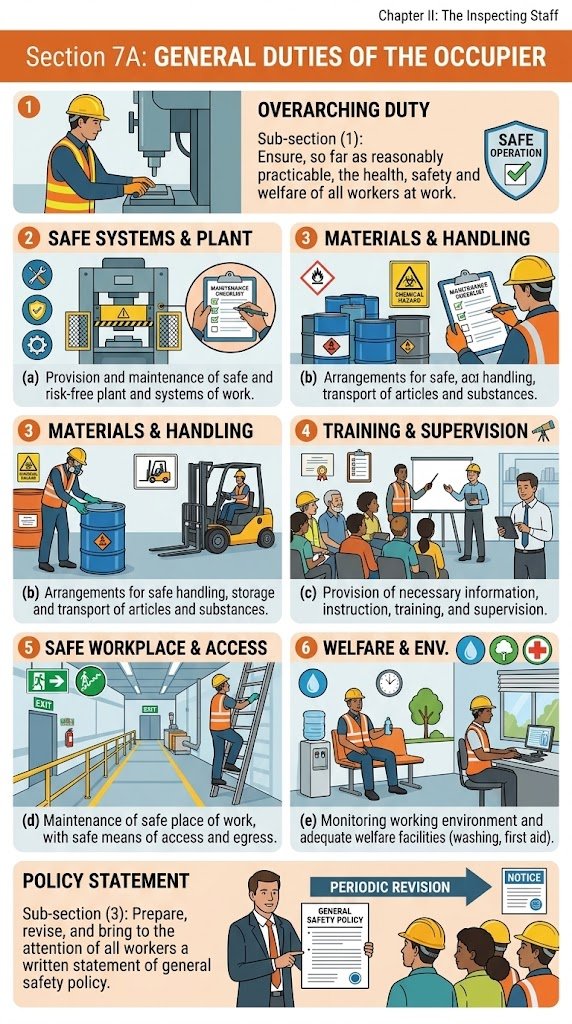
A Comprehensive Analysis of Section 7A: General Duties of the Occupier
Section 7A of the Factories Act (under Chapter II: The Inspecting Staff) outlines the statutory responsibilities and duties imposed upon the occupier of a factory. The primary goal of this legal provision is to ensure that factory environments prioritize the health, safety, and welfare of workers.
Below is an in-depth breakdown of the provisions, clauses, statutory implications, and practical implementation frameworks related to Section 7A.
1. Primary Mandate: Universal Duty of Care
Section 7A(1) establishes the overarching legal mandate:
“Every occupier shall ensure, so far as is reasonably practicable, the health, safety and welfare of all workers while they are at work in the factory.”
- Occupier Definition & Liability: The “occupier” refers to the person or entity with ultimate control over the affairs of the factory. The legal duty of care rests directly on them.
- The “Reasonably Practicable” Standard: The obligation is qualified by what is “reasonably practicable”. In legal terms, this requires a balanced risk assessment where the risk to safety or health must be weighed against the effort, time, and monetary cost required to eliminate or mitigate that risk.
2. Specific Scope of Duties: Section 7A(2)
Without limiting the general obligation set out in sub-section (1), sub-section (2) enumerates five mandatory operational areas where the occupier must maintain safe practices:
(a) Safe Plant and Systems of Work
- Statutory Requirement: Provision and maintenance of plant and systems of work in the factory that are safe and without risks to health.
- Operational Application:
- Regular engineering audits, preventative maintenance, and structural safety inspections of all machinery and plant equipment.
- Standard Operating Procedures (SOPs) designed to reduce operational fatigue, physical strain, and hazard exposure.
(b) Safe Use, Handling, Storage, and Transport of Articles and Substances
- Statutory Requirement: Arrangements in the factory for ensuring safety and absence of risks to health in connection with the use, handling, storage, and transport of articles and substances.
- Operational Application:
- Comprehensive hazardous materials management, including proper labeling, Material Safety Data Sheets (MSDS), and safe storage containment (e.g., bunded containment for chemicals).
- Implementation of safe mechanical handling equipment (forklifts, cranes, conveyors) and guidelines for manual handling.
(c) Information, Instruction, Training, and Supervision
- Statutory Requirement: Provision of such information, instruction, training, and supervision as are necessary to ensure the health and safety of all workers at work.
- Operational Application:
- Mandatory safety inductions for all new employees, contract staff, and temporary workers.
- Specialized training programs for high-risk operations (e.g., confined space entry, working at heights, lock-out/tag-out procedures).
- Active workplace supervision to ensure safety compliance and mitigate unsafe behaviors.
(d) Safe Places of Work and Access/Egress
- Statutory Requirement: Maintenance of all places of work in the factory in a condition that is safe and without risks to health, alongside safe means of access to and egress from such places.
- Operational Application:
- Keeping walkways clear of obstructions, trip hazards, and oil/liquid spills.
- Ensuring adequate emergency exits, clear escape routes, fire doors, and proper emergency lighting.
(e) Safe Working Environment and Adequate Welfare Facilities
- Statutory Requirement: Provision, maintenance, or monitoring of such working environment in the factory for the workers that is safe, without risks to health, and adequate as regards facilities and arrangements for their welfare at work.
- Operational Application:
- Environmental controls: Adequate ventilation, temperature control, dust and fume extraction, and noise mitigation.
- Welfare arrangements: Clean drinking water, suitable washrooms, changing areas, rest rooms, and lunchrooms.
3. Health and Safety Policy Statement: Section 7A(3)
Section 7A(3) mandates formal documentation and communication regarding health and safety policies:
- Written Safety Policy: Every occupier must formulate a written statement setting out their general policy regarding the health and safety of workers at work, along with the organizational structure and arrangements in place to execute that policy.
- Periodic Revision: The policy must be regularly reviewed, updated, and revised whenever operational changes, process modifications, or new hazards emerge.
- Worker Communication: The occupier must explicitly bring the safety policy and any subsequent revisions to the attention of all workers in a clear and understandable manner (e.g., translated into regional languages, displayed on notice boards, or distributed during onboarding).
4. Summary of Key Obligations
| Clause | Primary Area | Core Legal Requirement |
|---|---|---|
| Section 7A(1) | General Duty | Ensure health, safety, and welfare of workers so far as reasonably practicable. |
| Section 7A(2)(a) | Machinery & Systems | Maintain safe machinery, plant equipment, and work procedures. |
| Section 7A(2)(b) | Material Handling | Safe handling, storage, and transport of chemical and physical substances. |
| Section 7A(2)(c) | Education & Oversight | Provide comprehensive information, instruction, ongoing training, and supervision. |
| Section 7A(2)(d) | Workplace Access | Ensure safe access, egress, walkways, and emergency exits throughout the site. |
| Section 7A(2)(e) | Environment & Welfare | Maintain safe working environment and proper welfare/sanitation facilities. |
| Section 7A(3) | Safety Policy | Prepare, revise, and communicate a written corporate health and safety policy. |
5. Strategic Implementation Framework
To fully align with Section 7A, factory management should maintain an integrated occupational health and safety system:
- Hazard Identification & Risk Assessment (HIRA): Systematically evaluate risks before introducing new processes or equipment.
- Incident Reporting & Root Cause Analysis: Log all near-misses and workplace injuries to implement corrective and preventative actions (CAPA).
- Safety Audits & Inspections: Conduct periodic statutory safety audits to identify non-compliance and maintain structural and machine standards.
- Safety Committees: Form joint worker-management safety committees to encourage active participation and improve overall safety culture.
