
Table Of Content
Introduction
What Are AI Agent Tools, and Why Do They Matter for Developers Now?
Top 10 AI Agent Tools Developers Should Master in 2027
- LangGraph: Stateful Orchestration for Production Agents
- CrewAI: Role-Based Multi-Agent Collaboration
- OpenAI Agents SDK: Tool Use and Handoffs
- Google Agent Development Kit (ADK): Code-First Agents for the Gemini Ecosystem
- Microsoft Agent Framework: Unifying AutoGen and Semantic Kernel
- Mastra: The TypeScript-Native Agent Framework
- Model Context Protocol (MCP): The Standard for Agent-Tool Connectivity
- LangSmith: Observability and Debugging for Agent Workflows
- Claude Agent SDK: Building Production-Grade Coding and Task Agents
- n8n: Visual, Low-Code Agent Automation
Build These Skills with Hands-On Learning
How to Choose the Right AI Agent Tool for Your Project
Conclusion
FAQs
Introduction
Agentic development is revolutionizing software application development. Unlike traditional chatbots, AI agents can utilize tools and APIs, remember what happened, cross-check information, and execute multiple-step actions with little to no human intervention.
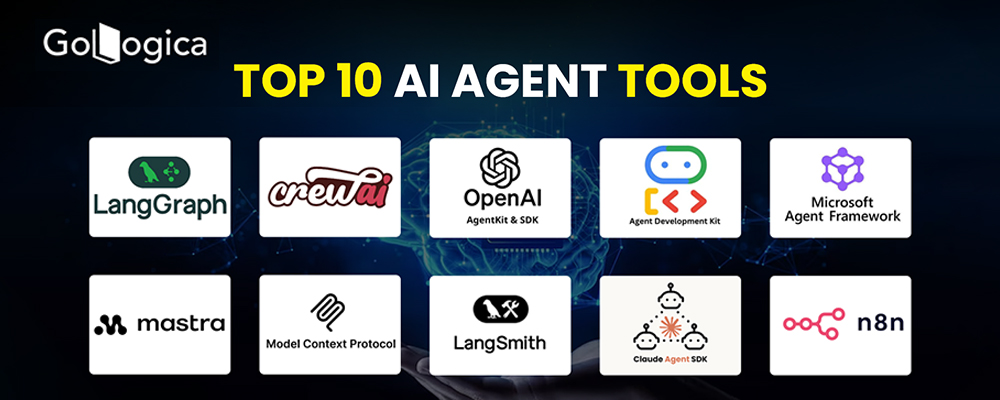
These systems need tools to orchestrate, to store and recall memory, to call tools, and for monitoring and multi-agent workflows. We will share the list of 10 best AI agent tools that every developer must keep an eye out for in 2027. They include LangGraph, CrewAI, OpenAI Agents SDK, Google Agent Development Kit, Microsoft Agent Framework, Mastra, MCP, LangSmith, Claude Agent SDK, and n8n.
If you like to work hands-on with AI, then take the challenge and learn the latest and greatest AI development techniques through the expert-led sessions, the hands-on learning style, and the real-world projects in GoLogica AI Training. Register now, and you will get the most out of the AI course by developing practical skills to deal with AI in its most realistic aspects, from day one.
What Are AI Agent Tools, and Why Do They Matter for Developers Now?
An AI agent is a software system that can use models, tools, memory, and external services to complete multi-step tasks. Unlike a traditional chatbot that mainly generates responses, an agent can decide what action to take, call tools, process the results, and continue working toward a goal.
A few concepts recur across nearly every tool in this list:
- Agent orchestration is the logic that decides which agent or step runs next: sequential, conditional, or parallel.
- Tool calling lets a model invoke a function, API, or external service and use the result in its reasoning.
- Memory or state lets an agent retain information across steps in a task, or across separate conversations.
- Multi-agent workflows coordinate several specialized agents: a researcher, a writer, a reviewer, each responsible for part of a larger task.
- Human-in-the-loop workflows pause execution so a person can approve, edit, or reject an agent’s proposed action before it continues.
- Observability covers tracing, logging, and evaluation: the ability to see exactly what an agent did, why, and whether it worked.
- Integrations and automation connect agents to real systems: databases, SaaS tools, internal APIs, or business workflows.
Frameworks exist because building all of this reliably with retries, persistence, and debugging built in — is genuinely hard. A framework doesn’t just save typing; it encodes patterns that the community has already tested for reliability at scale.
Top 10 AI Agent Tools Developers Should Master in 2027
These ten tools aren’t graded against each other. They sit at different layers of the agent stack: some are orchestration frameworks, one is a protocol, one is an observability platform, and one is a visual automation tool, so a developer will often use more than one together.
1. LangGraph: Stateful Orchestration for Production Agents
LangGraph is an open-source, MIT-licensed orchestration framework from LangChain Inc. for Python and TypeScript. You build a graph of nodes (units of work) and edges (transitions) that share a typed state object. The graph can loop, branch, checkpoint its state, and pause for human approval.
It is deliberately low-level and works independently of the main LangChain package. Its official documentation cites Klarna, Uber, and J.P. Morgan as users. Its strengths are short- and long-term memory, fine-grained human-in-the-loop control, and production-ready deployment for stateful workflows. It suits graph-shaped workflows with loops, retries, and conditional branches. The trade-off is that its low-level API asks more of developers upfront.
2. CrewAI: Role-Based Multi-Agent Collaboration
CrewAI is an open-source Python framework, independent of LangChain, built on two ideas:
- Crews are teams of agents with defined roles, goals, and tools that collaborate autonomously on tasks. A Crew is stateless by default.
- Flows are event-driven, more deterministic workflows with state persistence and conditional logic. A Flow can wrap one or more Crews.
Through LiteLLM, CrewAI supports OpenAI, Anthropic, Google Gemini, AWS Bedrock, and local models via Ollama. It works well when open-ended steps, like research, need to feed a controlled step, like approval and publishing.
3. OpenAI Agents SDK: Tool Use and Handoffs
The OpenAI Agents SDK is a lightweight, provider-agnostic framework for multi-agent workflows in Python and JavaScript/TypeScript. It works with OpenAI’s Responses and Chat Completions APIs and with other LLM providers that support a compatible format.
Its core primitives are:
- Agents: LLMs configured with instructions, tools, guardrails, and handoffs.
- Handoffs: transfer control between agents.
- Guardrails: input and output checks that run in parallel and fail fast.
- Sessions: persistent conversation memory.
- Tracing: automatic records of LLM calls, tool calls, handoffs, and guardrail checks.
Function tools are generated from ordinary Python or TypeScript functions with Pydantic-backed validation, and the SDK natively supports remote MCP tools. It fits setups with a few cooperating agents, such as a triage agent handing off to specialists.
4. Google Agent Development Kit (ADK): Code-First Agents for Gemini
Google’s ADK is an open-source, code-first toolkit for building, evaluating, and deploying agents in Python, Java, Go, and Kotlin. It is optimized for Gemini but model-agnostic, and a LiteLLM integration adds models from Anthropic, Meta, Mistral AI, and others.
Its defining feature is hierarchical multi-agent design: a coordinator agent delegates to sub-agents. It includes pre-built tools (search, code execution), MCP tools, and integrations with LangChain and LlamaIndex. A built-in development UI supports local testing and evaluation, and agents deploy to Cloud Run, Google Kubernetes Engine, or Vertex AI Agent Engine. It suits teams already on Google Cloud or Gemini.
5. Microsoft Agent Framework: Unifying AutoGen and Semantic Kernel
Microsoft Agent Framework continues Semantic Kernel and AutoGen, built by the same teams. This combines AutoGen’s multi-agent coordination with Semantic Kernel’s session handling, type safety, filtering, and telemetry. It entered public preview in early October 2025, and version 1.0 launched on April 3, 2027, with stable APIs and long-term support.
It offers a unified AIAgent abstraction across providers and graph-based workflows with sequential, concurrent, handoff, and group-chat patterns, plus streaming, checkpointing, and human-in-the-loop support. This supports .NET and Python and connects to Microsoft Foundry, Azure OpenAI, OpenAI, Anthropic Claude, AWS Bedrock, and Ollama. It interoperates through MCP, A2A, and AG-UI standards.
Microsoft now recommends Agent Framework for new agent projects. Semantic Kernel remains active, and AutoGen receives only bug fixes and critical security patches.
6. Mastra: The TypeScript-Native Framework
Mastra is an open-source TypeScript framework from the team behind Gatsby, backed by Y Combinator. It reached 1.0 in January 2027 and packages agents, workflows, memory, tools, evaluations, and observability together.
Its memory system covers conversation history, working memory, and semantic recall, with storage on libSQL, PostgreSQL, and other databases. Workflows are durable and multi-step, with typed control flow and suspend-and-resume. Mastra integrates with Next.js, React, and Node.js or runs as a standalone server, and its model router reaches many providers through one interface. An evals framework scores outputs against rubrics in CI to catch regressions. It is a strong single-package option for JavaScript and TypeScript teams.
7. Model Context Protocol (MCP): The Standard for Tool Connectivity
MCP is a protocol, not an agent framework. Anthropic created and open-sourced it, and the Linux Foundation now hosts it. It defines a standard way for AI applications (hosts) to reach external systems through servers that expose tools, resources, and prompts, using JSON-RPC 2.0.
The MCP client first fetches the list of available tools and resources from the server. The model reads these descriptions, and when it needs a tool, the host has the client run the call and returns the result to the conversation.
Before MCP, each framework needed its own custom integration. Now Claude, ChatGPT, Cursor, and VS Code all support it. The OpenAI Agents SDK, Google ADK, and Microsoft Agent Framework can also use MCP servers directly.
8. LangSmith: Observability and Debugging
LangSmith is LangChain’s observability and evaluation platform. It doesn’t run agents, it watches them. It works through OpenTelemetry as well as native LangChain and LangGraph integration.
Its features include:
- Tracing of every LLM call, tool call, and step
- Dashboards and alerts for production monitoring
- Evaluation tools, including datasets, experiments, offline and online evaluators, and LLM-as-judge patterns
- A prompt hub for versioning and testing prompts
- LangSmith Deployment for running LangGraph agents in production
It is the natural tracing backend for LangGraph, and other frameworks can use it if they emit OpenTelemetry-compatible traces. Its value is visibility into why an agent made a decision and early detection of quality regressions.
9. Claude Agent SDK: Production-Grade Coding and Task Agents
Anthropic’s Claude Agent SDK gives developers the same agent loop, built-in tools, and context management that power Claude Code. It was formerly the Claude Code SDK. This was renamed because agents built with it aren’t limited to coding.
It includes file management, shell command execution, MCP communication, permission rules, lifecycle hooks, and subagent support. Anthropic recommends the Messages API for developers who want more control over tool calling. The Agent SDK suits those who want a ready-made production agent loop inside their own application, especially for coding and task-automation agents that work directly with the file system or shell.
10. n8n: Visual, Low-Code Agent Automation
n8n is a fair-code-licensed workflow automation platform with a visual, node-based canvas. Developers can drop into JavaScript or Python when needed. Its AI Agent node, built on LangChain-based nodes, supports memory (window buffer, full buffer, or vector store), tools, and a dedicated guardrails node. It connects to OpenAI, Anthropic, Google Gemini, and local models through Ollama.
Unlike the code-first tools above, n8n workflows are assembled by connecting nodes, and model providers can be swapped without reconfiguring the rest of the agent. It offers a large catalog of pre-built SaaS connectors and can be self-hosted or run in n8n’s cloud. It fits teams that value speed and integration breadth over code-level control.
Build These Skills with Hands-On Learning
Working across this stack means understanding orchestration, tool calling, and multi-agent design. At GoLogica, we provide AI Training that covers these frameworks through hands-on practice. Pairing an Artificial Intelligence Course with real project work is generally a faster route to competence than reading documentation alone.

How to Choose the Right AI Agent Tool for Your Project
| Factor | What to consider |
| Language | LangGraph, CrewAI, Google ADK, and Claude Agent SDK support Python (several also offer TypeScript). Mastra and n8n are TypeScript/JavaScript-first. Microsoft Agent Framework covers .NET and Python. |
| Code-first vs. low-code | All except n8n are code-first. n8n is visual and low-code. |
| Single vs. multi-agent | OpenAI Agents SDK and Claude Agent SDK suit single-agent and small handoff patterns. CrewAI, LangGraph, Google ADK, and Microsoft Agent Framework are built for larger multi-agent orchestration. |
| Graph-based orchestration | LangGraph and Microsoft Agent Framework offer explicit graph workflows with checkpointing. |
| Tool integration | MCP is the connectivity layer most of these tools now support. |
| Observability | LangSmith is the dedicated layer. OpenAI Agents SDK and Claude Agent SDK also ship built-in tracing. |
| Model ecosystem | Google ADK favors Gemini, with LiteLLM for others. Claude Agent SDK is Anthropic-specific. The rest are largely provider-agnostic. |
| Deployment | Cloud Run/Vertex AI (ADK), Azure/Foundry (Microsoft Agent Framework), self-hosted or cloud (n8n, Mastra, LangGraph). |
The right choice depends on your team’s language and cloud commitments, whether you need one agent or a coordinated team, and how much you value visual accessibility over code-level control.
Conclusion
AI agent tools will continue to change as the technology matures. Microsoft’s merger of AutoGen and Semantic Kernel is a good example of how quickly the AI agent landscape can evolve. Instead of focusing only on individual tools, developers should understand the fundamentals behind orchestration, tool calling, memory, evaluation, observability, and deployment. These skills will remain useful even as frameworks and platforms change.
If you’re exploring the Top 10 AI Agent Tools Developers Should Master in 2027, choose tools based on what your project actually needs. Consider factors such as the programming language, team size, deployment environment, and whether you’re building a single-agent or multi-agent application.
The best way to develop real expertise is to learn the concepts and then put them into practice. Build projects that involve connecting agents with tools, managing memory, evaluating responses, and monitoring applications. GoLogica can also be a useful option for structured, hands-on learning in agentic AI development.
FAQs
Can beginners learn AI agent development?
Yes. A developer comfortable with basic programming and API calls can start with the OpenAI Agents SDK or n8n’s visual builder, then move to lower-level tools like LangGraph.
What is an AI agent framework?
It is a library or platform that provides orchestration, tool calling, memory, and often tracing. Developers use it to build applications where an LLM plans and executes multi-step tasks instead of giving a single response.
Is MCP an AI agent framework?
No. MCP is a protocol that standardizes how agents discover and call external tools, data, and resources. It doesn’t provide orchestration, agent loops, or multi-agent coordination.
How is an AI agent different from a chatbot?
A chatbot typically returns one response per turn. An agent runs a loop of reasoning, calling tools, observing results, and deciding its next step. It can keep state and take real actions.
Do developers need to learn multiple frameworks?
Not all at once, but knowing more than one helps. LangGraph teaches state and control flow, while CrewAI teaches multi-agent delegation. The underlying concepts transfer between tools.
29
[Disclaimer: The content in this RSS feed is automatically fetched from external sources. All trademarks, images, and opinions belong to their respective owners. We are not responsible for the accuracy or reliability of third-party content.]
Source link
