
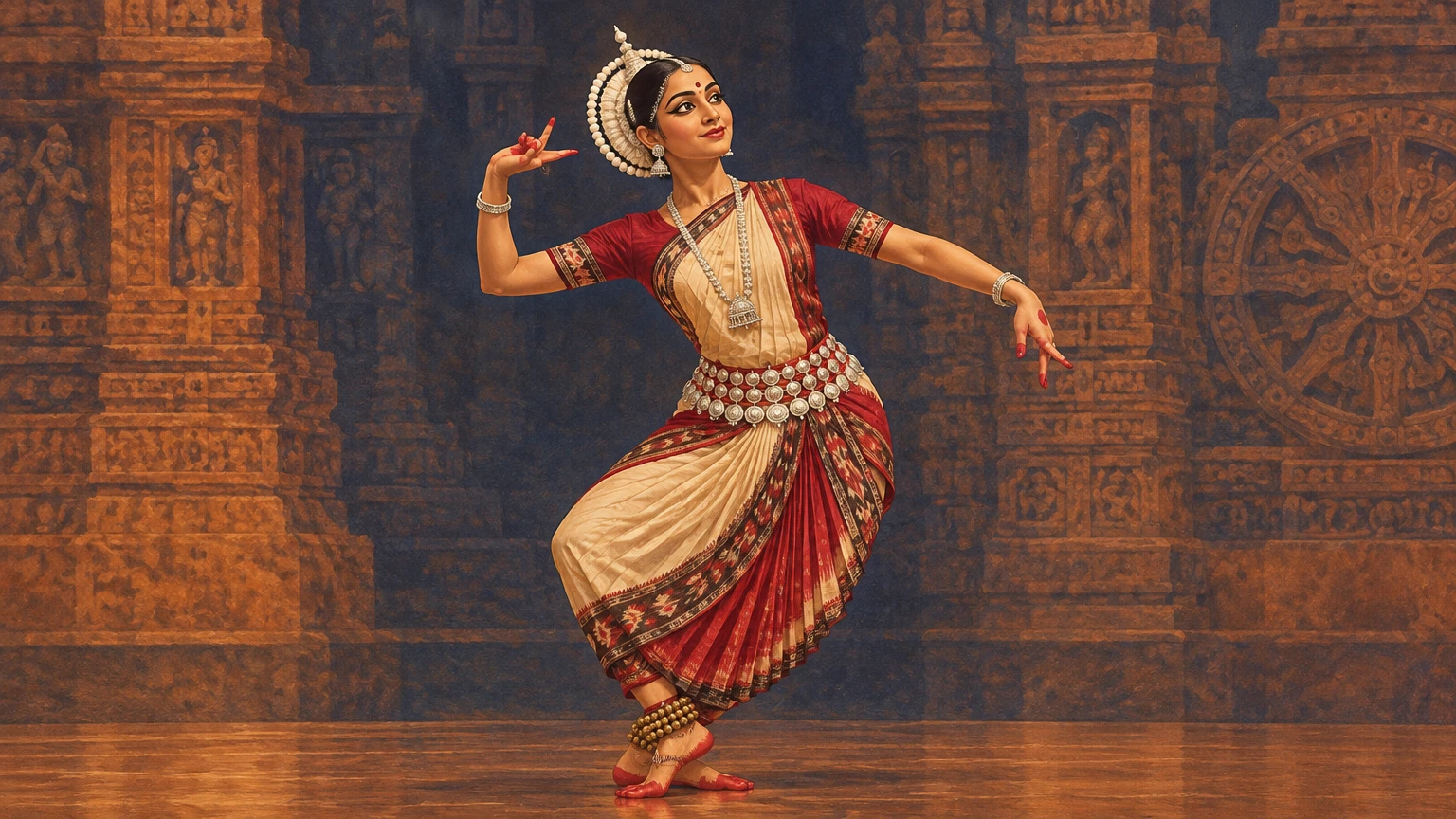
Odissi is often introduced through a striking image: a dancer bends into tribhanga, the body shaped by three curves, while the hands narrate and the feet answer a complex rhythmic phrase. The form is associated with Odisha and is recognised nationally as one of India’s classical dances. But its history is not a simple line running unchanged from an ancient temple carving to a contemporary stage. A more useful account follows several strands—ritual service, regional performance, sculpture, theatre, scholarship, institutions and the choices of artists—meeting and sometimes disagreeing as Odissi took its modern shape.
That distinction matters. Odisha has a deep history of dance, music and temple arts; Odissi draws on artistic and performance traditions that predate its mid-twentieth-century codification. Yet the name “Odissi,” its present stage grammar and its widely taught repertoire emerged through modern work. The tradition is neither an invention without roots nor an unchanged survival untouched by history. It is a living classical form whose practitioners have continually interpreted inherited materials, created new choreography and debated what should count as authentic.
A form with a layered history
Sangeet Natak Akademi, India’s national academy for music, dance and drama, lists Odissi in its national inventory of intangible cultural heritage as “A Classical Indian Dance That Originated In Odisha.” That official description establishes a useful broad identification, but an inventory entry is not a full history. It should not be stretched into a claim that every movement in today’s repertoire has existed in exactly the same form for millennia, or that inclusion in a national inventory is the same as inscription on UNESCO’s Representative List.
The historian’s task is to ask what each kind of evidence can and cannot show. A carved figure can demonstrate that a posture or performance scene was represented in stone; it cannot by itself establish the name, teaching sequence or uninterrupted transmission of a dance style. A text may describe a theory of performance without documenting exactly how a particular community danced. A living ritual or performance tradition can preserve knowledge, but its present form may also reflect centuries of change. Odissi’s history becomes clearer when those sources are put beside one another without asking any one of them to prove too much.
Sahapedia’s historical account, written by Odissi dancer Supriya Nayak and updated in October 2026, treats the dance as a formation drawing on multiple pre-modern traditions as well as post-Independence artistic work. That framing makes room for both continuity and innovation. It also helps explain why dancers, gurus and scholars can value the same past while telling different stories about which parts should shape the dance today.
The region around the dance
The geographic centre of many accounts of Odissi lies among Puri, Bhubaneswar, Cuttack and Konark in coastal Odisha. These places connect temple worship, courtly and civic life, theatre, education and public performance. But the story is not confined to those towns. Performance traditions and musical practices from elsewhere in Odisha also informed the evolving dance, and individual gurus carried distinctive regional experiences into their work.
Odisha’s religious history was diverse. The temples and monuments of the region reflect changing and coexisting traditions, including Jainism, Buddhism, Shaivism, Vaishnavism, Shakti worship and devotional movements. Temple architecture often provided spaces for ritual, gathering and performance; some larger complexes included halls associated with dance and public assembly. Sculptural programmes show dancers and musicians among many other figures. Such evidence establishes that dance was a significant part of the region’s artistic world, not that a single modern choreography can simply be read off a wall.
This distinction also protects the history from becoming a story of one site or one patron alone. Puri’s Jagannath tradition is important to Odissi’s cultural imagination, while Bhubaneswar and Konark supply significant architectural references. Cuttack became a crucial centre for modern training and organisation. The different places contribute different kinds of evidence and memory. The dance’s regional identity was made through their connections, not by treating one monument as a complete origin story.
What the ancient evidence shows
Udayagiri and Khandagiri, near Bhubaneswar, include Jain cave complexes dating to around the second century BCE. Their reliefs include scenes of dancers and musicians. One celebrated panel in Rani Gumpha depicts figures gathered in a performance-like setting. The Hathigumpha inscription has also been discussed in relation to a performance involving tandava and abhinaya associated with King Kharavela. These materials are important evidence for the long presence of performance in the region.
They do not, however, tell us that a modern Odissi recital was being performed in the caves. The figures are carved images, not a complete movement notation; the inscription’s wording and its relationship to current dance practice require careful interpretation. Sahapedia notes a conspicuous gap in the surviving archaeological evidence between these early materials and the renewed record of temple building from the sixth century CE. A gap in the record does not mean that no dance happened during those centuries. It means that the available evidence cannot securely trace every link in a continuous chain.
Later temples in Bhubaneswar, Puri and Konark provide further visual evidence of dance, music and performance in sacred and public life. A sculpture may preserve a posture, a rhythmic stance or an image of a musician; it can inspire a dancer’s body and imagination. But the sculpture’s original ritual context, the identities of the people depicted and the precise relationship between the image and a present-day technique may remain uncertain. Responsible interpretation allows the carvings to matter without turning them into a photographic record of today’s stage form.
Mahari traditions and the temple
The mahari tradition is a central strand in accounts of Odissi’s history. The term refers specifically to female ritual specialists associated with Odisha’s temples and is often compared with the wider Indian term devadasi. In Puri, women’s singing and dancing formed part of temple service, and the tradition became closely linked in later accounts to the Jagannath temple. Maharis were trained in music and dance and undertook different forms of service within temple ritual and at festivals.
The history should not be romanticised as a timeless world of uncomplicated devotion. The institution was shaped by religious authority, gender, caste, patronage and changing political arrangements. Women could be supported through temple systems, but their social position and control over their lives were also constrained by the expectations and power relations of their time. Scholarship cited by Sahapedia describes both the ritual importance of mahari service and the difficult social conditions that affected mahari women. The fact that a tradition contributed to a dance’s history does not erase the people’s lived realities.
In the mid-twentieth century, as artists and scholars debated how to present Odissi on the public stage, mahari practitioners themselves were not equally included in the meetings that shaped the new dance’s codification. Sahapedia notes that male gurus and scholars largely dominated those discussions and that mahari efforts to establish training for girls faced institutional barriers. This exclusion is part of the modern history, not an incidental footnote. It asks present-day audiences to consider who was able to define the classical form and whose knowledge was treated as heritage while the living bearers had less access to recognition and resources.
Gotipua: performance beyond the temple
Gotipua is another important tradition in Odissi’s development. The name is often translated as “one boy.” Gotipua performers were young boys who trained in singing, dance and acrobatics, sometimes in akhadas or other organised settings. They performed publicly outside the temple as well as in other community contexts. In performance, boys could dress in feminine costume and express devotional love for Krishna through sakhi-bhav, the attitude of a companion or friend. Some presentations include bandha nritya, acrobatic poses and group formations that display flexibility and balance.
The origins of Gotipua are described cautiously in scholarship: the tradition is believed to have taken shape in the sixteenth century under the influence of the Vaishnava saint Chaitanya, but that formulation is not the same as a fully documented date of origin. Families, local patrons, devotional communities and teaching lineages contributed to its life. The form is more than a storehouse of steps; it has its own performance settings, training demands and aesthetic aims.
Several twentieth-century male gurus had experience in Gotipua training, and Sahapedia traces elements of the modern Odissi physical vocabulary to that background. The square chowk stance and the curved tribhanga stance are among the best-known examples. The modern technique also developed through study of temple sculptures and other sources. These influences were adapted, selected and codified, not copied mechanically. Recognising Gotipua’s role does not mean collapsing the two forms into one: they remain distinct traditions, with different performance conventions and histories.
Theatre and public stages
Modern Odissi did not emerge only inside temples or academic seminars. Odia theatre companies in the first half of the twentieth century offered important spaces where performers, musicians, playwrights and cultural organisers met. Dance appeared between scenes or as an opening act. Gurus who later became central to Odissi’s stage history worked in theatrical environments, where they encountered multiple performance styles and audiences.
Sahapedia documents a 1946 stage presentation of a dance choreographed by Pankaj Charan Das in a mahari style, with Laxmipriya performing and Kelucharan Mohapatra accompanying on percussion, for the opening of a play. The account connects this event to a broader theatre movement rather than portraying it as a single moment that created Odissi. Theatre offered new opportunities to arrange movement for a proscenium stage, to tell stories in a different sequence and to reach audiences beyond temple ritual.
The theatre environment also brought contact with forms from outside Odisha. The artists and cultural organisers who worked there were part of a period when Odia linguistic identity and regional cultural expression were increasingly asserted in public life. Such circumstances did not simply dictate choreography, but they shaped the institutions and audiences through which a dance might be recognised as a regional and national art. The later stage form therefore grew from a conversation among community traditions, theatre practice, emerging scholarship and the politics of cultural representation.
The making of a modern classical form
When India became independent, four dance forms were already widely accepted under the national category of “classical”: Bharatanatyam, Kathak, Kathakali and Manipuri. The category brought different regional histories under a shared institutional label. It did not mean that those forms were identical or had developed through the same path. In the decades after Independence, other forms, including Odissi, were recognised as classical through performance, scholarship, teaching and institutional advocacy.
The name Odissi itself came into use in the late 1950s, as the stage form was taking shape. This does not mean that the underlying regional traditions began then. It means that the modern name and the public category of a distinct classical dance were comparatively recent. Keeping the difference between older traditions and modern codification in view prevents two opposite mistakes: treating Odissi as a sudden invention without ancestry, or claiming an unchanged form extending without interruption from antiquity.
In 1952, Kala Vikash Kendra was established in Cuttack as a centre for the research, development and teaching of Odissi. The Sangeet Natak Akademi, established in 1953, provided a national institutional context for the dance’s recognition. A 1954 performance by Priyambada Mohanty and Dhirendranath Patnaik at an inter-university youth festival in Delhi helped audiences outside Odisha encounter the evolving form. These events mattered because a dance’s public identity depends not only on movement, but also on training institutions, performance opportunities, critical writing and people willing to teach it.
Jayantika and the work of codification
A group of gurus, writers, journalists and scholars began meeting in Cuttack in 1958 under the name Jayantika. Its first meeting is dated June 22, 1958. The participants sought to systematise movement vocabulary and repertoire and to strengthen Odissi’s claim to classical status. They drew on existing practices, artists’ knowledge and textual frameworks. The meetings continued over several years, with participants entering and leaving and differences arising about how the dance should be defined.
Codification can make a form teachable across classrooms and legible to audiences who are encountering it for the first time. It can provide shared names for movements, organised practice sequences and a repertoire that helps performers build a full recital. But codification is also a selection process. Some practices become central, others are reworked or left at the margins, and the authority to choose may not be evenly distributed. In Jayantika’s case, discussions over the spirit and vocabulary of Odissi included disagreements about how much emphasis to place on Sanskrit texts, regional Odia expression and the mahari inheritance.
The association is therefore best understood as an influential forum, not as a single body that invented a dance by decree. Its work helped create a broadly recognisable repertoire and pedagogy, but artists continued to develop distinct lineages. Pankaj Charan Das and Deba Prasad Das, for example, are associated with positions that differed from some of Jayantika’s directions. This plurality is not a flaw in the dance’s history. It shows how living traditions grow through debate as well as agreement.
What classical status does—and does not—mean
The word “classical” can sound as if it names an ancient, fixed and universally agreed category. In practice, it is also a modern institutional status, connected to systems of pedagogy, textual reference, performance circuits, public support and national cultural identity. Odissi’s recognition in the late 1950s reflected work by artists who researched history, refined technique, created performance material and carried the dance to wider stages. It was an achievement, but not a certificate proving that every feature of the modern form existed unchanged in antiquity.
The movement toward classical recognition took place alongside broader regional and national cultural projects. Odisha had become a separate province in 1936, and the public assertion of Odia language and cultural identity formed part of a wider political landscape. Presenting Odissi as a classical art gave the region a powerful national cultural presence. At the same time, the process also required the dance to be explained through terms and texts that could be understood within national frameworks for classical performance.
The resulting form holds multiple histories in tension: temple ritual and public theatre, regional vocabulary and pan-Indian theory, inherited movements and new choreography. That tension is visible in debates over Sanskritisation—the use of Sanskrit terminology and textual authority to frame a practice—and the value of Odia-specific concepts. Rather than declaring one side authentic and the other false, a careful account asks what each approach made possible, whose knowledge it foregrounded and which practices it left less visible.
Sculptural inspiration and the dancer’s body
Odissi’s visual identity is often associated with two stances: chowk, a grounded, square posture, and tribhanga, a three-bend line through the body. These forms are frequently compared to temple sculpture, and the comparison can be illuminating. Sculpture offers dancers and choreographers a vocabulary of curves, balance, torso articulation and ornamented stillness. It can help performers think about how movement occupies space and how a pose carries visual meaning.
But a stone figure is not a choreography. It does not reveal the rhythm that preceded the pose, the breath that sustains it, the transition into the next movement or the training that made it possible. The dancer animates the body through time; the sculpture fixes an instant. Reading the dance directly from the sculptural record would erase the interpretive labour of living artists and the many other influences that shaped their movement.
Sahapedia describes modern Odissi’s physical vocabulary as involving Gotipua-derived movements modified through codification, in conjunction with study of temple sculpture. That formulation is useful because it treats sculpture as one source among several. The interplay is especially evident in the torso: a controlled central axis, expressive upper-body movement and the distinctive curve of tribhanga create a sense of fluidity without abandoning balance. The viewer sees an image, but the dancer is coordinating weight, breath, gaze, footwork and rhythm in real time.
Music, text and expressive interpretation
Odissi performance combines movement with music and poetic interpretation. The form’s musical world is associated with Odissi music, while particular recitals may include compositions in Sanskrit and Odia. The Gita Govinda, the twelfth-century Sanskrit poem of Jayadeva about Krishna and Radha, has held an important place in devotional and performance traditions. Odia bhakti poetry from later centuries also informs abhinaya, the interpretive dimension in which gesture, facial expression and movement carry the meaning of a text.
The relation between text and dance is not a matter of illustrating each word with a fixed sign. A performer shapes a phrase through timing, mood, gesture, eye movement and repetition. The same poetic line can be explored from different emotional angles. This interpretive work asks for both technical discipline and artistic judgement; it is one reason a piece may change in nuance between performers or across performances by the same dancer.
The accompaniment is equally active. Percussion structures rhythmic cycles and can converse with the dancer’s footwork; melodic instruments and voice shape the atmosphere and clarify the musical phrasing. A solo performance may make these relationships particularly visible, while group choreography can arrange them differently. Descriptions of Odissi that focus only on costume or posture miss this interdependence. A complete performance is a relationship among dancer, musician, poem, rhythm, audience and the space in which the dance is presented.
A repertoire that gives shape to a recital
From the 1960s onward, a five-part repertoire associated with Jayantika became widely practised: mangalacharan, batu or sthai, pallavi, abhinaya and moksha. The sequence is a common framework, not a requirement that every performance include every item in the same length or order. Short programmes may omit pieces, and longer performances may include additional or expanded material.
Mangalacharan generally opens the recital. It may include the dancer’s entrance, an offering of flowers, a gesture of respect to the earth, an invocation and salutations to the deity, teacher and audience. Batu or sthai foregrounds pure dance and introduces aspects of the movement grammar through postures and rhythmic phrases. Pallavi develops melody and rhythm into more elaborate movement; the word evokes blossoming or expansion.
Abhinaya turns toward interpretation. The dancer carries a poem or devotional text through expressive movement, gesture and facial expression. A composition may draw on the Gita Govinda or Odia devotional poetry, among other sources. Moksha, often presented as a conclusion, builds through rhythmic patterns and a sense of acceleration toward release. The names offer a route into the structure, but they should not be mistaken for a rigid template that determines every recital.
The sequence makes a useful learning map for new audiences: entry and salutation, movement grammar, expansion, interpretation and rhythmic culmination. It also demonstrates that “classical” form is not only a set of poses. It is an organised relationship between abstract dance, musical development, text and dramatic expression.
Lineages, gurus and distinct styles
Odissi is often represented through the work of prominent gurus, but a history centered only on famous men would be incomplete. The modern form was shaped by teachers, performers, musicians, writers, students and institutions. Women dancers such as Priyambada Mohanty, Sanjukta Panigrahi and Minati Mishra helped bring Odissi to wider audiences and built careers in performance, film, teaching and scholarship. Their work illustrates how a dance becomes visible through both individual artistry and the networks that sustain it.
Kelucharan Mohapatra became one of the most widely known choreographers and teachers, with students across India and abroad. Pankaj Charan Das is remembered for his relationship to the mahari tradition and his role in stage development. Deba Prasad Das cultivated an approach with strong regional Odia features and influences beyond the coastal centre. Mayadhar Raut contributed to pedagogy and repertoire while drawing on his experience of other dance forms and textual study. These shorthand descriptions should not reduce any artist to one trait; each had a complex practice and body of work.
Different lineages shape the emphasis a dancer may place on torso movement, rhythm, expression, choreography or regional vocabulary. Students often learn within a guru-shishya relationship, but training also takes place in universities, academies, private institutions, workshops and dance companies. A lineage is not merely a label for a fixed style: it is a way knowledge is transmitted, interpreted and renewed. Watching more than one Odissi artist can reveal a shared grammar alongside distinctive choices.
Institutions, teaching and transmission
Institutions have provided spaces for training, research and performance. Kala Vikash Kendra opened in Cuttack in 1952. Utkal Sangeet Mahavidyalaya was established in 1964, and the Odissi Research Centre followed in 1986. Private schools and organisations led by individual gurus added further structures for learning and public presentation. These institutions differ in purpose, pedagogy and resources, but together they demonstrate that the survival of a dance depends on practical systems as well as admiration.
Transmission is not a simple handover of an unchanged object. A teacher chooses what to emphasise, a student develops embodied understanding through repetition, and choreography may adapt to a new stage, audience or ensemble. Notation and written description can preserve useful information, but they cannot fully capture balance, timing, energy or the quality of a movement. Direct practice, observation, correction and musical collaboration remain central to learning.
The question of transmission also includes who has access. Tuition, travel, instruments, performance opportunities and time for practice all shape who can become a dancer. Historical exclusions, such as the limited participation of mahari women in the mid-century codification process, remind us that preservation efforts should consider living practitioners and their communities, not only the artistic form. Safeguarding is meaningful when it supports the people who sustain knowledge and allows them agency in how it is represented.
Odissi in contemporary life
In the twenty-first century, Odissi circulates through festivals, dance schools, universities, cultural organisations, touring ensembles and digital media. Sahapedia’s account, updated in 2026, describes private and organisational networks as increasingly important alongside public patronage, and notes how social media can help dancers reach students and audiences across borders. These broad changes affect many performing arts, not only Odissi. They reshape how artists find support, share work and build communities.
Contemporary performers may present a traditional repertoire, create a theme-based production, collaborate with artists from other disciplines or teach through online formats. Such choices do not automatically make a work less Odissi. The relevant questions are more specific: what movement vocabulary is used, how does the choreography relate to the dancer’s training, what sources does it acknowledge, and how does it engage the form’s musical and interpretive practices? Innovation can be grounded in tradition without being a replica of an earlier performance.
Digital circulation creates opportunities as well as limits. A short clip can introduce a posture or a musical phrase to someone who has never seen a recital, but it can remove the work from its full duration, context and live relationship with musicians. An online audience may learn about the dance through a video, while embodied technique still calls for sustained instruction and feedback. The screen expands access; it does not replace every mode of learning or performance.
How to watch with curiosity
For a first encounter, it helps to notice a few relationships rather than trying to identify every mudra. Watch how the dancer moves between chowk and tribhanga, how the torso, head and eyes coordinate, and how a rhythmic phrase is answered by the feet. In an abhinaya passage, listen for a shift in mood or musical line and see how the dancer interprets it. In a pallavi, notice the way a phrase expands over time rather than expecting a literal story.
If the programme includes the five-part repertoire, the order can offer a broad orientation. But remain open to variation: one artist may present a shorter sequence, another may expand a particular item, and a choreographer may choose a different structure. The title of a piece, its language and its musical setting can help you follow its context. A programme note that names the guru, composer, text and lineage is useful, but it is not the only way to experience the performance.
A respectful audience also avoids treating the dancer as a museum object or the dance as a single frozen emblem of Odisha. Odissi carries devotion, virtuosity, regional memory, theatrical craft and modern artistic choice. The people who perform and teach it are not simply preserving the past; they are making decisions in the present. Seeing those decisions can deepen appreciation rather than diminish the tradition’s historical significance.
A history still open to interpretation
Odissi’s story is strongest when it resists both easy certainty and easy dismissal. The ancient carvings of Udayagiri, Khandagiri and later temples show a region with a substantial history of dance and music. Mahari and Gotipua traditions preserve different kinds of knowledge and performance practice. Odia theatre, institutions and artists in the twentieth century brought older and newer materials into a public stage form. Jayantika’s meetings helped codify a repertoire, while disagreements within and beyond the group remind us that no single account could contain the whole dance.
The national label “classical” offered Odissi visibility and institutional recognition. It also encouraged debates over textual authority, regional identity, gender and the proper relation between ritual and stage. Those debates are not solved once and for all by choosing one origin story. They remain part of how artists understand their craft and how audiences learn to see the form.
A better question than “How many centuries old is Odissi?” may be: which traditions, people and historical changes have contributed to the dance we encounter now? That question honours the depth of Odisha’s artistic past while acknowledging the modern work that shaped a distinctive classical form. It leaves room for evidence, argument and new research—and for the dancer on stage, whose living body makes the history present again without pretending that it has stood still.
Sources and scope
- Supriya Nayak, “A Brief History of Odissi Dance,” Sahapedia, updated 28 October 2026: https://www.sahapedia.org/brief-history-odissi-dance. Used for the layered account of archaeological, ritual, Gotipua, theatre, institutional and contemporary histories; the article notes debates and limits in tracing continuity.
- Sangeet Natak Akademi, Ministry of Culture, Government of India, “Intangible Cultural Heritage” inventory: https://www.sangeetnatak.gov.in/event-details/ICH. The page lists Odissi as a classical Indian dance originating in Odisha within a national inventory; this article does not treat that listing as UNESCO inscription.
This content is a collection of ancient history,books and various articles and collection of library and news and other post ; all details may not be the same. Readers are requested to verify the information themselves. Readers are not allowed to take any disciplinary action; content is only for educational purposes. If readers do not agree about the contents, they may send a personal comment to my personal email ID: achary.purna@gmail.com
