
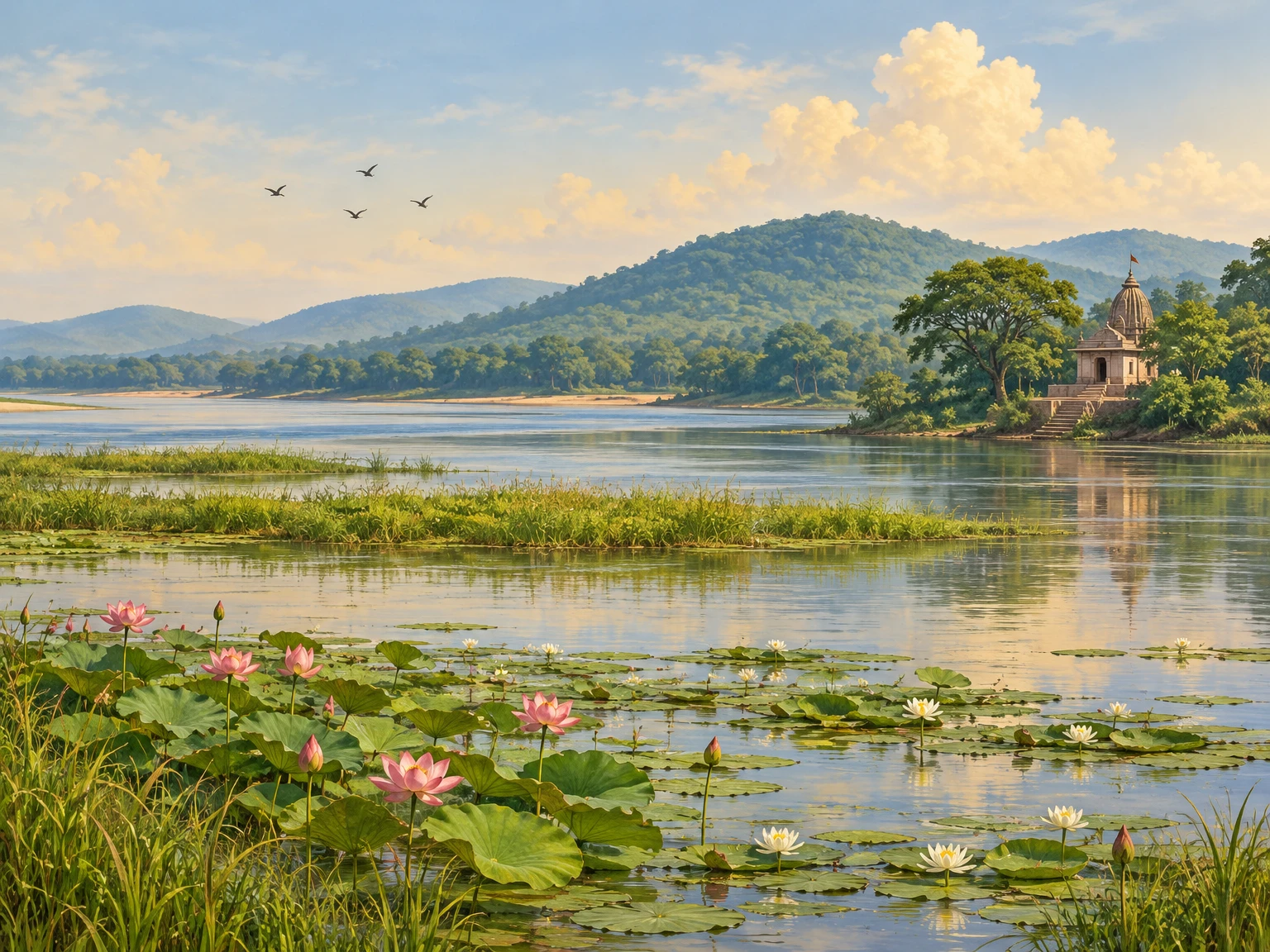
Cuttack is often approached as a city of bazaars, silverwork and crowded festival grounds. Look beyond the urban peninsula, however, and a larger district comes into view: Buddhist remains on a low hill, a freshwater lake in an old river course, and goddess shrines set among settlements along the Mahanadi.
These places are connected by water, but they do not tell a single story. Lalitgiri’s excavated monasteries speak through material evidence; Dhabaleswar’s name lives in a story devotees tell; Ansupa’s birds and aquatic plants belong to a wetland that still supports fishing and farming. A rewarding journey leaves room for each kind of knowledge.
District overview & geography
The Mahanadi is the organizing line of Cuttack district. It travels eastward from the hill country toward the delta, and near Naraj the Kathajodi branches away. Cuttack city occupies the land between the Mahanadi and Kathajodi; other channels, including the Birupa and Chitrotpala, belong to the wider deltaic network. Embankments, bridges and barrages are practical reminders that the river is both a resource and a force to be managed.
Geography changes across the district. The eastern lowlands are part of a cultivated alluvial landscape, while the western areas around Banki and Athagarh include hills and forested slopes.
The lakeside hills around Ansupa make that transition visible: the wetland lies close to the great river, but its setting is more enclosed than the open delta. The river’s seasonal behavior matters to both landscapes. Floodwater can replenish wetlands and fields, while heavy rain can also disrupt roads, farming and settlement.
Ansupa is an oxbow lake, formed from an old course of the Mahanadi. Its 2022 Ramsar information sheet source describes a historic connection to the river through the Kabula Nala, but also identifies the channel’s loss of function as a management concern. The sheet records fishing and agriculture among the livelihoods supported by the wetland. It is therefore not an ornamental pond on the edge of a city: changes in water, sediment and vegetation have consequences for the people who live around it. Cuttack has a hot summer, a rainy monsoon and a milder winter. Odisha Tourism suggests November to March source for a city visit; cooler months are also useful for walking archaeological sites and watching winter birds. Monsoon greenery can be beautiful, but rainfall, swollen channels and slippery approaches make flexibility essential. A seasonal recommendation is not a weather forecast or an assurance that a particular site is accessible. The district’s forests and wetlands should be understood as habitats rather than guaranteed wildlife-viewing venues. Around Ansupa, bamboo and mango grow near the nature camp, while water lilies and other aquatic plants have been documented in the lake. The Ramsar record lists Indian skimmer, black-bellied tern and river tern among species recorded there, as well as fish including Labeo bata and Wallago attu. These are records, not promises of a sighting; birds move, water levels change and some species are especially vulnerable to disturbance. Incredible India’s lake guide source and the Ramsar sheet provide useful starting points for understanding the setting.
Mythological & historical significance
Cuttack’s name is associated with kataka, a military camp or seat of government. Accounts differ over the city’s precise founding and the earliest history of Barabati Fort, so a single founding date should not be treated as settled fact. What is clear is the importance of the fortified city under the Eastern Ganga and Gajapati rulers, followed by Afghan, Mughal, Maratha and British phases of rule. Cuttack later served as the capital of the separate province of Odisha before the capital shifted to Bhubaneswar. The district history overview source sets out this sequence while noting the competing accounts of the fort’s origins. This history is not confined to a royal enclosure. The former princely areas of Athagarh, Tigiria, Badamba and Narasinghpur became part of the district after independence. Their names remain useful on a map because they identify different local landscapes and cultural centers, not simply stops on a road out of the city. Cuttack was also the birthplace of Subhas Chandra Bose; his family home is now a museum that connects the district to the history of India’s independence movement. The older Buddhist landscape reaches beyond the city. At Lalitgiri, archaeological work uncovered monasteries, a stupa, an apsidal prayer hall, sculptures and inscriptions. A terracotta sealing names a monastic community associated with Chandraditya Vihara. The evidence shows a place used and reworked over a long period, not a single monument created in one moment. The UNESCO tentative-list submission source, submitted on 22 December 2025, places Lalitgiri alongside Udayagiri and Ratnagiri in a linked Buddhist cultural landscape. Tentative-list status is not World Heritage inscription.
The relic caskets discovered at Lalitgiri are especially evocative. Stone, steatite, silver and gold containers were nested within the stupa. They are important evidence of Buddhist relic worship, but the boxes do not securely identify the individual whose remains were preserved. As Live History India source notes, attributing them definitively to the Buddha would go beyond what their inscriptions establish. Sacred stories elsewhere in the district work differently from archaeological evidence. Odisha Tourism recounts a Dhabaleswar tradition in which Shiva turns a black calf white to protect a repentant thief; the name is explained through dhabala, or white. The same temple account source associates its origins with the Somavanshi period and later renovation by Athagarh rulers. The story of the calf is a belief attached to the shrine, not a documented account of its construction. Nor should a traditional attribution settle the date of every part of the present temple. Bali Jatra offers another kind of historical memory. The fair recalls Odia merchants and sailors whose voyages connected the region with Southeast Asia. The associated Boita Bandana custom of floating miniature boats expresses that memory in ritual form. A modern fair is not a reconstruction of a medieval port: it is a living public event in which trade, craft, food and performance give older maritime associations a contemporary setting.
Tourist Destinations & Hidden Gems
Lalitgiri: Reading a Buddhist landscape
Lalitgiri, also written Lalitagiri or Naltigiri, is in the Mahanga area of Cuttack district. Its low hill and excavated remains reward a slower visit than a checklist circuit. Begin with the stupa, then look for the outlines of the monasteries and the unusual apsidal chaitya, or prayer hall. Together they suggest different aspects of Buddhist life: veneration, residence, gathering and teaching. The site museum adds another scale to the story. Sculpture and smaller finds help visitors imagine communities whose buildings survive only in part. Look for the difference between a monumental image intended to be seen and a sealing that once carried an institutional name. Neither tells the whole story alone; the historical value lies in their relationship to the excavated place. Odisha Tourism describes Lalitgiri as part of the Buddhist Diamond Triangle with Ratnagiri and Udayagiri. There is an important boundary here: Lalitgiri is in Cuttack, while Ratnagiri and Udayagiri are in neighboring Jajpur source. They can be combined in a wider journey, but should not be presented as three Cuttack-district attractions. The UNESCO submission describes evidence associated with several Buddhist traditions over a long span. Those labels are useful guides to changing religious art and practice, but a visitor need not force every sculpture into a simple sequence. The remains are fragmentary, and scholarly dates and interpretations can differ. Allow time for both the site and museum, check their current access separately, and avoid climbing or touching archaeological structures.
Ansupa: A working wetland
Ansupa’s appeal begins with its shape and setting. The Mahanadi left an old loop of water below the Saranda and neighboring hills; over time, aquatic vegetation, fish, birds and human uses made it a distinct wetland. A viewpoint can help reveal the relationship between the water and the surrounding slopes, but the lake is more than a panorama. The Ramsar information sheet records Indian skimmer, black-bellied tern and river tern, alongside fish such as Labeo bata. It also describes sedimentation, vegetation growth and the impaired river connection as pressures on the wetland. An Odisha Review account from January 2015 source identifies lotus and water lilies among its plants. Such records build a picture of habitat; they do not establish what will be visible on the day of a visit. The wetland’s ecological value and local livelihoods are inseparable. Fishing and farming are part of the landscape described in the Ramsar record, so visitors should not treat working shorelines as open recreation space. Use established visitor areas, take binoculars rather than approaching birds, and carry waste away. Do not enter the water or assume that a boat, trail or viewpoint is operating. Ask the responsible operator about current conditions and follow local and forest-authority directions.
Sources use different area figures for Ansupa: the 2022 Ramsar sheet gives a designated site area of 231 hectares, while Incredible India describes a lake area of about 141 hectares. They may refer to different boundaries or measurements; neither should be presented as an unquestioned current water spread. The discrepancy matters less to a visitor than the principle it illustrates: a wetland includes more than the water visible from a photograph.
Naraj: Where the delta begins to unfold
Naraj is a useful place to understand Cuttack before entering the busier city. Here the Mahanadi approaches the delta and the Kathajodi branches away. The resulting river system helps explain why the old city’s position was strategically valuable and why bridges, barrages and flood management remain important to everyday life. Come for the geography as much as the view. A broad channel in the dry season can look entirely different after heavy rain; the exposed ground of one season is not necessarily safe ground in another. Observe from a safe, permitted public position and keep away from barrage works, steep banks and active traffic. This is an opportunity to read a landscape, not an invitation to walk onto river structures or enter the water. Naraj can be paired with a city visit or with a road journey west, but it deserves its own pause. Looking upstream toward the hills and downstream toward the branching channels makes the district’s contrast between upland river and alluvial plain easier to understand.
Dhabaleswar: A shrine in the river
Dhabaleswar’s setting is inseparable from its worship: the Shiva shrine stands on an island in the Mahanadi near the Athagarh area. The river is not merely a backdrop to the temple but part of the experience of reaching and imagining the sacred place. Devotees know the shrine through its rituals and stories as well as its architecture. Odisha Tourism’s account links the shrine’s origins to the Somavanshi period and later work to Athagarh rulers, while presenting the white-calf story as legend. Those different layers should be kept distinct. The age of a sacred place, the date of surviving masonry and the time a story took its familiar form are not necessarily the same. Check current arrangements with the temple and local authorities before travel, especially after high water or heavy rain. Published descriptions of bridges or boats do not establish that either is open or safe on a particular day. Dress respectfully, ask before photographing worshippers and do not obstruct rituals. If the island approach is restricted, accept the restriction rather than seeking an unofficial crossing.
Banki and Badamba: Two goddess shrines
Across the western river landscape, Banki’s Charchika temple is a major Shakta pilgrimage place. Its image is identified with Chamunda; a district history overview dates the image to roughly the ninth or tenth century and describes the temple as later rebuilt. That distinction is important: an old image does not automatically date every wall of the building that houses it. For devotees, the shrine’s significance lies equally in continuing worship, not only in architectural chronology. Read the historical overview source. Farther into the Badamba area, Bhattarika is another goddess shrine associated with the Mahanadi. The district profile identifies it as a Shakti pitha; its riverside position makes the relationship between pilgrimage and the water especially apparent. Do not assume that a riverbank route, ghat or shrine approach is usable during floods. Ask locally about the current road and respect any closure. These are living temples, not museum exhibits. Visitors may encounter prayer, offerings and periods of crowding that matter more to worshippers than a traveler’s schedule. Follow posted instructions, seek permission for photographs and avoid treating ceremonies as performances staged for an audience. A road itinerary linking Banki and Badamba is best planned around present conditions rather than a fixed riverside crossing.
The city as a companion journey
The district’s rural sites make more sense when paired with Cuttack city. At Barabati, the moat, gateway and surviving mound evoke the fortified center associated with the Ganga dynasty, while leaving much to the historical imagination. The remains are not a complete palace. The Incredible India city guide source connects the fort with the city’s role as a military and administrative center. The Netaji Birth Place Museum offers a different perspective: a domestic setting through which to consider Subhas Chandra Bose’s life and the independence movement. The Odisha State Maritime Museum at Jobra provides a complement to Bali Jatra’s public memory of seafaring. Check both museums’ current visitor arrangements before making them the anchor of a day. In the markets, tarakasi, or silver filigree, is a living craft rather than a relic. Fine silver is worked into delicate patterns for ornaments and decorative objects; silver backdrops also give Cuttack’s Durga Puja a distinctive visual character. Ask a seller about the work and its maker rather than assuming every silver-colored object is locally made. Buying directly from an established artisan or workshop, where possible, makes the transaction more meaningful.
Recent news & tourism developments
Bali Jatra opens 24 November: The eight-day fair is scheduled to run from 24 November to 1 December 2026 on Cuttack’s upper and lower grounds. On 11 November, The Times of India source reported the district administration’s announcement that President Droupadi Murmu was scheduled to inaugurate it. On 23 November, The New Indian Express source reported that police had stepped up security and set out the traffic advisory: restrictions in and around Cuttack from 2 pm daily until crowds disperse, a heavy-vehicle ban in the city and on the Ring Road for the fair period, and shuttle buses from Chahata Square parking to Cantonment police station. These are reported plans, not confirmation that the grounds are fully ready or every route is open. Rain disrupted preparations: On 21 November, The New Indian Express source reported that rain associated with Cyclone Akvan had waterlogged both grounds and interrupted stall construction. The administration had set 23 November as a preparation deadline. That report does not establish that the grounds have since dried, that all work is complete, or that visitors have been cleared to enter. Check current district notices, weather advice and traffic directions before leaving. Drone restriction: Argus English reported on 20 November source a district order covering a five-kilometre radius around the upper and lower grounds from 22 November to 3 December. Travelers considering aerial photography should consult the current order and authorities rather than assume an exception.
Longer-term proposals: On 31 March 2026, OMMCOM News source reported a minister’s description of proposed projects under the Bhubaneswar–Cuttack–Puri–Paradeep economic-region plan. These included redevelopment of Barabati Fort and the Bali Jatra ground, a Swaraj Ashram–Netaji Museum corridor, and promotion of ecotourism at Ansupa. They were proposals in the report, not evidence of completed visitor facilities. Satkosia was also mentioned in the wider plan, but should not be treated as a Cuttack-specific attraction.
Traveler essentials
Getting there and planning the route
By air: Biju Patnaik International Airport in Bhubaneswar is the practical air gateway. Continue to Cuttack by road, allowing extra time when weather or city traffic warrants it. For Lalitgiri, Odisha Tourism identifies the same airport as the nearest air approach; check the onward road route for your actual starting point. By rail: Cuttack railway station is a useful arrival point for the city and onward road travel. Verify train availability and connections with the railway before booking. A station listed as nearest in a tourism guide does not necessarily provide a direct service from a traveler’s origin. By road: From Cuttack, plan separate journeys toward Naraj and the western Banki–Ansupa area, toward Dhabaleswar and Athagarh, or toward Lalitgiri in Mahanga. Bhattarika lies farther west in the Badamba area. Routes and travel times depend on the chosen bridge, traffic and weather; consult a current map and local road advice rather than assuming a ferry or shortcut is available. For Ratnagiri or Udayagiri, plan a cross-district continuation into Jajpur.
A practical first visit might use one day for the city’s fort area, a museum and the markets; another for Lalitgiri; and a further day for the western wetland and shrine landscape. This is a framework, not a promise that every site will be open. Avoid squeezing Lalitgiri, Ansupa and a major festival visit into one long day: they lie in different directions and each rewards time on foot.
When to go and what to check
November through March is generally the more comfortable sightseeing season, according to Odisha Tourism. Winter is also the period in which migratory birds are associated with Ansupa, though individual sightings remain uncertain. Summer heat calls for water, sun protection and a slower pace. In the monsoon and after cyclonic rain, confirm road conditions and heed official warnings even if a destination is normally popular. For this edition in particular, the recent fairground waterlogging makes a fresh check essential. Consult the district administration and current India Meteorological Department advice for the actual travel day. A scheduled festival, a tourism-page description or a photograph is not proof of safe access. Keep a flexible plan and be prepared to postpone a river or island excursion. Check directly with museums, temple authorities and the Ansupa nature-camp operator for current opening arrangements, accessibility and any required booking. Ask about steps, walking surfaces and vehicle access if mobility is a concern. No fixed hours, fares or transport frequencies are assumed here.
Food, craft and considerate travel
In Cuttack city, try dahibara aludum: soft lentil dumplings in a curd-based preparation served with spiced potato curry. Odisha Tourism source identifies it with the city. Salepur is also associated with rasagola; an Odisha Tourism travel account source, published in 2020, notes a well-known local confectioner. Neither dish is exclusive to one place, and availability varies. Choose freshly prepared food from vendors whose hygiene practices you are comfortable with, and carry drinking water. At fairs, allow room for queues and follow crowd-management directions. When shopping for filigree, discuss material, workmanship and price before purchase; a photograph of a workshop is not a substitute for the maker’s permission. At temples, wetlands and archaeological sites alike, modest behavior is the most useful equipment: stay on permitted paths, do not remove plants or objects, keep noise low around wildlife and take litter home. Ask before photographing people. Cuttack’s richest experiences are not necessarily the most dramatic ones; they are often the moments when a river, a working landscape and a long-lived tradition can be understood together.
Publishing Metadata & Tagging
- Group: Odisha Tourism
- Section/Category: Society And Culture
- Destination: https://pcachary.in
- District: Cuttack
- Edition: 2026-11-23
- Cycle: 2
- Tags: Odisha Tourism; Cuttack; Society And Culture
Sources & checks
Evidence checked: 23 November 2026. Pages are public research sources; changing access and event conditions require a fresh check.
- Odisha Tourism: Kataka destination guide source, undated; city, craft, food and seasonal guidance.
- Odisha Tourism: Lalitagiri Buddhist Complex source, undated; site and travel approach.
- UNESCO World Heritage Centre: Buddhist Triangle tentative-list submission source, submitted 22 December 2025; archaeology and district boundaries.
- Live History India: Lalitgiri source, 18 June 2019; excavations and uncertainty over relic identification.
- Ramsar Sites Information Service: Ansupa information sheet source, 31 October 2022; habitat, livelihoods and threats.
- Odisha Review: Ansupa Lake source, January 2015; aquatic plants. Its historical area figure differs from the Ramsar designated area.
- Incredible India: Ansupa Nature Camp source, undated; landscape and travel approach. Its approximate lake-area figure differs from the Ramsar site boundary.
- Odisha Tourism: Dhabaleswar Temple source, undated; temple tradition and attributed provenance.
- Odiapedia: Cuttack district source, undated; historical sequence and shrine descriptions. Fort founding accounts differ.
- Incredible India: Cuttack source, undated; city heritage.
- The Times of India: Bali Jatra preparations source, 11 November 2026; announced fair and inauguration plans.
- The New Indian Express: Rain disrupts preparations source, 21 November 2026; reported waterlogging.
- Argus English: Fairground drone restriction source, 20 November 2026; reported district order.
- OMMCOM News: Proposed Cuttack projects source, 31 March 2026; proposals, not completion.
- Odisha Tourism: A sweets journey source, 7 August 2020; Salepur rasagola.
- Cover: original text-free artwork generated for this Cuttack article on 23 November 2026; interpretive, not a reconstruction.
- The New Indian Express: President to open Balijatra, security and traffic advisory source, 23 November 2026; reported inauguration plans, traffic restrictions and shuttle arrangements, not completed ground readiness.
Disclaimer
This content is a collection of ancient history,books and various articles and collection of library and news and other post ; all details may not be the same. Readers are requested to verify the information themselves. Readers are not allowed to take any disciplinary action; content is only for educational purposes. If readers do not agree about the contents, they may send a personal comment to my personal email ID: achary.purna@gmail.com
