
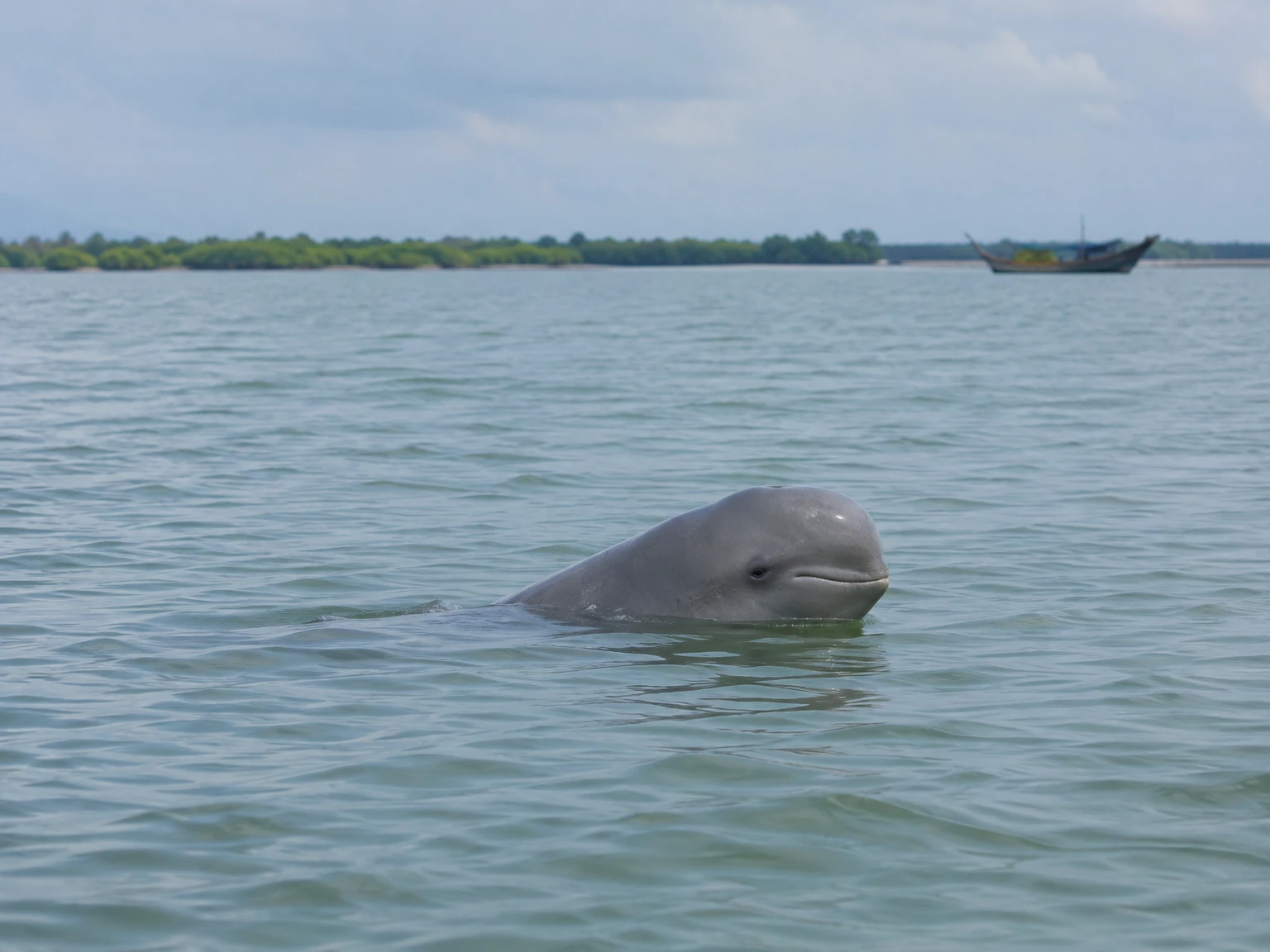
At the southern edge of Chilika, the lagoon does not end at a simple line on a map. Water moves between a vast brackish basin, channels, islands and the Bay of Bengal, shaping a habitat in which an elusive dolphin shares space with fishing boats and working communities. The Irrawaddy dolphin is not a river dolphin in the narrow sense suggested by its name: coastal populations also live in brackish and saline waters, often near estuaries and freshwater inflows. Chilika is the best-known Indian home of this species, but its story is not only about sightings. It is also about how wildlife surveys work, how people make a living from the lagoon, and how conservation depends on managing a busy, changing ecosystem.
This article looks at what the latest Odisha census says, what it cannot say, and why careful viewing, fishing practices, water quality and local participation belong in the same conversation. The aim is not to treat fishers or visitors as the problem, nor to claim that any one intervention has solved it. Instead, it follows the evidence available from government reporting, conservation organisations and lagoon authorities, separating direct observations from interpretations and aspirations.
A dolphin adapted to edges between water types
The Irrawaddy dolphin, Orcaella brevirostris, belongs to the family of oceanic dolphins, yet it is associated with coastal waters as well as rivers. The International Whaling Commission describes coastal populations in brackish or saline habitats that receive freshwater, including estuaries, river mouths and mangrove channels. This mix of habitats helps explain why a lagoon such as Chilika can support the species: it is not a freshwater lake sealed off from the sea, but a connected system influenced by both inland water and marine exchange. The exact conditions differ across seasons and locations, so no single description of “the lagoon” captures every dolphin’s daily environment.
Irrawaddy dolphins have a rounded forehead and a short, indistinct beak, features that can make them look different from the more familiar pointed-snouted dolphins. They are mammals: they breathe air, surface, and care for their young in water. Their presence at the surface is brief and unpredictable. The Chilika Development Authority notes that the species is shy and that a complete view is uncommon; a head or part of the tail may be all a visitor sees. That is a useful reminder that a responsible wildlife encounter is not measured by how close a boat gets or how long an animal is kept in sight.
The species is widely distributed in patches rather than as one continuous population. Some populations occupy rivers such as the Ayeyarwady, Mekong and Mahakam, while coastal groups use estuarine and nearshore waters. These populations are not interchangeable. A broad global status or a count from one habitat should not be used as a shortcut for describing every local group. WWF lists the species as Endangered globally and identifies accidental capture in fishing gear as a major threat. The IWC also describes bycatch as the leading human-caused source of mortality across the species. Those general findings matter to Chilika, but local decisions still need local observation.
What the January 2026 count found
The latest state-wide dolphin and cetacean census reported in the available coverage was conducted by Odisha’s Wildlife Wing on 20 January 2026. It recorded 765 animals across six species along the state’s coast and lagoon systems. The reported total included 208 Irrawaddy dolphins across Odisha, with 159 counted in Chilika. Other Irrawaddy observations were reported in coastal divisions outside the lagoon. The survey combined boat-based and shore-based transects, with staff and specialists trained in identification, methods and safety. These details matter: the figure is a survey estimate from a specified exercise, not an exact inventory of every animal that may have been present at every moment.
The number 159 was also reported for Chilika in the previous year’s estimate. That matching figure is evidence that the latest survey again counted 159; it does not establish that every individual was the same, that the population never changes, or that the actual population is exactly 159. Animals may be missed, observed more than once, or move beyond a survey route. Survey conditions, visibility, effort and movement can affect what observers record. A careful reading therefore calls this an unchanged reported count across two annual exercises, not proof of a perfectly static population.
Counts are valuable because repeated, methodical surveys can reveal patterns that casual sightings cannot. A trend is more informative than a single headline number, especially when surveys use comparable methods and their limitations are documented. Odisha’s survey reporting also places Chilika within a wider coastal picture, rather than treating the lagoon as the only place where Irrawaddy dolphins occur in the state. That distinction helps conservation planners ask better questions: Are animals using more than one area? Are counts affected by seasonal movement? How can surveys distinguish an ecological change from a change in detectability? The current public report raises these questions but does not answer all of them.
Why a lagoon can be productive and vulnerable
Chilika’s ecological character comes from the meeting of waters and habitats. Its brackish conditions support fish and other aquatic life, while its islands, channels and shoreline sustain birds, plants and human activity. Freshwater inflows, the connection to the Bay of Bengal, local currents and changing water levels all influence how the lagoon functions. These are not abstract background details. A change in channels, vegetation, salinity or water quality can affect the distribution of prey and the places where boats, nets and wildlife overlap. The same ecological richness that makes the lagoon valuable can also make it sensitive to cumulative pressures.
For an animal that feeds on fish and uses nearshore or estuarine habitats, the quality of the lagoon is inseparable from the quality of its water and the shape of its food web. The IWC’s species overview describes Irrawaddy dolphins as generalist feeders and notes that they may forage near fishers’ nets in some places. That is a species-level observation, not a claim that every dolphin in Chilika behaves identically. It does help explain why fishing gear and dolphin habitat can intersect: both fishers and dolphins rely on fish, and both may use productive channels where fish gather.
Habitat pressure is rarely one simple cause. Pollution from settlements or runoff, disturbance from vessels, changes to water circulation and fishing practices can interact. A single measure may help one part of the system while leaving another challenge untouched. The responsible conclusion is not that Chilika is either pristine or ruined; it is that the lagoon is a living ecosystem with competing demands, and conservation requires evidence that is refreshed over time. Long-term monitoring of water, species and human use makes it possible to notice changes early and adjust management rather than relying on one-time campaigns.
Fishers are part of the ecosystem’s human history
Fishing in Chilika is not an incidental activity that can simply be removed from the conservation story. Families and communities have long depended on the lagoon for work, food and social life. Their knowledge of channels, tides, fish movements and seasonal conditions can be important to day-to-day stewardship. A policy that ignores those relationships may be difficult to implement and may impose costs on people whose livelihoods are already closely tied to the wetland. Conservation is more durable when local people have a meaningful role in shaping it and can see how restrictions or new practices affect their lives.
Research on Irrawaddy dolphins and artisanal fishers in Chilika has examined the overlap between dolphins and fishing activity, including the possibility that dolphins forage around fishing structures and nets. The study’s framing is a reminder that human-wildlife relationships can be more complex than simple competition. Some fishers may interpret dolphin behaviour positively; others may be concerned about gear, safety or income. Those views can vary by location and circumstance. They should be documented rather than assumed. No single account of fishers’ attitudes can speak for every household in the lagoon.
Government reporting on the lake’s Integrated Management Plan says local fishing communities’ views were taken into account. It also describes local involvement in awareness work, watcher roles, information collection, patrols and responses to stranded marine animals or bycatch. These are reported program activities, not a guarantee that every community has equal influence or that every measure has achieved the same result everywhere. Still, they point toward a practical principle: fishers can be partners in observing wildlife, reducing harm and improving management, not merely people to be regulated.
Fishing gear and accidental capture
Bycatch means an animal is unintentionally caught in fishing gear intended for other species. For dolphins, entanglement can prevent them from surfacing to breathe. The IWC identifies bycatch as the leading human-induced cause of Irrawaddy dolphin mortality across the species’ range, especially where unattended large-mesh gillnets are used. The exact gear mix and local risk in Chilika should be established from local monitoring rather than inferred from a global summary. But the general mechanism is clear enough to justify attention: when dolphins and nets occupy the same waters, gear design, placement, soak time, checking practices and response after an encounter can make a difference.
Solutions must be developed with the people who use the gear. Abruptly banning a livelihood tool without viable alternatives can shift risk rather than resolve it. Useful measures may include recording when and where entanglements happen, training fishers in safe release techniques, improving gear checks, avoiding high-risk areas at sensitive times where feasible, and testing modifications that reduce accidental capture without destroying catch or income. Which measures work best depends on the fishery and the ecology. They need trials and evaluation, not a blanket promise that one device or rule will protect every animal.
Odisha’s public reporting describes patrolling, community engagement and assistance with bycatch release among current conservation efforts. These can form part of a wider strategy, but their success should be assessed using transparent outcomes: the number and circumstances of incidents, response times, animal survival, participation and any effects on fishing households. A count of patrols or training sessions is useful process information, but it is not by itself evidence that mortality has fallen. The distinction between activity and outcome helps the public understand what remains to be learned and encourages continued improvement.
Boats, tourism and the value of restraint
Satapada is a well-known place to experience the southern edge of Chilika, where the lagoon meets the Bay of Bengal. Odisha Tourism presents it as a wildlife and eco-tourism destination; the Chilika Development Authority’s interpretation centre introduces visitors to the lake, its fishing communities, birds and biodiversity. Visitors often hope to see dolphins, but wildlife is not a scheduled performance. The authority itself notes that the animals are shy and that only part of a dolphin may appear above water. An outing can be meaningful even when the sighting is brief or absent, because the wider lagoon is the habitat that makes the encounter possible.
Boat traffic can create disturbance, particularly in narrow channels where animals and vessels share space. A sensible viewing approach gives dolphins room to choose their direction and remain undisturbed. Operators and visitors should follow local guidance, avoid chasing or surrounding animals, keep noise and speed under control, and leave promptly if dolphins change direction or show signs of disturbance. The specific rules in force should be checked with local authorities and operators before travel; this article is not a substitute for current operating instructions. Respectful observation protects the animal and also creates a more honest experience for visitors.
A 2025 parliamentary reply, reporting actions by the Odisha government and Chilika Development Authority, says a standard operating procedure for dolphin watching has been developed and wildlife staff patrol to support adherence. It also says the Puri district authority formed a high-level committee to suggest carrying capacity for boats in the outer channel. The wording is important: a committee was formed to suggest carrying capacity; that statement alone does not establish what final capacity was adopted or the current number of permitted boats. Visitors should not treat a policy announcement as a live permit or assume that every boat follows the same conditions.
Restoring channels and managing enclosures
Chilika’s channels connect habitats and help maintain the exchange of water. The parliamentary reply describes the Chilika Development Authority’s work on feeder and lead channels, dredging, de-weeding and related ecological management. It reports monthly water-quality monitoring at 33 predefined stations across four lake sectors. The monitoring network is useful because it can show variation across the lagoon instead of treating water quality as a single lake-wide value. To understand whether conditions are improving, however, a reader needs the measured parameters, time series, locations and the interpretation of results, not only the fact that monitoring is being done.
The same reply reports joint enforcement drives that removed more than 152 square kilometres of gherries, or fish enclosures, and says this restored the seagrass ecosystem. This is a government-reported area and outcome; it should be attributed as such. The statement does not mean every enclosure has disappeared, that seagrass recovery is complete, or that all ecological effects are known. Any restoration claim is strongest when supported by maps, follow-up surveys and independent measures of habitat and species response over time. For readers, the key point is that the management discussion includes both habitat processes and people’s use of the water.
Channel work, water-quality monitoring and enforcement cannot be evaluated in isolation from one another. Dredging might change the movement of water; removal of enclosures can alter access and fishing patterns; water-quality readings can reveal whether pollution or other stressors persist. The right questions include: Which parts of the lagoon are monitored? What changes are seen through seasons? How are local fishers consulted before and after an intervention? Are indicators of fish, seagrass and dolphin use changing together? Publishing understandable, dated results would help communities and visitors distinguish a completed activity from a lasting ecological outcome.
How sightings and counts should be interpreted
A sighting is an observation of an animal at a place and time. It can be exciting, and it can provide useful information, but it is not automatically a population estimate. A dolphin may surface only briefly; weather, glare, water conditions and observer experience affect detection. If many boats travel through a channel, they may create more opportunities to see an animal while also increasing disturbance. Photos and videos can help document behaviour when captured responsibly, but social-media posts rarely supply the standardized effort needed to estimate abundance.
Annual counts add structure by defining survey routes, dates and methods. Their value grows when protocols are consistent and observers record effort as well as sightings. A survey that reports a number without explaining its coverage is difficult to compare with another. Odisha’s 2026 census reporting identifies its date, participating personnel and transect approach, which helps readers understand how the estimate was produced. Additional detail about route coverage, visibility, detection assumptions and uncertainty would make comparisons still more informative. These are normal scientific questions, not reasons to dismiss the survey.
It is also important to distinguish the count of Irrawaddy dolphins in Chilika from the total count of all cetaceans in Odisha. The 765 animals were reported across six species statewide; the 159 figure refers to the Chilika Irrawaddy count. Mixing those denominators can make a trend appear better or worse than it is. Likewise, “the largest single concentration” is a comparative statement attributed in news coverage to officials, not a direct measure of global abundance. The most useful public explanation keeps each number beside its location, date, species and method.
Learning beyond a boat trip
The Satapada interpretation centre offers a way to place a dolphin sighting in a wider context. Its description says visitors can learn about fishing practices, fishing communities, birds, available species and the lake’s biological richness. That matters because the animal is part of a shared place, not a detached attraction. A short visit to an interpretation centre can help visitors understand why water levels, channels and livelihoods matter, and why a quiet, brief encounter may be preferable to an aggressive search for a close-up photograph.
Good wildlife education should make uncertainty visible. Visitors can learn that the latest census estimate is not a live count, that dolphin movements are not fully captured by a single observation, and that management statements have dates and scopes. It should also avoid portraying residents as scenery or as a threat. Fishing communities have knowledge, needs and histories of their own. An educational visit is stronger when it recognizes both the biodiversity of the lagoon and the people who depend on it.
For schools and families, Chilika can support discussion across biology, geography and civic life. Students might compare brackish and freshwater habitats, map a lagoon’s connection to the sea, examine how a transect survey differs from casual sightings, or discuss how a conservation rule can protect wildlife while remaining fair to people. The point is not to turn a trip into a lecture. It is to show that environmental care involves observation, evidence, practical choices and respect for those who live in the landscape.
What a responsible conservation program should measure
Conservation plans become more credible when they identify what success would look like before actions begin. For Chilika’s dolphins, relevant indicators could include standardized survey estimates with uncertainty, records of entanglement and strandings, vessel activity in sensitive channels, water-quality trends, habitat indicators such as seagrass, and the livelihood effects of rules on fishing households. These measures should be interpreted together. A stable count might coexist with high mortality if new animals replace those lost, or it may reflect imperfect detection; a change in counts could be caused by movement or observation conditions rather than a sudden change in births or deaths.
Participation should be measured too. Who was consulted? Which villages and fishing groups were represented? Were local suggestions adopted, and were reasons given when they were not? Did patrols or training reach the people most likely to encounter dolphins? Are there safe and practical ways for fishers to report a sighting or bycatch event without fear of blame? These questions turn community participation from a slogan into a transparent process that can be improved.
Public reporting can bring these pieces together in a format that is easy to understand: date, location, method, results, limitations, actions taken and next questions. It should distinguish what officials observed from what a study inferred, and what has been proposed from what has been implemented. Such clarity does not weaken conservation. It helps residents, researchers and visitors see where evidence is strong, where it is still developing, and what kind of follow-up could make management more effective.
Questions that deserve continued research
Several questions remain important for the lagoon. How do Irrawaddy dolphins use different parts of Chilika across seasons? Do animals move between the lagoon and nearby coastal habitats, and what evidence would demonstrate such movement? Which fishing gears or locations present the greatest risk in particular months? How does boat traffic influence behaviour in the outer channel? What measures reduce bycatch while keeping fisheries viable? These are not questions that a single census or a visitor’s sighting can settle.
Photo-identification and other non-invasive methods may help researchers learn about individual animals and movement, provided the work follows appropriate ethical standards. Acoustic monitoring can sometimes detect animals when visibility is poor, but it also requires careful interpretation and local validation. Fishery surveys and participatory monitoring can reveal where people and dolphins overlap. Water and habitat measurements can show whether the broader system is changing. Each method answers a different question; combining them is more useful than asking one dataset to do everything.
Research should also be communicated back to people living around the lagoon. Results have practical value when they inform fishing guidance, boat management, education and restoration decisions in ways that can be discussed openly. Local observations can help scientists identify overlooked areas, while standardized methods allow those observations to be tested and compared. This exchange respects both scientific measurement and local knowledge, without pretending that either is complete on its own.
A shared lagoon, not a stage
Chilika’s Irrawaddy dolphins are compelling partly because they are difficult to see. Their brief appearances reveal only a moment of a much larger life shaped by water, fish, channels and human activity. The 2026 census reported 159 Irrawaddy dolphins in the lagoon, unchanged from the preceding year’s estimate, but the number should be read as a survey result with a date and method rather than as a perfect census of every animal. The wider lesson is that repeated, comparable monitoring is essential for understanding trends.
Conservation in a working lagoon requires more than protecting an animal from a distance. It calls for healthy water, functional habitats, careful boat practices, attention to fishing-gear risks and genuine collaboration with the communities who use the lake. Government reporting describes measures in each of these areas, including water-quality stations, channel work, patrols, a dolphin-watching procedure and community roles. Their longer-term results should continue to be measured and reported transparently.
For visitors, the best encounter may be a short one: a quiet surface, a curved head, a wake disappearing into the lagoon. Let the dolphin decide how near it comes. For residents and managers, the work is ongoing: observe carefully, share useful information, weigh impacts fairly and keep learning from the lagoon itself. The aim is not to turn Chilika into a stage for wildlife viewing, but to sustain a living place where dolphins, fishers, birds and visitors can all be considered in the decisions that shape its future.
Sources and further reading
- Down To Earth, “There are 765 dolphins of six species along Odisha’s coast, latest census reveals” — reporting on the 20 January 2026 Wildlife Wing survey.
- Press Information Bureau, “Parliament Question: Chilika Lake Ecosystem in Odisha” — government-reported monitoring, management measures and community involvement.
- International Whaling Commission, Irrawaddy dolphin species overview — habitat, feeding and bycatch context.
- World Wildlife Fund, Irrawaddy dolphin — species facts and global conservation status.
- Chilika Development Authority, Interpretation centre at Satapada — visitor learning and the authority’s description of dolphin viewing.
- Odisha Tourism, Satapada (Chilika) — destination overview and visitor information.
- D’Lima and colleagues, “Positive Interactions Between Irrawaddy Dolphins and Artisanal Fishers in Chilika Lagoon of Eastern India are Driven by Ecology, Socioeconomics, and Culture,” Ambio — peer-reviewed study on dolphin-fisher interactions.
This content is a collection of ancient history,books and various articles and collection of library and news and other post ; all details may not be the same. Readers are requested to verify the information themselves. Readers are not allowed to take any disciplinary action; content is only for educational purposes. If readers do not agree about the contents, they may send a personal comment to my personal email ID: achary.purna@gmail.com
