
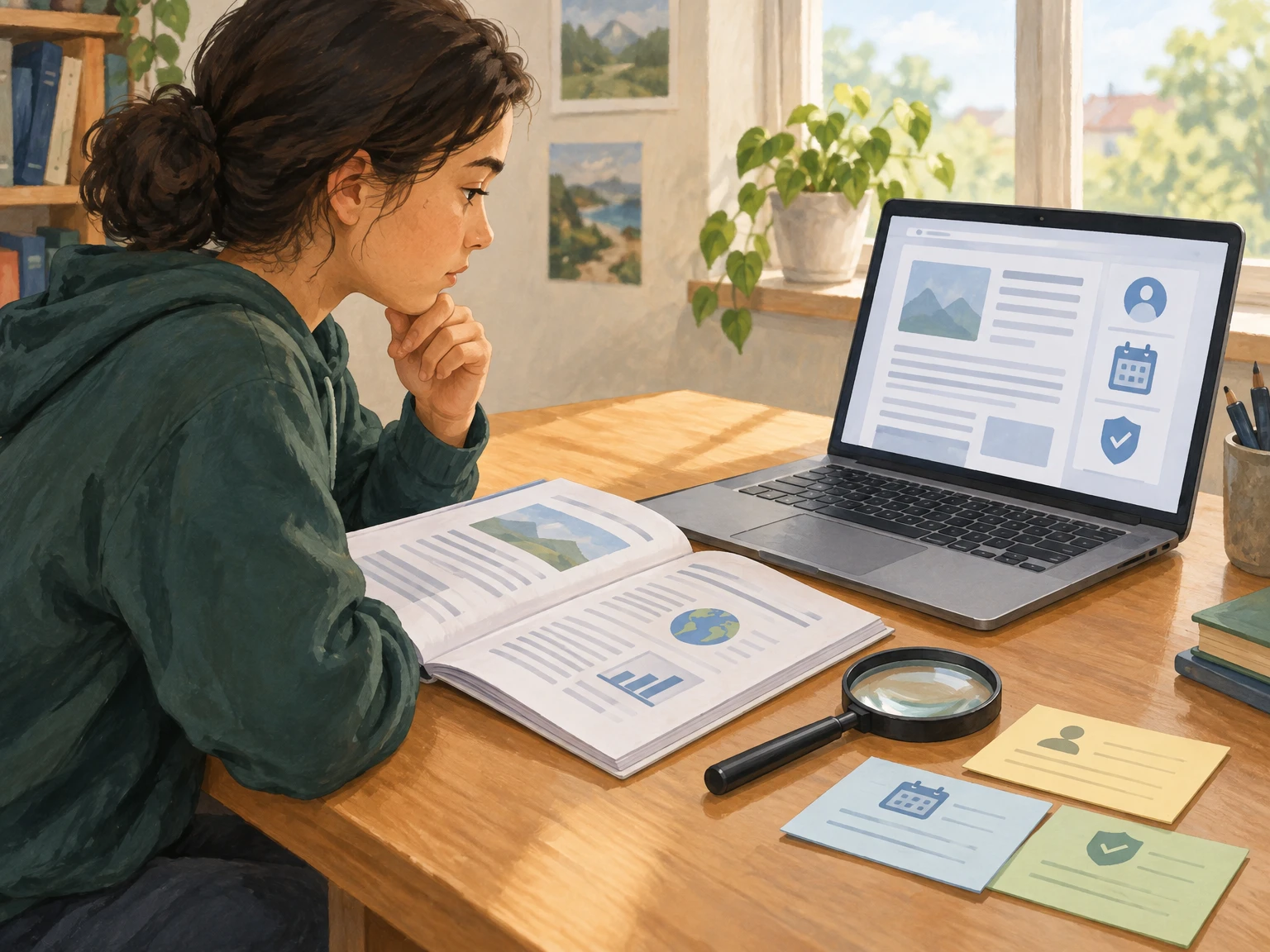
Search results can make a page look authoritative before you have checked what it says, who made it, or whether it fits your lesson. A useful study source is not simply the first result, the most polished video, or a page that repeats the answer you expected. It is a source whose origin and evidence fit the question you are trying to answer.
This guide offers a practical way for students to move from finding material to understanding and checking it. The method works for a history paragraph, a science diagram, a current-affairs presentation, a video lesson, or a fact generated by an AI tool. It is not a demand to distrust everything online. It is a way to decide what deserves confidence, what needs another check, and what should not be repeated as fact.
The key habit is simple: pause before copying, identify the claim, trace it to its source, compare it with independent evidence, and keep a note of what remains uncertain. Use that habit with books and printouts as well as websites. A digital page can be useful; a printed page can be out of date or mistaken. The medium alone settles nothing.
1. Begin with the question, not the search box
Before opening a browser, write the question in one sentence. “Find information about rivers” is too broad to guide a search. “How does a dam change the flow of a river downstream?” gives you a topic, a relationship to investigate, and a clue about what evidence you need. If the question has several parts, split it into smaller questions rather than collecting a pile of unrelated facts.
Next, ask what kind of source could answer it well. A government department may be useful for the current name of a scheme or the text of a public rule. A textbook or a trusted educational institution may explain a school-level concept. A research paper can describe a study, but may be too narrow or technical for a general introduction. A news report can give a dated account of an event; it is not automatically the best source for a scientific definition. A local resident may offer valuable experience about a place, but one person’s memory is not the same as a measured record.
Match source to claim. If you are checking a date, look for a reliable record that gives the date. If you are comparing two explanations, look for sources that explain their reasoning. If you need to know whether a resource matches your class, board, language, and chapter, check those details directly. The question determines the evidence you should seek.
2. Identify the exact claim
Pages often mix facts, interpretation, advertising, opinion, and calls to action. Do not judge a whole page with one label such as “good” or “bad.” Pick out the sentence you want to use and make it precise. “The platform helps students” is a broad claim. “This page provides a downloadable Class 8 science activity in Odia” is more specific and can be checked against the page itself.
Break a large statement into smaller parts. A sentence may contain a date, a number, a cause, and a conclusion. Each part can need different evidence. “The programme began in 2017 and has improved learning in every district” contains a launch-date claim and a broad impact claim; evidence for one does not prove the other. Ask what would count as a fair answer: a record, a direct observation, a dataset, a comparison, a documented explanation, or several independent accounts.
Notice the strength of the wording. “May help,” “is associated with,” “caused,” and “always works” do not mean the same thing. A single example can show that something happened once; it cannot by itself establish a universal rule. When the source uses stronger language than its evidence supports, report the narrower finding instead.
3. Ask who is behind the page
Look for the person or organization responsible for the material. Is an author named? Does the page explain the author’s role or expertise? Is there an institution behind it, and does the institution state what it does? Is there a date, an editorial process, contact information, or a correction policy? These details help you understand where the information came from and who can be asked about it.
A familiar logo, a professional design, a secure-looking address, or a large number of followers is not proof that every statement is accurate. A page can copy a logo. A real organization can publish material outside its area of expertise. A person with relevant expertise can still make an error. Treat identity as one clue, then examine the claim and evidence.
Check the site’s purpose. Is it teaching, reporting, selling a product, gathering donations, campaigning, entertaining, or promoting a particular view? A commercial purpose does not make every statement false, but it may affect what the page emphasizes or leaves out. Separate the useful information from the page’s attempt to persuade you. If the author’s identity or purpose is unclear, look for a second source that does not depend on the same author or organization.
4. Read laterally: leave the page to check it
When you land on an unfamiliar page, do not spend all your effort reading its own description of itself. Open a new tab and search the organization or author independently. See how other credible sources describe it, whether its expertise fits the topic, and whether its claims are discussed elsewhere. This approach is often called lateral reading: checking outward rather than allowing a page to be its only witness.
Use independent sources, not several copies of one story. Five websites may repeat the same press release or social post; that is one underlying source echoed five times. Look for different evidence streams: a primary record and an independent explanation, or two organizations that gathered information separately. If both pages cite the same study, follow the link and inspect the study’s scope before counting them as corroboration.
Search the exact phrase or a distinctive part of the claim in quotation marks when useful, then search for a correction, criticism, or alternative explanation. Do not assume the loudest rebuttal is correct either. Ask who produced it, what evidence it offers, and whether it addresses the same claim. A disagreement is a reason to inspect the evidence, not a reason to choose whichever side sounds more certain.
5. Look for evidence, not just confidence
Reliable explanations show how the author knows. They may link to a document, describe a method, give a date and location, identify a dataset, quote a source in context, or explain how a conclusion follows from observations. A confident tone, a dramatic image, a graph without labels, or a list of references is not enough if you cannot tell what those materials support.
Follow important links. Check whether they lead to an original report or merely another page repeating the claim. Read enough of the cited source to confirm that it supports the statement being made. A study about one school or one small group does not automatically represent all students. A survey records responses under its methods and date; it does not necessarily measure what people actually did. A chart may use a narrow time range or omit a comparison that changes its meaning.
For numbers, ask who counted, what was counted, when, where, and how. Check units, sample size, definitions, and whether a percentage has a denominator. “The number doubled” can sound dramatic if it rose from one to two. “Most students improved” needs a clear definition of improvement and information about how many students were included. If the source does not supply enough detail, say that the number is reported by the source and avoid presenting it as independently established.
6. Check dates, versions, and context
Information can be accurate for one time and misleading later. Look for a publication date and, where available, an update date. For current rules, fees, schedules, weather, product features, or admission requirements, check the responsible institution’s current page and confirm the date that applies. An old article may still explain a stable concept, but it should not be used as proof of today’s conditions.
Do not confuse the date an event occurred with the date a page was posted. A report published this week may describe an older event. A page updated today may retain information about a programme that ended years ago. Read the sentence around the date and look for a named period, edition, academic year, or version.
Historical and policy sources need context too. An older recommendation may have been written for a particular emergency, age group, or teaching arrangement. For example, NCERT’s PRAGYATA digital-education guidelines were issued in 2020, during a period of exceptional reliance on remote learning. They can be studied as a dated guidance document, not treated without checking as a universal rule for every school today. When a resource gives a recommendation, distinguish “the document recommended” from “the law requires” or “all schools currently do.”
7. Check that a learning resource fits your class
A resource can be credible and still be wrong for your assignment. Check the class or grade, board, subject, chapter, language, edition, and learning objective. A lesson titled “fractions” might teach a different method from the one your course is using. A video may be helpful background but not the material your teacher asked you to use. Read the title page or resource details instead of inferring alignment from a thumbnail.
DIKSHA is a national school-education platform initiated by NCERT under India’s Ministry of Education and launched in 2017. Its state and institutional partners use the platform in different ways, and it includes multiple kinds of resources. That makes it a useful place to look for course-related material; it does not mean that every item on the platform is necessarily the right item for every student. Verify the board, class, language, subject, and relevant textbook or unit shown for the resource.
When using a textbook QR code, check that the code belongs to the book and unit you hold, and read the resource details shown after scanning. DIKSHA’s guide explains that a QR code can lead to one or several related resources, and downloaded content may be available offline. If several items appear, choose by the lesson objective and details rather than the first thumbnail alone. If your book edition or course differs, ask your teacher which version to follow.
8. Treat AI output as a starting point to verify
An AI system can produce a fluent explanation, summary, answer, image caption, or list of sources. Fluency does not establish that the output is true, complete, current, or correctly attributed. A generated answer may blend a sound general explanation with a mistaken date, invented reference, missing qualification, or claim that cannot be traced to a real source.
Use AI, where your school permits it, for tasks that keep you actively involved: asking for simpler wording, generating questions to test your understanding, suggesting search terms, or comparing two explanations you already have. Then verify important facts in sources you can open and read. If the system gives a citation, check that the cited page exists and supports the sentence. Do not cite an AI answer as if it were the original research or official record behind the answer.
Protect personal information. Do not enter passwords, private messages, addresses, phone numbers, identity documents, school login details, or another person’s sensitive information into a tool just to complete an assignment. Follow your school’s rules about permitted tools and disclosure. If a generated answer conflicts with your textbook or a teacher’s instruction, preserve the question and ask for clarification rather than quietly replacing the assigned material.
9. A worked example: checking a claim about a digital lesson
Imagine a page says: “A QR code in every schoolbook instantly provides the official answer to every chapter, even without internet.” Before repeating that sentence, split it into parts. Does every book have a QR code? Does each code provide one item? Is the item an official answer? Is it always available offline? The broad sentence may have been built by stretching a narrower fact.
Start with the actual book. Does this edition contain a code? Does the code identify a unit or a resource? Scan it with the platform named in the book’s instructions, then read what the results page says. If there are multiple resources, that already differs from “the answer to every chapter.” Check whether the item is an explanation, activity, video, quiz, or answer key. Do not call all of these an “official answer” unless the platform or publisher identifies them that way.
Next, check the platform’s own guide. DIKSHA’s help page describes textbook QR codes as a way to discover related content; a scan can show one resource or a list. Its instructions say downloaded content already on the device can be opened through the QR scan whether online or offline. That is a narrower, conditional statement than “everything works offline”: a student still needs the relevant item downloaded, and an online resource that has not been saved may need a connection.
Then ask whether the page’s claim is about all books, every chapter, or only a specified book and content. Look for the textbook board, edition, language and code. If the page does not identify these, do not extend one observed example to every student. A fair summary might say: “The platform links some textbooks and units to related digital resources. A resource already downloaded on the device may be available offline; check the specific book and item.” That version carries the useful idea without promising more than the evidence supports.
This example shows why checking is not merely catching falsehoods. It also protects true but limited statements from being made too broad. The source can be trustworthy and the summary can still be careless. Your job is to preserve the limits that make a statement accurate.
10. Use a short evidence note
When a fact will appear in an assignment, save a compact note as you go. Record the claim in your own words, the author or organization, title of the page or book, date, relevant section or page number, and the exact URL if it is online. Add one sentence describing what the source actually supports and any limit you noticed. This is more useful than saving a long link list and trying to remember later why each link mattered.
Keep direct quotations short and visibly marked as quotations, with the source beside them. For everything else, close the source and explain the idea in your own words, then reopen it to check that your paraphrase has not changed the meaning. Changing a few words while keeping another author’s sentence structure is not the same as writing an original explanation. Follow the citation style or source format your teacher requests; the important habit is to make borrowed ideas traceable.
Separate what the source states from what you infer. You might write: “The report describes a survey of 250 students in two schools; it does not measure every school in the state.” Then, if useful, add your own inference: “This suggests the question deserves a wider study.” Labelling the difference makes your reasoning clearer and lets a reader judge it fairly.
11. Keep safety and privacy in the research routine
Research sometimes brings you to unfamiliar sites, comment sections, file downloads, quizzes, and requests to sign in. A page asking for personal details may not need them for a school lesson. Before sharing anything, ask what the information is for, who can see it, and whether your school or a trusted adult has approved the service. Do not share account passwords or one-time login codes with a stranger, even if a page says it is necessary to unlock a result.
If something feels threatening, upsetting, or suspicious, stop interacting, do not forward it as a joke or evidence, and speak with a trusted adult or your teacher about the appropriate next step. Keep screenshots only when it is safe and useful, and do not post another student’s name or private information to make a point. The National Commission for Protection of Child Rights’ “Being Safe Online” guideline is intended to raise awareness among children, parents, educators, and the public; it also emphasizes tailoring information to people’s circumstances and attending to privacy. It is a resource for awareness, not a substitute for the specific reporting route your school or local authority provides.
Use only sites and downloads needed for the assignment. If a file asks you to install an unknown program, enable unusual permissions, or enter credentials that do not fit the lesson, leave it and ask an adult. A teacher can often provide the material through a safer school route.
12. Make comparison fair
When two sources disagree, write down exactly what each one claims. They may be answering different questions, using different dates, defining a term differently, or discussing different places. A historical account and a current government page may not actually conflict if one describes an earlier arrangement and the other a later update. A science explanation for younger students may simplify a process that an advanced text describes in more detail.
Compare the evidence, not just the conclusions. Ask who produced each source, what method it used, whether it links to primary material, what limits it mentions, and whether an independent source supports the key part. Look for possible shared origins: if one article quotes another, they are not two independent confirmations. Give greater weight to direct, relevant evidence for the exact claim, but do not assume that “primary source” means “complete or unbiased.” A record can be authentic and still omit context.
If the disagreement remains, report it rather than hiding it. You can write: “The two sources give different dates. One reports the event date; the other gives the date the programme began. I could not resolve the difference from the material available.” This is better research than choosing a date because it appears more often. Uncertainty is a result to describe accurately, not a flaw to conceal.
13. Turn checking into a repeatable study routine
A practical routine can take only a few minutes. First, state the question and the exact claim you need. Second, locate a source that fits the subject and the type of evidence. Third, identify its author, purpose, date, and relevant section. Fourth, search outside the page for independent context. Fifth, open the important cited evidence and check what it supports. Sixth, write a short note in your own words, keeping the source and its limits attached. Finally, check whether the material matches your class and assignment before you use it.
Use a small table when a task has several claims. A row might include “claim,” “source,” “what it directly shows,” “second check,” and “remaining question.” This prevents a common mistake: collecting many sources that all support only one part of the assignment. It also gives you a quick map of which facts are well supported and which still need work.
For a presentation, use the same routine on images and numbers. Ask where a picture first appeared, whether it shows the event described, and whether it has been cropped or captioned in a way that changes its meaning. For a graph, read the title, axes, units, time period, and source note. If the image or chart cannot be traced, do not use it as evidence just because it looks convincing.
14. Common shortcuts that lead students astray
One shortcut is to treat the search ranking as an accuracy ranking. Search tools order results using many signals, and the first result is not a guarantee that it best answers your assignment. Another is to trust a page because it agrees with your first idea. Confirmation feels easy, but a fair check includes looking for evidence that could change your mind.
A third shortcut is to count search hits as proof. Many pages may repeat one unverified post. A fourth is to read only the headline; headlines simplify and sometimes frame a story more strongly than the article supports. A fifth is to cite a page you have not opened or to list a source that does not support the sentence. A sixth is to remove all caveats when summarizing. “The study found a possible relationship in this group” should not become “the study proved this always happens.”
Another common error is treating a source’s silence as evidence that something never happened. A page may have a limited date range, a missing archive, or a narrow subject. Say “I did not find this in the sources I checked” only when that is what you mean; do not turn it into “there is no information.” The scope of your search sets the scope of your conclusion.
Finally, do not mistake a plausible explanation for a verified one. A claim can sound logical and still be wrong. A striking statistic can be accurate but irrelevant to your question. A useful study habit is to separate “this seems possible” from “this source demonstrates it.”
15. A small practice exercise
Choose a claim from a lesson you are already studying. Write it as one sentence, then underline the nouns and circle any number, date, comparison, or cause. Ask what source would best check each part. Search for the source named by the claim, and then search independently for the author or institution. Do not stop at a page describing itself; look at what other credible sources say and whether they cite the same original material.
Make a three-column note: “claim,” “evidence I found,” and “what I still cannot say.” Use at least two sources that do not simply copy one another. Open the evidence, check the date and context, and write a one-sentence summary with a limit. If your evidence changes the original wording, update the claim rather than forcing the evidence to fit it.
Then swap notes with a classmate. Ask them to find the source for one sentence in your summary and tell you whether it supports the sentence exactly. This is not a contest to catch each other out. It is a way to test whether your notes are clear enough for another reader to follow. If your classmate cannot locate the evidence, add the missing link or page detail. If they find a limit you missed, include it.
16. What teachers and families can reinforce
Students learn source evaluation more effectively when they practice it with ordinary assignments, not only with one special lesson about misinformation. A teacher can model how to compare sources while studying a science question, a historical date, or a local issue. A parent or caregiver can ask “How did you check that?” without assuming that every online resource is unsafe or every printed resource is correct.
Questions should be proportionate to the task and age of the learner. A younger student may need help noticing the publisher and date; an older student may compare methods and identify the limits of a study. The aim is not to make every student an expert fact-checker in a single sitting. It is to build a habit of asking where information came from and what supports it.
Digital learning also depends on access, language, device sharing, and connectivity. Students should not be blamed for being unable to open a resource that requires data, a personal account, or a device they do not have. When possible, a teacher can provide an offline copy or an alternative source and explain how it relates to the same learning objective. A useful resource is one students can actually access and understand, not merely one that exists online.
17. Finish with a claim you can stand behind
At the end of your research, ask: Could I point to the evidence behind my key sentence? Have I checked the date and context? Do my sources actually provide independent support? Does the resource fit this class and assignment? Have I preserved important limits and made borrowed ideas traceable? If not, narrow the sentence, seek another source, or say that the answer is still uncertain.
The goal is not to gather the largest number of links. The goal is to understand a question well enough to explain what the evidence says, what it does not say, and how you reached your conclusion. A short, careful answer is stronger than a long list of unchecked claims. When you learn to move between a page, its source, and independent context, the internet becomes more useful for study because you are no longer only collecting information—you are evaluating it.
Sources and further reading
- UNESCO, Media and Information Literacy for Teachers, Module 1, Unit 1: https://www.unesco.org/mil4teachers/en/module1/unit1?hl=en-US
- UNESCO, Media and information literate citizens: think critically, click wisely! (2021): https://www.unesco.org/en/articles/media-and-information-literate-citizens
- DIKSHA, About Us: https://diksha.gov.in/about-us/
- DIKSHA Help, Understanding QR Codes: https://diksha.gov.in/help/getting-started/explore-diksha/understanding-qr-code.html
- National Commission for Protection of Child Rights, Being Safe Online (guideline): https://www.ncpcr.gov.in/public/index.php/viewPdf/16613370496305fdd946c31_being-safe-online.pdf
- NCERT, PRAGYATA Guidelines for Digital Education (2020): https://ncert.gov.in/pdf/announcement/PRAGYATA_Guidelines_English.pdf
This content is a collection of ancient history,books and various articles and collection of library and news and other post ; all details may not be the same. Readers are requested to verify the information themselves. Readers are not allowed to take any disciplinary action; content is only for educational purposes. If readers do not agree about the contents, they may send a personal comment to my personal email ID: achary.purna@gmail.com
