
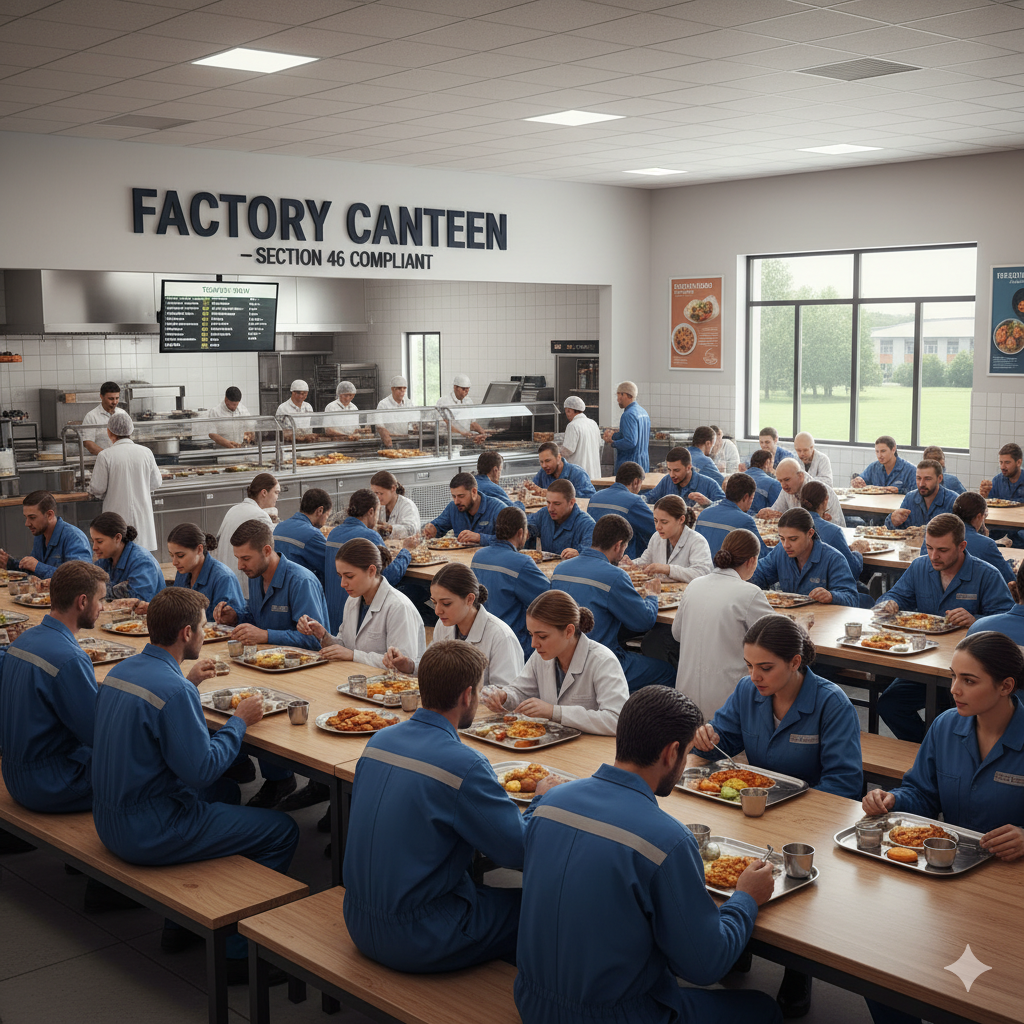
The Former Section 46 Canteen Framework
1. The Statutory Requirement
The Factories Act, 1948, is repealed from 21 November 2025 by section 143(1) of the Occupational Safety, Health and Working Conditions Code, 2020 (OSHWC Code). Former section 46 described a state-rule-based canteen requirement for specified factories employing more than 250 workers; it is historical, not the current threshold. Section 24(1)(v) of the OSHWC Code provides for canteen facilities in establishments where 100 or more workers, including contract labourers, are ordinarily employed, as prescribed by the Central Government. Local rules and the establishment’s coverage matter.
- The Threshold: The State Government may make rules requiring that in any specified factory where more than 250 workers are ordinarily employed, a canteen shall be provided and maintained by the occupier for the use of the workers.
- The former section 46 authorized State Governments to make rules for specified factories above its threshold; detailed canteen requirements depended on the applicable State rules.
2. The Multi-Layered Compliance Framework
Historical canteen rules varied by State and date. This article does not establish that any particular facility standard remains in force or applies to an establishment under current law.
A. Construction and Accommodation
Some historical State rules addressed canteen construction and accommodation. Exact requirements depended on the jurisdiction and rule in force; check current rules before treating any standard below as binding.
- Distance: Historical State rules sometimes prescribed distance from latrines or other specified structures; the standard and applicability varied by rule and period.
- Space: Some State rules set accommodation requirements, but the percentage and measurement depended on the applicable rule and period.
- Hygiene: Historical State rules addressed washing, painting, floors and cleaning; exact standards and intervals varied.
B. Historical State-Rule Pricing (State-Specific)
Former section 46 itself did not set a universal no-profit pricing rule. Any pricing obligation must be tied to the specific applicable State rule and period; this article does not establish current applicability.
- Some State rules historically addressed meal pricing; former section 46 did not itself prescribe a universal non-profit basis. Check the applicable rule and its current status.
- Some State rules may allocate canteen construction, equipment, staffing and meal costs differently. The claim that employers universally bear all expenses except ingredients and fuel requires a specific rule and should not be treated as a current nationwide requirement.
C. The Canteen Managing Committee
Some State canteen rules may provide for management and worker participation; former section 46 itself did not establish a uniform committee structure. Verify the applicable State rule and period before treating any committee requirement as current.
- Some State rules historically provided for canteen committees. Their existence, composition and advisory role depend on the specific State rule and period; former section 46 did not establish a uniform committee or a nationwide worker vote.
- Where a specific historical State rule created a committee, its functions were those stated in that rule; former section 46 alone did not impose these consultation duties nationwide.
- Logic Check: Former section 46 did not itself guarantee a direct worker vote on operational management; committee participation, if any, depended on the applicable State rule.
D. Equipment and Sanitation
- Storage: Some rules addressed storage, food protection and cleanliness; the precise equipment requirement depended on the State rule and period.
- Waste: Some State rules addressed drainage and waste; requirements were jurisdiction- and period-specific.
The Intellectual Counterpoint: Is Section 46 Obsolete?
Now, let’s challenge the assumptions behind this law. While Section 46 was written with noble intentions (preventing malnutrition in the 1940s industrial workforce), modern critics argue it creates several perverse incentives:
1. The “249 Worker” Ceiling
Former section 46 did not impose a universal automatic canteen duty at 250 workers: it authorized State Government rules for specified factories with more than 250 workers ordinarily employed. The current OSHWC Code §24(1)(v) uses a 100-or-more-worker threshold, including contract labourers, ordinarily employed, with facilities as prescribed by the Central Government. Applicable rules and the establishment’s coverage must be checked; the old 249/251 comparison does not state current law.
- The Result: The former threshold alone does not prove that factories limit hiring or use contract labour to avoid welfare duties; that claim requires evidence.
2. The Quality vs. Cost Paradox
Where a specific applicable State rule historically required non-profit pricing, critics may argue it affected incentives; this policy argument is not a universal current legal rule or a demonstrated outcome.
- Whether pricing rules affect meal quality depends on the applicable rule, costs and management; claims that every employer loses money or supplies lower-quality meals require evidence.
- In the modern world, would workers be better off with a “meal allowance” or a digital voucher (like Sodexo) that allows them to choose their own food, rather than being forced to eat at a state-mandated industrial trough?
3. The Liability Trap
Section 46 alone does not establish the present allocation of liability for food safety or prove that a factory manager would face criminal prosecution in a particular food-poisoning case. Liability depends on the applicable current law, rules and facts; seek jurisdiction-specific advice before drawing that conclusion.
- The Logic Test: Should a manufacturing expert (a Factory Manager) be legally liable for the temperature of a soup? Many argue this “vicarious liability” discourages large-scale employment.
Comparison Table: Mandated Canteen vs. Modern Food Subsidy
| Feature | Former §46 (historical) | Modern Digital Voucher System |
|---|---|---|
| Control | Depends on applicable State rules and arrangement | Worker-choice (Market-driven) |
| Cost to Employer | Varies by applicable rules and arrangement | Low (Direct transfer) |
| Hygiene Responsibility | Responsibility depends on applicable law and facts | Restaurant/Vendor (External) |
| Scalability | Fixed (Hard to expand/shrink) | Infinite (Scales with headcount) |
As a provision of the former Factories Act, Section 46 reflected an industrial-welfare model in which employers provided canteen facilities under applicable state rules. Its historical framework should be read alongside the current OSHWC Code and the rules applicable to a particular establishment.
Official sources: OSHWC Code §§24(1)(v), 143(1)(a), India Code: https://www.indiacode.nic.in/indiacode/bitstream/123456789/22041/1/a2020-37.pdf; commencement notification S.O. 5321(E), 21 November 2025: https://egazette.gov.in/WriteReadData/2025/267884.pdf; former Factories Act §46, India Code: https://www.indiacode.nic.in/bitstream/123456789/6323/1/factories_act_1948.pdf.
This content is a collection of ancient history,books and various articles and collection of library and news and other post ; all details may not be the same. Readers are requested to verify the information themselves. Readers are not allowed to take any disciplinary action; content is only for educational purposes. If readers do not agree about the contents, they may send a personal comment to my personal email ID: achary.purna@gmail.com
