
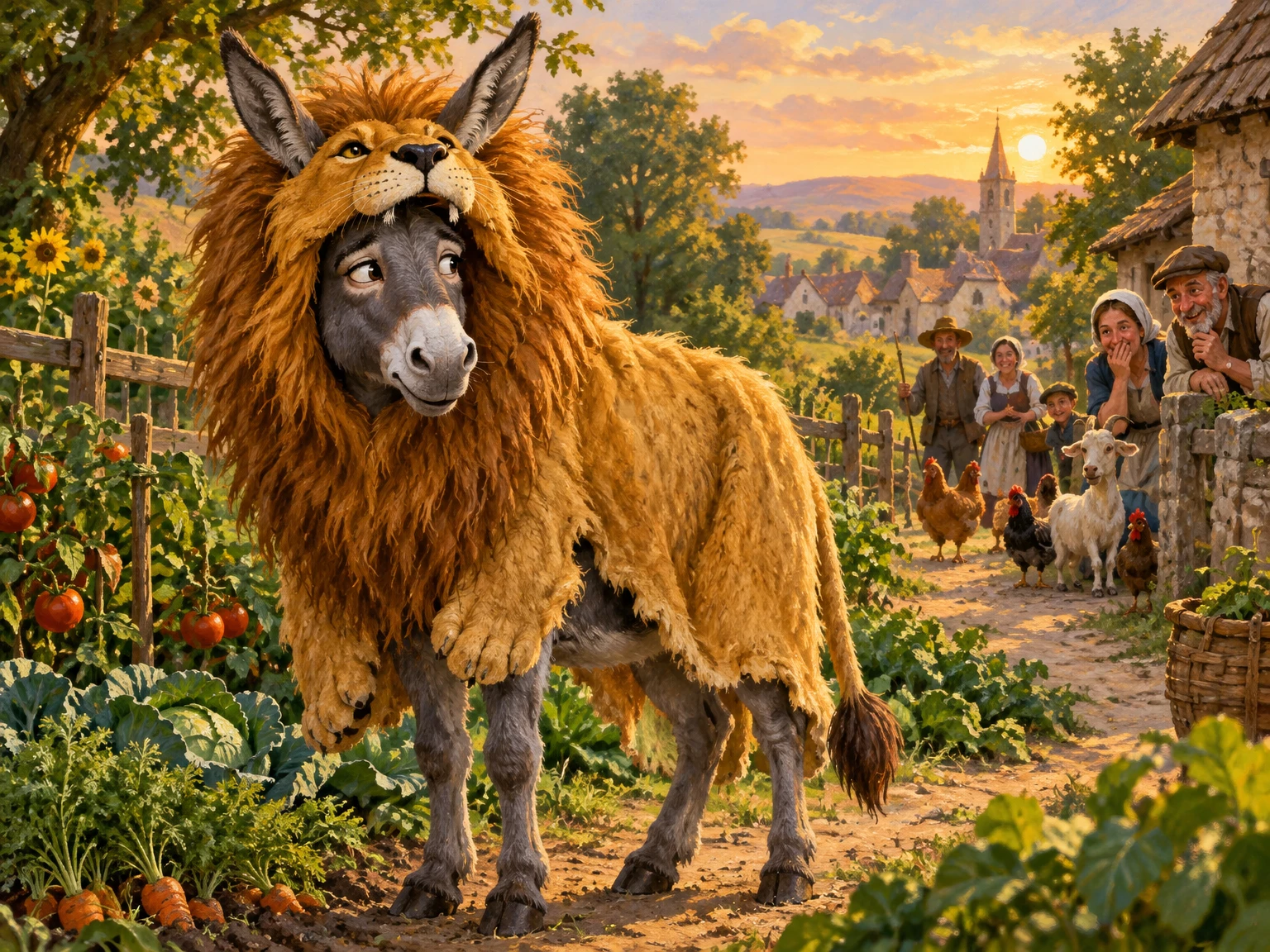
An original retelling and commentary on a traditional fable; the village, characters and incidents below are imagined.
The Donkey in a Lion’s Skin
An original retelling
At the edge of a village, where the last houses gave way to fields and scrub, a donkey spent its days carrying whatever the household needed moved. Some mornings it bore sacks of grain to the mill; on others, bundles of sticks or baskets of vegetables. The animal knew the routes by their stones and slopes. It knew where a shallow stream crossed the track and where a cart wheel had made a rut deep enough to catch a hoof. It did not know the names of the people who praised its work, because praise was rare. It knew the farmer’s whistle, the weight of a load, and the relief of a quiet patch of shade.
This donkey was not the only worker on the farm, but it was the one expected to keep going after the others had stopped. When the cattle settled in the evening, the donkey still had a harness to lose and a trough to reach. It was neither wicked nor foolish by nature. It was tired, and it had noticed that some creatures were treated differently from others. The house dog was welcomed near the fire. The donkey was called when something heavy needed carrying. From the donkey’s point of view, the distinction seemed to have less to do with effort than with the way others looked at you.
One warm afternoon, after a long journey with a load that pressed against its shoulders, the donkey reached the outer field and was allowed to rest. It lowered itself beneath a tree and stretched its legs. While it waited for its breathing to settle, it saw something tawny caught among the low branches. At first it looked like a heap of dry leaves. Then the light shifted, and a coarse mane appeared.
The thing was an old lion’s skin. It had been left behind, weathered by sun and dust, but the outline was still striking: a broad back, a thick neck and a mane that made the animal beneath it seem larger. The donkey sniffed the hide, stepped around it, and tried to imagine what it would look like from a distance. A thought arrived before caution could stop it. If others feared a lion, perhaps they would fear anyone who looked like one.
The donkey tugged at the skin and managed to pull it across its back. The mane fell around its neck and partly covered its ears. The hide was awkward and heavy; it shifted when the donkey moved. Still, when it looked at its reflection in a pool, it saw a shape unlike its familiar grey self. The water trembled, so the image did too. The donkey mistook that uncertain reflection for proof that the disguise was convincing.
It walked out from the shade and into the pasture. A few sheep looked up. They did not wait to find out what the newcomer was. They ran, and the movement of one frightened animal startled the rest. The shepherd, seeing a mane and a large body advancing through the grass, shouted a warning and hurried away. The donkey stood still. No one had asked it to move the load or obey a command. The field had opened before it simply because its appearance had changed.
The donkey felt a new kind of pleasure. It had worked hard for years and had not been able to make the pasture quiet by asking. Now the animals scattered without a word. The donkey began to think that fear might be a quicker road to importance than usefulness. It did not stop to ask whether the sheep feared the lion itself, the unknown shape, or the possibility of danger. It only noticed that they had moved aside.
Encouraged, it followed the track towards the village. The skin brushed against its legs, and the mane bounced with each step. At the first houses, people saw the silhouette and ducked indoors. A child called to an adult; a door closed; a basket was dropped in the road. No one paused to inspect the hide. In the confusion, a frightened guess became a shared certainty: a lion had come near the village.
The donkey passed through the square. The stallholders had left their produce uncovered, and the road was suddenly clear. It could have turned back then. Instead, it lingered long enough to savour the silence. The village had never made a path for it before. It had not become stronger, kinder, wiser or more deserving in the space of an afternoon. But the villagers’ fear made the borrowed skin feel like a crown.
Near the edge of the settlement, the donkey came upon a small patch of crops. It was hungry, excited and pleased with itself. It wanted to announce its triumph, though it had no plan for what would follow. A lion’s roar belonged to the animal it imitated; the donkey’s own voice belonged to the animal it was. It opened its mouth, and a bray rang across the fields.
The sound changed the scene. A farmer who had been watching from behind a shutter recognized it. Another villager heard the same familiar call. The people did not need a close look at the mane now: the voice gave them a different explanation. The feared visitor was a donkey wearing a discarded skin.
Fear turned into embarrassment, and embarrassment quickly became anger. The villagers came out, some laughing, some scolding. The donkey had frightened them, but it had also exposed how easily the whole crowd had treated a glimpse as knowledge. The animal tried to run. The loose hide caught at its legs, so it shook the skin free and hurried back towards the farm.
When the farmer found the donkey, the old skin lay in the dirt. The animal was tired again, and now it was frightened for a different reason. The story does not tell us that every villager forgave it, or that one afternoon changed the life of the farm. It leaves a simpler picture: a donkey, a discarded disguise and a community that had mistaken a shape for a fact.
The fable’s familiar lesson is not that a person should never change clothes, adopt a role or try something new. It is that a borrowed appearance cannot supply the qualities the appearance suggests. The donkey could wear the mane, but it could not become a lion by putting it on. Its own voice and choices eventually mattered more than its costume.
What kind of story is this?
The donkey in a lion’s skin belongs to a long tradition of animal fables: brief narratives in which animals act in recognizably human ways and a decisive event makes an idea memorable. This version is a new retelling, not a transcription of an ancient manuscript. The familiar motif is older than any one modern edition, and stories commonly grouped with “Aesop’s Fables” have passed through many languages, collections and adaptations. Aesop is the traditional name attached to a body of fables, but the existence of that name does not prove that one historical author wrote every story now printed under it.
That distinction matters. People often ask whether Aesop really lived, whether a particular fable was composed by him, or whether a schoolbook preserved an unchanged ancient text. Those are historical questions, not facts a retelling can settle. The safer description is that this is a traditional fable conventionally attributed to Aesop, retold here in original language. The sources below give readers a short nineteenth-century version and background on the uncertainties surrounding Aesop and the fable tradition. They do not establish this exact retelling as an ancient text.
The village in the story is imagined. So are the farmer, the pasture, the stream, the crop patch and the villagers’ particular reactions. They create a setting where a disguise can be tested; they are not evidence about a real place, a historical incident, or the life of a particular donkey. The tale can be read without pretending that each detail came from a record.
The disguise: appearance is evidence, but incomplete evidence
The skin works because the animals and villagers see only part of the truth. They do not inspect the stranger carefully; they respond to a shape that resembles danger. That response is not entirely irrational. In an uncertain situation, a person may move away first and investigate later. The fable is not a field guide to lions or a realistic account of animal behaviour. It turns a familiar human problem into a compact scene: we make judgments with limited information, and the first interpretation can travel faster than correction.
Yet appearance is not meaningless. Clothing, uniforms, badges, titles and settings can signal a real role. A uniform may indicate training; a badge may show that someone has been authorized to enter a building. The warning is not “never trust what you see.” It is “do not let a sign do all the thinking.” A costume can suggest a role without proving that its wearer has the skill, permission or intentions associated with that role. A sensible observer asks what else would confirm the impression.
The villagers’ mistake is collective. One person sees a large tawny shape; another hears an alarm; the next person sees doors closing. Soon each person takes the group’s reaction as extra evidence. The crowd’s certainty grows, although nobody has learned more about the animal. This is one reason fables remain useful: a small imagined event can help readers notice how a rumor or first impression gains authority through repetition. A story does not prove that every crowd behaves this way, but it gives us a scene to think with.
The donkey also misreads what happens. It thinks the sheep’s flight and the villagers’ retreat mean it has earned respect. But respect, fear and compliance are not interchangeable. Someone may obey because they feel threatened, not because they admire or trust the person making the demand. The skin gives the donkey a brief advantage, but it does not create a relationship. When the disguise fails, the reaction changes at once.
The voice and the body beneath the costume
In the old story pattern, the donkey gives itself away by braying. The moment is comic because a sound that belongs to ordinary farm life breaks the grand picture the animal has tried to create. A costume changes what others see, but the donkey has not learned the lion’s voice. In this retelling, the bray is not a scientific claim about how every animal would respond to a hide. It is the fable’s literary device: a recognizable sign reveals the concealed identity.
Readers can take “voice” literally, as the sound that exposes a disguise, or figuratively, as the words and actions that show how someone understands a role. The metaphor should be handled carefully. A person’s accent, disability, language, or way of speaking does not reveal whether they are honest or capable. The fable’s point is not that a person’s voice is a reliable test of character. Rather, the donkey’s own chosen boast exposes the gap between the image it has borrowed and the identity it is trying to conceal.
The donkey might have remained unrecognized a little longer if it had stayed silent. But silence would only have prolonged the performance; it would not have made the disguise true. The story’s turning point arrives because the donkey wants an audience. It is not satisfied with escaping a burden. It wants the villagers to witness its apparent triumph. That desire pushes it to act, and the action makes the pretense harder to sustain.
Why the donkey wants to be feared
The donkey’s motive is easy to dismiss as vanity, but the opening gives us another possibility: it has noticed an unfair difference in how the farm’s animals are treated. Its labor is expected and underappreciated. It longs for recognition and relief. That longing is understandable even though its plan is deceptive. A fable can make a character’s desire recognizable without declaring its choices right.
This makes the story more interesting than a simple warning against ambition. Wanting a lighter workload, fair treatment or appreciation is not the same as pretending to be dangerous. The donkey chooses fear because it seems to offer a shortcut to the respect it has not received. But fear only changes other people’s immediate behaviour. It does not repair the underlying arrangement at the farm, and it does not give the donkey a lasting voice in decisions about its work.
The animal’s disguise also moves responsibility around. The donkey decides to mislead; the villagers decide how to respond; the farmer has established the conditions in which the donkey’s work is routine and its comfort easy to overlook. The fable focuses most sharply on the donkey’s deception, but readers can still ask what the opening suggests about the life that made the deception tempting. Doing so does not excuse the lie. It widens the discussion from “Who is foolish?” to “What need is being expressed badly, and what would a fairer answer look like?”
Power, fear and mistaken respect
When the villagers hide, the donkey experiences a version of power. It has not persuaded anyone. It has not demonstrated knowledge. It has not helped the community. Its power depends on people believing that it could hurt them. That belief may secure space for a moment, but it is fragile. The moment a contrary sign appears, the power disappears.
The fable invites a useful distinction between authority and appearance of authority. Authority can be legitimate when it comes with responsibility, limits and accountability. A costume or title can imitate its outer signs while leaving those foundations absent. In everyday life, the analogy can apply to many situations, but it should not be used to accuse a particular person without evidence. The story supplies a question, not a verdict: what supports the authority we are being asked to accept?
Fear can also hide the truth from the person who benefits from it. The donkey sees no challenge and concludes that its plan has succeeded. It does not notice that the villagers’ silence is evidence of alarm, not agreement. The same confusion appears in human relationships when people interpret compliance as loyalty or lack of protest as approval. A fable cannot resolve those real situations, but it can help readers pause before mistaking silence for trust.
The bray is not the only cause
It is tempting to say that the donkey loses everything because it cannot keep quiet. But the bray is only the immediate trigger. Before it speaks, the donkey has already relied on deception, entered places where others feel unsafe, and mistaken panic for admiration. The ending becomes more thoughtful when we notice the chain: desire for recognition leads to disguise; disguise produces frightened compliance; success feeds overconfidence; overconfidence invites a final display; the display reveals the lie.
That chain does not mean every attempt at self-presentation is dishonest. People dress for a job interview, learn a new skill, practice speaking in public or take on a role they hope to grow into. Those acts can be honest when the person is clear about what they can do and is willing to learn. The donkey’s mistake is not trying to improve its circumstances. It is claiming through appearance to be something it is not, then using the fear that claim creates.
There is also a difference between hiding private information and making a false claim. Privacy can protect a person from unfair exposure; a disguise in the fable is used to manipulate others into believing a false identity. The story’s lesson should not be stretched into a demand that everyone disclose everything about themselves. Honesty does not require abandoning safety or personal boundaries.
What the ending teaches—and what it leaves unresolved
The ending gives the donkey a retreat and a moral, but it does not offer a realistic process for resolving the harm. The frightened villagers may have lost goods or felt genuine danger. The donkey may face punishment. The farmer may return it to the same exhausting routine. The traditional fable’s compressed ending does not explore those consequences. Readers can supply questions, but should not mistake their answers for facts stated by the story.
One possible lesson is about accountability: after misleading people, the donkey cannot simply announce that it meant no harm and expect trust to return immediately. Another is about proportionality: anger at a deception does not automatically justify cruelty. The villagers have reason to be upset, but the fable does not require readers to endorse every act of retaliation. A good discussion can hold both ideas at once—the donkey’s trick frightened people, and the response to the trick still deserves thought.
The story also leaves the donkey’s working life unchanged. If we read the opening seriously, the final return to labor is not an especially satisfying solution. A more humane ending might let the farmer notice how much the animal carries and change the arrangement, while the donkey acknowledges the fear it caused. That would be a new adaptation, not the traditional fable’s fixed moral. Imagining such an ending helps distinguish a story’s inherited lesson from the choices a modern storyteller might add.
Reading the moral with care
A familiar moral says that a disguise cannot conceal one’s true nature forever. This can be a useful warning about false claims, but it should not become a claim that people are trapped by a single identity or can never change. People learn, repair mistakes and take on new responsibilities. The donkey’s costume does not make it a lion, but a person can become more capable through practice and honest effort.
Another moral focuses on pride: the donkey wants everyone to admire its apparent power, and its desire to display that power contributes to its exposure. Pride is not always harmful. Feeling pleased with hard work or hoping to be recognized can be healthy. The trouble comes when the need for admiration becomes stronger than concern for truth and for other people’s safety.
A third lesson concerns imitation. Borrowing a symbol is not the same as understanding the role it represents. Learning from another person, adopting a tradition respectfully or using a familiar style can be valuable; copying surface features while pretending to possess a history or expertise one does not have is different. The fable’s lion skin is an exaggerated image of the gap between a borrowed outward sign and the work that gives a role meaning.
Questions for readers
Why does the donkey first want to wear the skin? Which parts of its wish seem understandable, and which choices cross a line? What evidence do the sheep and villagers have at the beginning, and what do they assume? Does the donkey earn respect, or does it merely cause people to move away? How does the bray change the meaning of the scene?
Readers can also ask what the fable leaves out. What might the farmer do after the donkey returns? How could the donkey ask for better treatment without frightening anyone? What would a responsible villager do when hearing the alarm? Is it possible to respond cautiously and still check what is true? These questions do not replace the fable’s moral; they help make its moral more precise.
For younger readers, the story can be retold with attention to sequence: the donkey sees the hide, forms a plan, observes the first reaction, grows bolder, makes a revealing sound and faces the consequences. For older readers, the same sequence can lead to discussion of rumor, symbols and authority. In either case, the aim is not to label one character “bad” and stop. It is to trace how a choice creates a new problem.
Adaptation and provenance
This article is an original retelling and commentary based on the traditional donkey-and-lion-skin fable. It does not reproduce a modern translation. A short nineteenth-century English version is available in the University of South Florida’s Lit2Go collection, and scholarly and reference works discuss the difficulty of assigning the whole fable tradition to one securely documented author. Those sources are listed for comparison and context; they do not establish the fictional village or details in this retelling as historical.
No claim is made here that this particular story appeared in Odisha primary-school English curricula in the 1980s. That claim would require a period textbook or syllabus as evidence. The fable’s wide circulation and later appearance in collections cannot by themselves prove a specific school, class, region or decade. Readers seeking that history should consult dated textbooks, official syllabus records or library catalogues rather than infer it from the story’s popularity.
Related video: “The Ass in the Lion’s Skin,” read aloud by Evergreen Tales (73 seconds). The page describes it as a story from The Aesop for Children (1919) and credits illustrations to Pearl Lewis and music to Eddie Lewis. This is an external link only; this article does not reproduce or reuse the video’s artwork or audio.
Sources
- Lit2Go, “The Donkey in the Lion’s Skin” (a short 1867 version, used for motif comparison, not copied here).
- Internet Encyclopedia of Philosophy, “Aesop” (background on the uncertain historical attribution and transmission of the fables).
- Swarthmore College Works, scholarship on Aesop and the fable tradition (historical context; see the work itself for its argument and qualifications).
Originality and image provenance: The narrative and commentary above are newly written for this post. Its featured illustration is an original generated, text-free editorial image made for this fable; it is not taken from the linked video or an outside edition.
Disclaimer
This content is a collection of ancient history,books and various articles and collection of library and news and other post ; all details may not be the same. Readers are requested to verify the information themselves. Readers are not allowed to take any disciplinary action; content is only for educational purposes. If readers do not agree about the contents, they may send a personal comment to my personal email ID: achary.purna@gmail.com
