
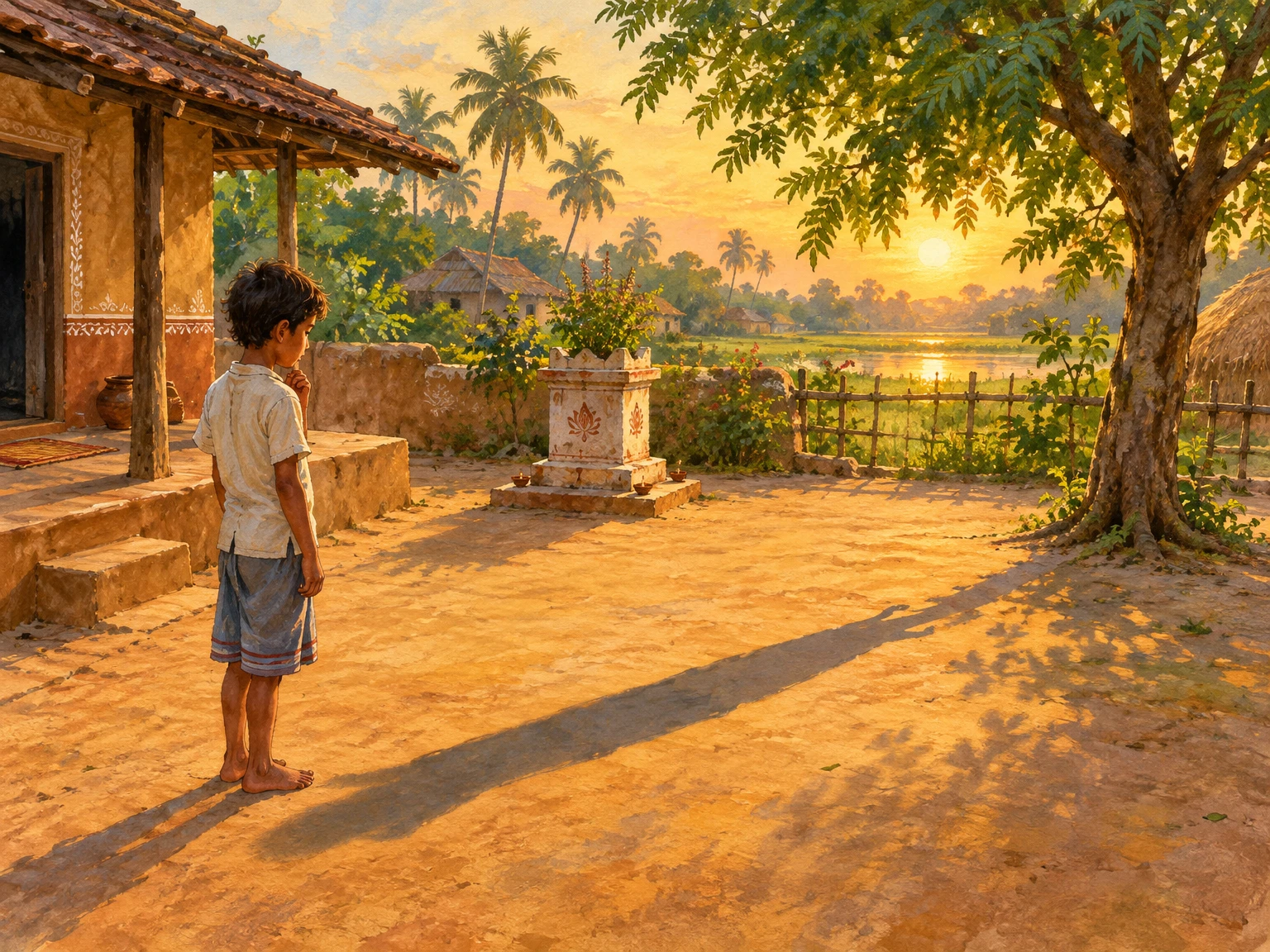
An original story about paying attention, asking careful questions, and discovering that an ordinary shadow can become a window into the moving sky.
1. The little shadow
In a village surrounded by rice fields and low, green hills, a boy named Abhijit liked to ask questions that adults sometimes forgot to ask. Why did the pond look silver in the morning? Where did the clouds go when the rain stopped? Why did the same road seem shorter when he ran home than when he walked to school? His grandmother, whom everyone called Aja, never laughed at his questions. She would pause in the middle of grinding spices or sorting lentils and say, “Let us look first. A good answer begins with noticing.”
One clear afternoon, Abhijit came home from school and stopped in the courtyard. The sun was high, and his shadow lay close beneath him. It was so short that his sandals nearly covered its feet. He turned left, then right. The dark shape turned too. He jumped; the shadow jumped. He crouched; it folded down beside him. “You are following me,” he told it, “but you have hardly any legs today.”
His cousin Rina, who was drawing a hopscotch grid with chalk, glanced over. “It is always there,” she said. “You are only noticing it now.” Abhijit felt there was more to discover. If the shadow had changed since morning, perhaps it would change again. He fetched a piece of chalk and marked the place where his toes met the ground. Then he drew a small line to show where the shadow ended. He wrote “after lunch” beside it. It was not a grand experiment. It was a mark on the courtyard, made by a curious child.
2. A question follows him
As the afternoon went on, Abhijit kept glancing at the chalk mark. The shadow seemed to be creeping away from his feet. At first he wondered whether the earth itself had moved under him. The courtyard stones were still, the tulsi plant still stood in its corner, and the wall had not shifted. He asked Rina to stand in the same place. Her shadow stretched farther than before, pointing across the packed earth. They changed places, but the result stayed: the direction and length depended on where the light came from and how high the sun appeared in the sky.
Abhijit wanted to tell his friends, but he wanted something better than “I think.” So he set a short bamboo stick upright in a patch of level ground. He used a little clay at its base to keep it from tipping. Beside the stick he laid a straight twig, then made a new chalk mark at the tip of its shadow. He asked Rina to help him remember the time. She had a small watch, but Aja reminded them that the time on a clock and the sun’s position did not always match exactly. “The sun does not read your watch,” she teased. “Write down both, but let your eyes do their work too.”
They watched for a while, but the shadow moved too slowly to notice from one breath to the next. Abhijit grew impatient. “Maybe it is not moving at all.” Aja sat beside him. “A seed does not look busy either,” she said. “Come back after you have done something else.” That was the first lesson of his small investigation: some changes reveal themselves only when we give them time.
3. The village at evening
Later, when the family prepared for the evening meal, Abhijit returned to the courtyard. Now the sun was lower, and the bamboo’s shadow reached much farther. The afternoon line had been passed. He could see that the shadow pointed away from the sunlit side of the stick. He drew another mark and put a little stone over it so the wind would not confuse his notes. Rina measured the distance with her handspan. It was not a perfect ruler, but it gave them a way to compare one shadow with another.
At the edge of the courtyard, cattle came home along the dusty lane. Their bells made soft, uneven music. The last warm light touched the thatched roofs, and the long shadows of trees crossed the path. Aja called this time “cow-dust hour,” because the returning animals raised a faint cloud of dust that glowed in the sun. Abhijit watched his own shadow stretch nearly to the old well. It seemed like a second boy, taller and thinner, walking ahead of him.
“Why was it small earlier and so long now?” he asked. Aja asked him what had changed. He looked at the sun, then at the stick. “The sun is lower,” he said. “Its light comes from the side, not from above.” Aja nodded. “That is a good beginning. Can you explain it with the stick tomorrow?” She did not give him the whole answer. She trusted him to test the idea. Abhijit went inside thinking about the sun’s path, the stick’s quiet patience, and the marks waiting outside.
4. A morning comparison
Before school the next morning, Abhijit hurried into the courtyard. Dew shone on the grass near the path. The bamboo stick still stood upright, though the clay at its base had dried and cracked. Its shadow was long again, but it pointed in a different direction from the evening shadow. Abhijit called Rina. They marked its end and wrote “morning” beside the mark. At first this surprised him. The evening shadow had also been long, so why did it not lie on the same line?
Aja came outside carrying a cup of tea. She asked them to stand still and point toward the sun without looking directly at it. They could tell where the sunlight came from by noticing the bright ground, the lit wall, and the direction in which the stick’s shadow fell. “A shadow points away from the light,” she said. “As the sun seems to travel across the sky, the direction of the light changes. The shadow turns too.” Abhijit traced an arc in the dust, beginning in the east and ending in the west. It was not a map of the sun’s real movement through space; it was his picture of how the sun appears to move across their sky during the day.
He had heard that the earth spins, but until then it had seemed like an idea from a lesson, far away from the courtyard. Now the turning earth was connected to the change he could observe. The village did not feel as if it were spinning. The trees did not lean. Yet the sun’s apparent journey offered a clue. “So the shadow is telling us where the light is coming from,” Rina said. “And the light is telling us what time of day it is?” Abhijit considered that. “Maybe roughly. We have to be careful about the exact time.” They wrote that down too.
5. The shadow and the stick
Abhijit decided to make their comparison more careful. They chose the same bamboo stick, the same patch of ground, and the same upright position each time. If they moved the stick, even a little, the marks would not be a fair comparison. They used the chalk line between two courtyard stones to place its base. Rina watched whether it leaned. Aja helped them use a plumb line made from thread and a small washer to check that it stood nearly vertical. This was a simple home observation, not a laboratory instrument, but each small improvement made the comparison more useful.
They marked the tip of the shadow before school, after lunch, and near evening. The morning and evening marks were far from the stick. Around the middle part of the day, the shadow was shorter. Abhijit began to see a pattern: as the sun appeared higher, the shadow grew shorter; as the sun appeared lower, the shadow grew longer. But the pattern did not mean that every place on Earth had exactly the same shortest-shadow time, or that the shortest shadow always happened when a clock showed twelve. The sun reaches its highest point at local solar noon, which may not coincide with the clock’s noon.
They also discovered that a shadow’s length depends on the height of the object. The wall’s shadow was longer than the bamboo’s because the wall was much taller. To compare the sun’s position, they needed to compare the same object, not a wall at one time and a stick later. “If we want to compare fairly,” Rina said, “we must keep the thing we measure the same.” Abhijit smiled. She had found the heart of the experiment before he did.
6. When clouds interrupt
On the third day, clouds gathered over the fields. Abhijit had hoped to add another set of marks, but the sun disappeared behind a thick grey blanket. The bamboo still cast a faint, soft-edged shadow, then almost none that he could distinguish from the dim courtyard. He felt disappointed. The experiment seemed to have been spoiled. Aja suggested that clouds were not a failure; they were part of the world they were trying to understand. The sun was still shining above the clouds, but its light was scattered and softened before reaching the ground.
Abhijit noticed that even on a cloudy day, shadows did not always vanish completely. A nearby tree made a pale patch, softer at the edges than the crisp shadow it cast in bright sunlight. The sky itself was bright, and light arrived from many directions after scattering through clouds and air. That made the boundary less sharp. Rina drew two outlines: one dark and crisp on a sunny patch, another pale and fuzzy below the cloud. They labeled them “sharp edge” and “soft edge,” not “sun gone” and “sun present.”
That afternoon taught Abhijit to write down conditions. If he compared a sunny morning with a cloudy afternoon, he should not pretend they were exactly alike. He began adding notes beside each measurement: “clear sky,” “clouds at west,” “ground dry,” or “stick leaning—redo.” The marks were not just numbers. They were records of what was happening when the marks were made. Aja said a careful observer does not hide inconvenient details. Abhijit understood that a good answer is not only a clever idea; it is an idea that has survived honest checking.
7. The doubt from school
At school, Abhijit told his teacher, Ms. Pradhan, about the measurements. One classmate said the sun moved around the earth every day. Another said the earth turned. A third remembered that the earth also travels around the sun. Their statements seemed to argue with one another. Ms. Pradhan drew a small circle for Earth and a lamp for the Sun. She explained that the everyday appearance of the sun crossing the sky is mainly because Earth rotates. Over the course of a year, Earth’s orbit and its tilted axis also shape seasonal changes in the sun’s path and the length of daylight.
“A model is a way of thinking,” she said, “not the thing itself.” She held a ball and turned it slowly under the classroom lamp. A spot on the ball moved from bright to dark as the ball rotated. Abhijit pictured his village turning with Earth, bringing him toward the sunlit side in the morning, facing the sun more directly around the middle of the day, and turning away as evening approached. The picture helped him understand why the shadow changed, but he also knew the ball was only a model. It did not show every detail of Earth’s orbit, local landscape, atmosphere, or the exact path of sunlight.
Ms. Pradhan asked him whether the stick’s shadow could prove the earth was spinning. Abhijit said, “It is evidence that the sun’s apparent position changes, but we need more than one observation to explain why.” She praised that answer. They discussed how scientific explanations combine observation with models and other evidence. A shadow is useful, but it is not a magical clock that answers every question. The same observation can be part of a larger explanation, and we must say what it does and does not show.
8. The garden’s long ruler
Near the school stood a guava tree that cast a long shadow across the yard. Ms. Pradhan invited the class to observe it, but she reminded them not to damage the tree or scratch its bark. They placed a small marker on the ground at the shadow’s tip and returned later. The shadow had moved, so the marker was no longer at its end. The children made a rough diagram showing the tree, the sunlit side, and the direction of the shadow. Then they compared their notes with Abhijit’s courtyard observations.
The class learned that a vertical stick is sometimes called a gnomon when it is used to cast a shadow for telling time or tracking the sun’s apparent path. Ancient people in many places used shadows and simple instruments to observe the sky, but the details of those histories belong to particular cultures and periods. Ms. Pradhan cautioned them not to claim that one village’s stick represented every ancient timekeeping tradition. “We can be curious about history,” she said, “and still be precise about what we know.”
Abhijit liked that history and science both asked for care. He had thought of the stick as a little toy, but now he saw how a simple upright object could help people notice a regular pattern. Still, the courtyard’s stick was not a precision sundial. Its marks depended on where it stood, how vertical it was, the date, the local horizon, and whether the ground was level. The lesson was not that he had invented a clock. It was that people can learn a great deal by watching closely, recording what they see, and remembering the limits of their tools.
9. A second question: can shadows measure?
Rina wondered whether the length of a shadow could help them estimate how tall a tree was. Abhijit had heard that shadows could be used to compare heights, so they asked Ms. Pradhan how to do it fairly. She explained that when sunlight falls on objects at nearly the same time and angle, the heights and shadow lengths can form similar triangles. If they knew the height of a small upright stick and measured its shadow, they could compare the ratio with the tree’s shadow, provided both measurements were made under the same light and on level ground.
The class tried a simple comparison using a short measuring rod and a young tree in an open area. They kept the rod vertical, measured its shadow, and measured the tree’s shadow in the same moment. Their result was only an estimate. The tree’s top was uneven, the ground sloped slightly, and the shadow tip was fuzzy. Rather than announce a perfect height, they described the method and its limitations. Ms. Pradhan said that honest uncertainty is not weakness. It helps another person understand how much confidence to place in a result.
Abhijit saw how one question could lead to another. At first he wanted to know why his shadow was short. Then he wanted to know how it turned, whether its length could help measure, and why a clock did not always show solar noon. Each new question needed a slightly different method. A simple shadow could help illustrate geometry, but a careful measurement required a stable object, level ground, a clear boundary, and a record of the time and conditions. Curiosity opened doors; good method helped him walk through them.
10. The grandmother’s evening lesson
That evening, Aja sat in the courtyard with Abhijit and Rina. The sun had lowered behind the rooftops. The bamboo stick’s shadow stretched across the ground, and the leaves of the neem tree made a shifting pattern on the wall. Aja asked the children to describe what they had learned without using the words “always” or “never.” Abhijit said, “On a clear day, with the same upright stick on the same ground, its shadow is usually longer when the sun appears low and shorter when the sun appears high.” Rina added, “And it points away from the light.”
Aja nodded. “You have made your sentence more careful than the first one.” She told them that family sayings and observations can hold useful knowledge, but a saying is not a substitute for checking. Some old sayings describe a common pattern; some are poetic; some depend on local conditions. The children could respect what elders knew while still asking what a saying meant and whether it applied in every case. Aja said her own grandmother had used the length of afternoon shadows to decide when to bring the cattle home, but she had never called it a scientific measurement.
Abhijit realized that knowledge did not belong only in books or only in stories. People watched seasons, animals, light, and weather because daily life asked them to pay attention. A written record could preserve a careful observation; a story could help someone remember it; a model could explain a pattern; a conversation could reveal an assumption that needed checking. None of these forms had to compete. The best learning often came when they supported one another without pretending to be the same thing.
11. The morning of the demonstration
At the end of the week, Ms. Pradhan asked Abhijit and Rina to explain their observations to the class. They brought the bamboo stick, chalk, thread, and a page of notes. Abhijit began with the first mark, the short shadow after lunch. He showed the later marks and described how the shadow grew longer toward evening. Rina pointed to the morning mark, which lay in another direction. They told the class that they had used the same stick and the same patch of ground to make the comparison fairer.
One student asked whether the shadow would be shortest at exactly twelve o’clock. Abhijit remembered Aja’s warning. “Not necessarily,” he answered. “Clock time is set by time zones and local conventions. The sun reaches its highest apparent point at local solar noon, and that can be earlier or later than twelve on our clock.” Another student asked whether the shadow disappeared when the sun was overhead. Ms. Pradhan explained that at some places and times the sun can pass close to overhead, making a vertical object’s shadow very short, but whether this happens depends on location and date. It is not a universal daily event for everyone.
Then Rina showed the cloudy-day drawing. She explained that clouds softened the shadow’s edges because light scattered through the clouds and came from a broader area of the sky. They did not claim that every cloud makes a shadow vanish or that all shadows look equally sharp. Their notes showed different conditions. The class asked questions, and Abhijit found himself saying “we did not measure that” more than once. He was surprised to discover that not knowing something could make the presentation stronger when he said it plainly.
12. A shadow at dawn
On Saturday morning, Abhijit woke before the village rooster finished its first call. He stepped into the courtyard with the bamboo stick. The eastern sky was pale, and the first warm light reached the wall. The shadow lay long across the earth, pointing away from the bright horizon. He placed one final mark beside the others and wrote “early morning.” Beside it he sketched the little stick, not because the drawing was beautiful but because he wanted to remember what he had measured.
When Aja came outside, Abhijit told her that a shadow was not a creature following him. It was a patch of ground receiving less direct light because the stick stood between the light source and the ground. Its length and direction changed as the sun’s apparent position changed. “And what made the sun seem to move?” Aja asked. “Earth’s rotation is the main reason for the daily journey we see,” he answered. “But the exact path and daylight also change through the year because Earth is tilted and travels around the sun.”
Aja smiled. “You have learned to hold more than one idea at once.” The village began to wake. Someone swept a doorway, a bicycle bell rang on the lane, and smoke rose from a cooking fire. Abhijit looked again at the marks on the ground. They did not tell him everything about the universe. They did something better: they helped him ask a clearer question. He folded his notes into his schoolbag, ready to share them. The shadow would change again tomorrow, and he would still have more to learn.
What Abhijit’s observations show
A shadow forms when an object blocks some of the light reaching a surface. For a simple upright stick outdoors, sunlight travels in nearly straight lines through the air and the stick blocks part of that light. The region behind it receives less direct sunlight and appears darker than the surrounding ground. Because the sun is an extended source rather than a tiny point, and because the atmosphere scatters light, shadow edges are not always perfectly sharp. The closer an object is to the surface, and the broader the source of light appears, the softer the boundary may look.
The sun appears to travel from east to west across the sky during a day chiefly because Earth rotates from west to east. As the direction of sunlight changes relative to a vertical object, the shadow’s direction changes too. It points generally away from the sunlit direction. When the sun is low above the horizon, the rays meet the ground at a shallow angle and an upright object can cast a long shadow. When the sun appears higher, the shadow is generally shorter. Near local solar noon, when the sun reaches its highest point of the day, a vertical object’s shadow is usually at or near its shortest for that day.
These are patterns, not promises of identical measurements everywhere. Local terrain, buildings, latitude, date, season, object height, ground slope, cloud cover, and the object’s exact orientation can affect what an observer sees. A clock’s noon is not necessarily local solar noon. Some places experience the sun passing near the zenith at certain dates, while others do not. A classroom measurement can illustrate the relationship between light direction and shadow length, but it should not be presented as a precision astronomical observation unless the equipment and method justify that claim.
A simple observation anyone can try
Choose a clear, open place where you can safely observe the ground without looking directly at the sun. Set a short stick upright in firm, level ground, or use a fixed pole already in place. Mark the stick’s shadow tip with a small stone or chalk, then note the time and the weather. Return after a reasonable interval and mark it again. Keep the stick in the same place and do not move it between observations. If you compare length, measure from the base to the shadow tip using the same tool each time. A ruler or tape is more consistent than a handspan, though a handspan can still show a rough difference.
Record the date as well as the time. A shadow observed on a different date may not follow the same path at the same clock hour because the sun’s apparent daily path changes during the year. Note whether clouds are present and whether the ground slopes. If the shadow has a fuzzy boundary, choose a consistent point on the edge and describe how you chose it. Do not stare at the sun, even when it is low or partly hidden by cloud. You can infer the light’s direction from bright surfaces and the shadow itself. Stop if the observation would require looking toward the sun or entering an unsafe area.
For a group activity, one person can mark the shadow, another can measure, and another can keep the notes. Compare results only after checking that the stick stayed upright and the group used the same reference point. If one result looks surprising, repeat the measurement and ask what may have changed. The purpose is not to force every observation to match an expected answer. It is to learn how to collect evidence, notice variation, and improve a method without hiding uncertainty.
Why stories and science can sit together
This tale is an original work of fiction inspired by a child’s curiosity about a familiar phenomenon. Abhijit and his conversations are imagined; the scientific notes are separate from the invented scenes. A story can give a question a face and a place. It can help readers picture the moment when a child stops, looks, and decides to return later. The explanation of shadow formation, Earth’s rotation, and the changing apparent position of the sun should still be evaluated on its own merits, using reliable educational references.
When writing about nature, it is useful to distinguish observation from interpretation. “The shadow reached the second chalk line” is a record of what was seen. “The sun’s apparent height changed” is an explanation supported by the pattern and by our understanding of how light and Earth’s rotation work. “The sun chased Abhijit across the courtyard” is poetic language, not a literal account. Readers can enjoy a metaphor while recognizing that it is a metaphor. Clear labels protect both imagination and accuracy.
The most important lesson in Abhijit’s week is not that he found a final answer to every question. He learned to keep the conditions steady, to write down what he saw, to revise a claim when the evidence was more complicated, and to say when he had not measured something. Those habits make stories of discovery more believable and real investigations more useful. Curiosity begins with a small pause; understanding grows when we return, compare, and think carefully.
Before school the next morning, Abhijit stepped outside once more. The air was cool, and the eastern sky was beginning to brighten above the fields. The bamboo stood where it had stood all week. Its long shadow now reached in the opposite direction from the evening mark. He placed a small stone at the tip and wrote the date and “early morning” beside it, then compared the two observations. The change did not mean that the bamboo had moved; it showed that the Sun’s apparent position across the sky had changed between evening and morning.
At school, Abhijit shared his careful notes with Aja and their classmates. They compared the morning and evening marks and discussed how a shadow’s length and direction can change as the Sun appears to move across the sky. Their simple courtyard investigation did not measure the Sun itself, but it gave them a question they could test again at different times and on different days.
From then on, Abhijit looked at the familiar courtyard with new attention. A shadow was not merely a dark shape following a person or a tree. It was a clue: something to observe, measure, and compare. He kept his notebook close, ready for the next small mystery waiting in the light.
Related learning
For a classroom connection, see NASA’s educational video “Measuring Shadows & Determining Sizes of Angles”. It explores how shadows can be measured and related to angles. The video is an additional learning resource, not evidence that Abhijit is a real person or that the fictional events occurred.
For background on the daily apparent motion of the sun and the way shadows change, see NASA Goddard’s educational page “Stargazers and Sunwatchers.” It is an educational resource; readers should interpret its examples in relation to their own location and the date of observation.
Disclaimer
This content is a collection of ancient history,books and various articles and collection of library and news and other post ; all details may not be the same. Readers are requested to verify the information themselves. Readers are not allowed to take any disciplinary action; content is only for educational purposes. If readers do not agree about the contents, they may send a personal comment to my personal email ID: achary.purna@gmail.com
