
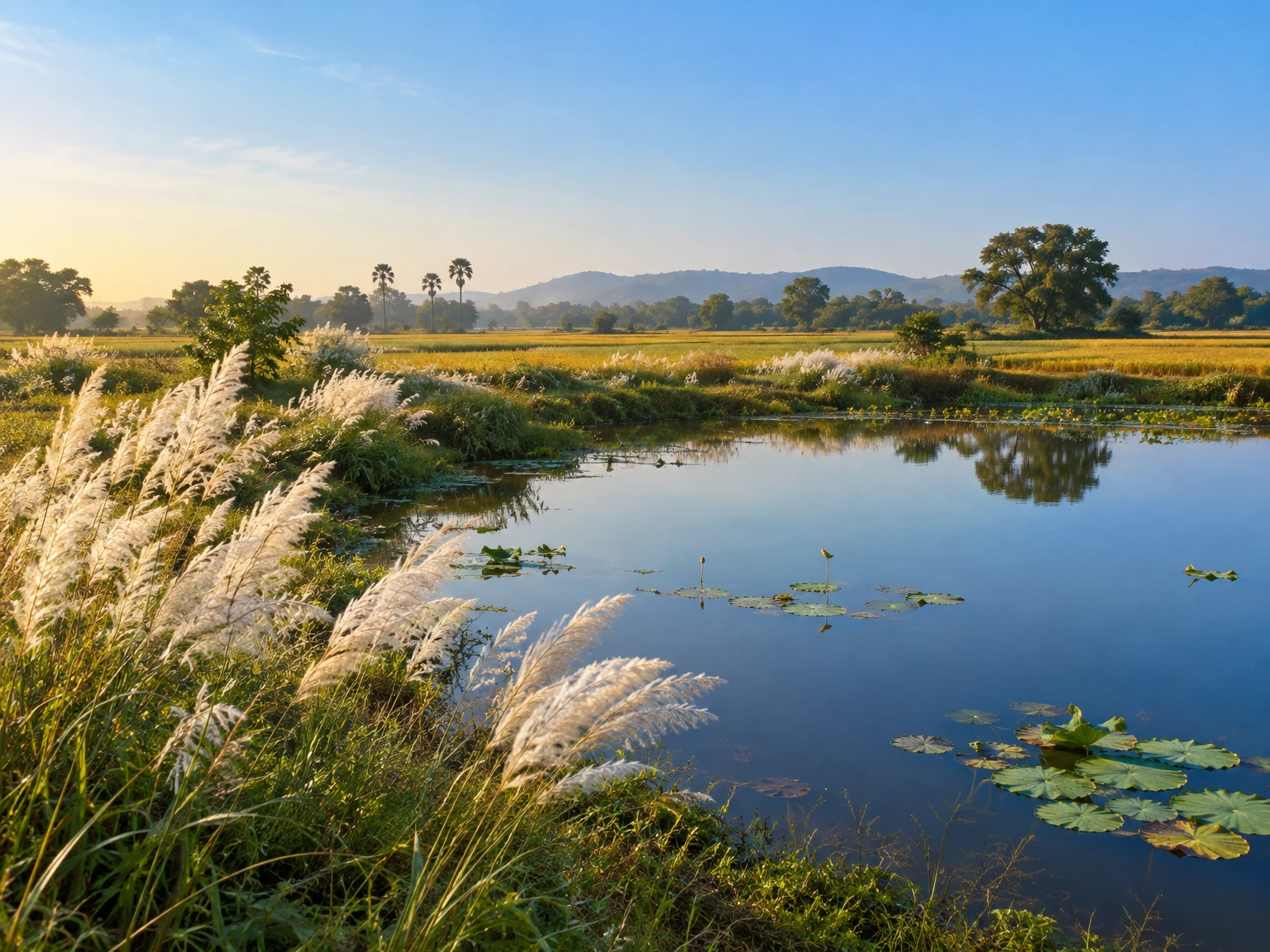
A season between rain and harvest
Sharata Rutu is often translated as autumn, though a season in a traditional calendar is not simply a weather station’s label. In one commonly used Odia calendar table, Sharata is paired with Bhadraba and Aswina; the English months overlap roughly with August through October. The calendar itself notes that different Odia calendar variants are followed in the region. These names help people tell a year through a cultural rhythm, but they do not promise that every district will experience the same weather on the same date. Odisha’s meteorological descriptions use a different, practical division: southwest monsoon generally runs June to September, and the post-monsoon period is October and November. The two ways of dividing the year can illuminate one another without being treated as interchangeable.
That distinction is a useful beginning, not a technical footnote. A season is at once a pattern outside the window and a way people remember, anticipate and interpret change. The calendar gives a name to a span of time; rain gauges, temperature records and local observation describe conditions. A coast, a river basin, a plateau and an eastern hill district will not all perform the same autumn scene. The word Sharata can still offer a shared frame for noticing transitions, so long as the frame is not mistaken for a universal forecast.
The supplied essay imagines an autumn sky opening after monsoon cloud, a riverbank brightened by pale grasses, ponds alive with flowers and dragonflies, crops moving toward maturity, and festival evenings drawing people outdoors. Those are evocative prompts. A responsible retelling can keep their sensory invitation while avoiding invented textbook history, quotations presented as old folk verses, or claims that every listed landscape or custom belongs to the whole state. The result can be both lyrical and careful: a portrait of a season made from verified public facts, qualified observation and openly imaginative reflection.
Light after the rain
At the edge of the rains, a change in light can be more persuasive than any calendar heading. When a cloud gap opens over a wet field, the water on leaves and soil catches the brightness for a moment, then disappears as the day warms. The scene may look newly washed, but it is not a guarantee of clear skies everywhere. Odisha’s monsoon rainfall is substantial and its distribution varies by district; the State Disaster Management Authority describes rainfall as uneven and notes that the southwest monsoon generally withdraws by mid-October. A careful observer therefore speaks of a transition, not a switch that flips across the state on one morning.
That transition can be read as a sequence of small contrasts. A road that was difficult after a shower dries at the crown before it dries at the verge. A pond mirrors a bright patch of sky, while its shaded bank remains damp. The evening air may feel less burdened by moisture in one place and remain warm and humid in another. A poem can notice these differences without turning one household’s experience into a climate rule. The detail is often more beautiful when it stays local: the wet clay on a particular lane, the sound of drops from a roof, the glint on a particular channel after the rain.
The given essay describes high blue skies and delicate clouds. Such imagery belongs to the poem’s invitation rather than a factual promise of autumn weather. The post-monsoon calendar still includes weather variability; the official climate profile notes that rainfall is not distributed evenly. In this retelling, the blue sky becomes a possibility the narrator notices between showers. This small adjustment protects both accuracy and art. A clear moment after rain does not need to represent every day in Bhadraba or Aswina in order to be worth describing.
The river’s changing edge
A riverbank is not a stage decoration. It is a working boundary among water, soil, plants, animals and people. Its appearance shifts with water level, currents, sediment, land use and local rainfall. The Mahanadi, Kathajodi and Brahmani are not one interchangeable landscape; each has its own reach, banks and neighboring communities. A short lyrical essay can name a river as a place of attention, but it should not suggest that one flower or one river condition is present everywhere along it.
The original prompt evokes pale wild grasses by water. Without a reliable botanical source that confirms a particular species and bloom time for all the named districts, a more careful article treats this as a visual motif: light plumes at a wetland edge, or grasses catching the late sun. That approach avoids misidentification while preserving the scene. If a local reader recognizes a plant in a familiar bank, their knowledge can enrich the picture; the article itself does not claim a species identity it has not established.
Water is also a living habitat, not merely a mirror for poetic sky. Odisha’s wetlands support resident and migratory birdlife, and the state’s tourism authority highlights the seasonal birding landscape at Chilika. That official account describes winter arrivals and identifies Mangalajodi and Nalabana as important sites. It is useful evidence for a later point in the year, not proof that a particular flock crosses every autumn riverbank. For Sharata, the more grounded observation is that wetland edges hold different forms of life as water, vegetation and season change. The exact birds depend on site and date.
The poem’s invitation is to look closely without claiming ownership over the landscape. On a walk, one might see a small insect pause above a still patch of water, a bird lift from a reed bed, or a reflection broken by a passing breeze. These are observations to make in person, not assurances that a visitor will encounter a named species. The river teaches a useful form of humility: it keeps changing whether the observer has found the perfect line or not.
Fields in the interval before harvest
The source essay describes paddy moving from green toward grain. That image can be retained with an important qualification: crop stage and timing vary by variety, district, planting date, rainfall and field conditions. No single seasonal description can stand in for every farm. Government crop advisories are therefore organized by zone, district and crop stage rather than by a single statewide picture. The Ministry of Agriculture’s crop calendar and the IMD’s agrometeorological bulletins are practical reminders that agricultural decisions depend on current, local information.
A field is not simply a painted rectangle whose color changes on cue. Paddy has a life cycle, and the farmer’s decisions respond to water, seed, soil, weather and labor. In some places during a particular year, a field may be in a stage of active growth; elsewhere, harvest work may be closer. A responsible literary account can say that Sharata invites attention to the approach of maturity in some agricultural landscapes, while explicitly declining to assign a universal harvest date. This is more truthful than inventing one state-wide chronology.
The observer can still imagine the texture of that work. A bund separates one plot from another; water may be held or released through a channel; leaves bend in wind; a person pauses to inspect the crop. These details do not require a claim that every farmer uses the same method, tool or schedule. The farmer’s knowledge is situational and accumulated. The article should not romanticize labor as a timeless rural tableau, nor turn a person’s livelihood into a symbol without acknowledging the decisions and uncertainty involved.
Modern agriculture is likewise not a neat story of old tools disappearing and new machines arriving everywhere. Technology, irrigation, market access and mechanization differ by place and household. The original essay speaks of both bullocks and tractors, but it offers no evidence for a universal timeline or pattern. This article therefore treats change as a subject for careful local reporting, not as a decorative claim. If future reporting names a machine, seed, procurement center or public scheme, it should verify the specific source and date rather than rely on a generalized seasonal picture.
The fields also remind the reader that food is collective work. Grain reaches a meal through soil preparation, planting, water management, harvesting, processing, storage, trade and cooking. Those steps involve different people and different kinds of knowledge. A story about a seasonal crop can honor that network without claiming that all households share the same role or ritual. The golden image is beautiful, but the work beneath it deserves more than a metaphor.
Festivals are particular, not universal
Odisha’s public cultural calendar offers reliable examples of autumn observance, but festivals are not identical across communities or locations. The Government of Odisha lists Durga Puja in September–October and describes Cuttack’s public celebrations and immersion procession. The same government source discusses Saraswati Puja and Dola Purnima elsewhere in the year. The important lesson for this autumn essay is not to collect every festival into a single season; it is to name only those supported by a suitable source, describe the location or scope, and leave room for variation in local practice.
The prompt’s treatment of Kumar Purnima as a moonlit celebration is a meaningful cultural lead. A 2015 Odisha Review article by Prafulla Chandra Mohanty discusses Kumar Purnima in Odishan culture, including an account centered on Ganjam and its observances on the full moon of Aswina. That is a specific author’s account, not a license to state that every family celebrates in the same way. A respectful description can say that the article records particular practices and that forms of observance can vary. It should not claim a single motive, song or rite is shared uniformly by all young people or all villages.
Durga Puja also has multiple local forms. A government description of Cuttack emphasizes the city’s mandaps and the immersion procession by the Kathajodi; those are situated details. A contemporary tourism account notes that Cuttack, Bhubaneswar and Puri each express the festival in distinctive ways. Such sources help the writer resist a flattened phrase like “Odisha celebrates in one way.†The atmosphere of a festival may be shared by visitors and residents, but the religious meanings and community practices remain particular.
A public celebration can be described through what a source actually establishes: an event, a location, a calendar placement, or a named public practice. A writer should be cautious about broad claims such as “festivals break down all social barriers†or “everyone participates,†because they describe social outcomes not proven merely by a festival page. An image of lamps or a procession can convey sound, light and movement; it should not be made to prove a social condition. Cultural writing becomes more generous when it distinguishes what is observed from what is inferred.
The atmosphere after rain may make an outdoor gathering feel different from a humid afternoon. That is a personal sensory contrast, not a claim that the season caused a particular social transformation. People attend for many reasons: devotion, family, art, work, friendship, curiosity or obligation. A thoughtful narrative leaves those motives open unless a source or participant has made them clear.
A literary season without invented quotations
Odia literature has a rich and diverse history. The Government of Odisha’s overview describes poetic traditions ranging from Charyapada verses through medieval kavya, devotional and other forms to modern poetry. It identifies major authors and literary developments, but it does not establish that each named poet wrote a particular poem about Sharata. That distinction matters. A writer may celebrate Odia poetry as a broad cultural inheritance without assigning a seasonal line to a poet without an edition, text and reliable attribution.
The supplied essay contains a line presented as a traditional verse and names several poets as recurring autumn voices. No dependable source has been established here for that exact quotation or each attribution. This article therefore does not reproduce it as folk poetry or claim that a named poet wrote it. Instead, it offers a new, clearly original reflection: after a rain, a road can hold the sky for a few minutes in a shallow pool; when a wheel passes, the image breaks, and the sky remains above. The observation is newly composed, not an inherited quotation.
Literary writing about seasons often does something different from meteorology. It may use cloud as a sign of longing, light as a metaphor for clarity, or a harvest as an image of patience. These are interpretive choices, not scientific descriptions. A poem can say that the mind feels clearer under a bright sky; it should not imply that autumn weather medically improves cognition or resolves distress. Metaphor belongs to the reader’s imagination, not to a clinical promise.
The Odia literary tradition also includes performance, song, devotional writing, storytelling and forms passed through print and oral exchange. A web article should be modest about what it can establish. A general state literature page is a starting point for context, not a substitute for a primary text. If an exact verse is important, the editor should consult a reliable published edition or a rights-cleared source, preserve the text accurately and attribute it correctly. When that evidence is absent, original writing is the more honest choice.
A new seasonal poem can still feel rooted in place without borrowing a line. It might follow a rainwater bead on a leaf, a quiet field path, or the gap between a cloud and its reflection. It might describe a person returning from the market as the sky turns copper. Such images are not claims of an ancient tradition; they are creative work made now. They can speak with the landscape while making no false claim about who said them first.
Sharata as a way of noticing
What does a season teach? That question belongs to philosophy, not to a weather bulletin. The answer may be that change arrives in small increments: dampness lessens in one place, a field matures at its own pace, a public calendar approaches a festival, and the evening light shifts. A person may read those changes as a lesson in patience, but this is an invitation rather than an authoritative doctrine shared by all Odias.
One possible reflection is that clarity is not the same as certainty. A bright patch of sky can make the landscape visible, but it does not reveal the whole year ahead. Likewise, a source may tell us when a festival is listed or how an official agency defines a season, while leaving many questions unanswered. Good attention keeps both the light and its limits in view.
Another reflection is that beauty and work inhabit the same field. A line of rice plants can be striking, but the crop is also food, income and labor. A wetland can be a place of wonder for a visitor and a living environment connected to local livelihoods. A festival can be visually elaborate and spiritually meaningful, while also depending on the skill and effort of craftspeople, organizers, performers and caretakers. To notice beauty without erasing work is a more complete form of admiration.
A third reflection is that a shared season does not produce identical lives. The six-ritu calendar can offer a common vocabulary, while a fisher, a cultivator, a city student, a craft worker and a visitor encounter different parts of the year. The climate of the coast differs from the hills; a public festival calendar describes events, not every person’s private experience. A seasonal essay can hold these distinctions without losing its lyric quality.
The title’s “crown†need not mean that Sharata rules over the other seasons. It can mean a moment of attention: the blue opening between clouds, a low sun on a water edge, the brief pause before another shower. A crown made of light is not a fixed object. It appears, changes shape and is gone. Its passing is part of its beauty.
A walk through the season
Imagine setting out after a morning shower. The path is dark where it is damp and pale where the sun has reached it. A narrow channel carries water toward a lower plot. At the bank, a few grasses lean with their seed heads; no name is assigned to them because this observer has not identified them. The air feels cooler than it did at noon yesterday, though that sensation belongs to this walk and not to every district or day.
A farmer working nearby checks a field. We do not presume to narrate the farmer’s thoughts or methods. We can see the pause, the glance, the decision to move along a bund. The field is not a stage for our metaphor; it is someone’s work and livelihood. We can respect that boundary and still recognize the quiet concentration of a person attending to living plants.
In the afternoon, a cloud passes over the river. The surface loses its glare; then the light returns. A bird crosses the far bank, too distant for confident identification. The observer makes no species claim. Near town, preparations for a public festival may be visible, but the details should be tied to a named place and source if they appear in a report. In an essay, we can simply say that the season’s calendar includes community observances, each with its own meaning and local form.
At dusk, the memory of the day is not one grand revelation. It is a series of small adjustments: water receding, light shifting, work continuing, people gathering for different purposes. A seasonal cycle is made of such transitions. The human mind may turn them into a story, but the story is strongest when it remembers that the landscape is larger than the narrator.
The value of a careful seasonal record
A seasonal essay can function as a record of attention if it separates three kinds of statements. The first is sourced fact: the state’s official climate account divides the year into four meteorological seasons and notes regional differences; a calendar reference pairs Sharata with Bhadraba and Aswina; a government festival page documents Durga Puja in Cuttack; a named cultural article records an account of Kumar Purnima. The second is personal or imaginative observation: the rain-dark path, the shining pond, the bright interval in the clouds. The third is an open question: which plants are blooming in this village this year, what work is happening on these fields, or how a household observes a festival. Keeping the categories distinct makes the writing clearer and invites local knowledge rather than pretending to possess it.
The same method protects against overconfident claims about the past. The original prompt invokes 1980s schoolbooks, but the article does not cite a specific textbook, edition, page or archival record. Therefore it does not say that a particular lesson was taught, that children memorized a particular poem, or that a certain social custom was universal in that decade. Those statements could be investigated in a separate historical project using actual books and dated sources. Until then, the past should not be used as a decorative credential for a present-day essay.
The article also avoids converting a traditional season into advice. Ayurvedic literature and other systems have their own historical frameworks, but a seasonal poem is not a medical guide. No claim here promises health benefits from moonlight, food, climate or ritual. Readers seeking health advice should consult a qualified professional and current evidence rather than treating metaphor as instruction.
This care is not an obstacle to storytelling. It gives each sentence a stable footing. A writer can say “in one account,†“the official page describes,†or “the narrator imagines†rather than pretending all evidence has the same scope. The reader can then distinguish a documented public event from a personal image and a poetic interpretation. Trust is part of the beauty of a story: it lets the reader enter without being asked to accept invented history as fact.
Closing: the light that does not stay
Sharata Rutu can be approached as a threshold: between monsoon and the drier part of the year in meteorological accounts, between one name and another in the calendar, between the vivid memory of rain and the next work of the field. The threshold is not a wall. Weather overlaps, calendar reckoning varies, and regional experience refuses to be reduced to a single scene.
Still, a single scene can be enough. A cloud lifts over the river; a field catches the sun; a wet path briefly reflects the sky. From that small moment, a reader may think about patience, work, cultural memory and change. Those reflections are offered as possibilities, not as fixed lessons imposed on a whole community.
The season’s crown is thus made of passing light. It rests on water, leaves and thought for a moment, then moves on. The land continues its own work, with or without our words. To observe it well is to look closely, speak carefully and leave room for the next person’s account.
Sources and further reading
- Odisha State Disaster Management Authority, “State Profile†(climate, seasons, rainfall variation and regional geography): https://www.osdma.org/state-profile/
- Shreekhetra, “Odia Calendar†(season-to-month mapping; notes calendar variants): https://www.shreekhetra.com/oriyacalendar.html
- Government of Odisha, “Fairs & Festivals†(Durga Puja and other listed observances): https://odisha.gov.in/en/explore-odisha/fairs-festivals
- Government of Odisha, “Literature†(overview of Odia poetic traditions): https://odisha.gov.in/en/about-odisha/literature
- Prafulla Chandra Mohanty, “Kumar Purnima in Odishan Culture,†Odisha Review, October 2015 (a situated cultural account): https://magazines.odisha.gov.in/Orissareview/2015/Oct/engpdf/46-47.pdf
- Odisha Tourism, “National Chilika Bird Festival†(winter birding and wetland context): https://odishatourism.gov.in/en/national-chilika-bird-festival
This content is a collection of ancient history,books and various articles and collection of library and news and other post ; all details may not be the same. Readers are requested to verify the information themselves. Readers are not allowed to take any disciplinary action; content is only for educational purposes. If readers do not agree about the contents, they may send a personal comment to my personal email ID: achary.purna@gmail.com
