
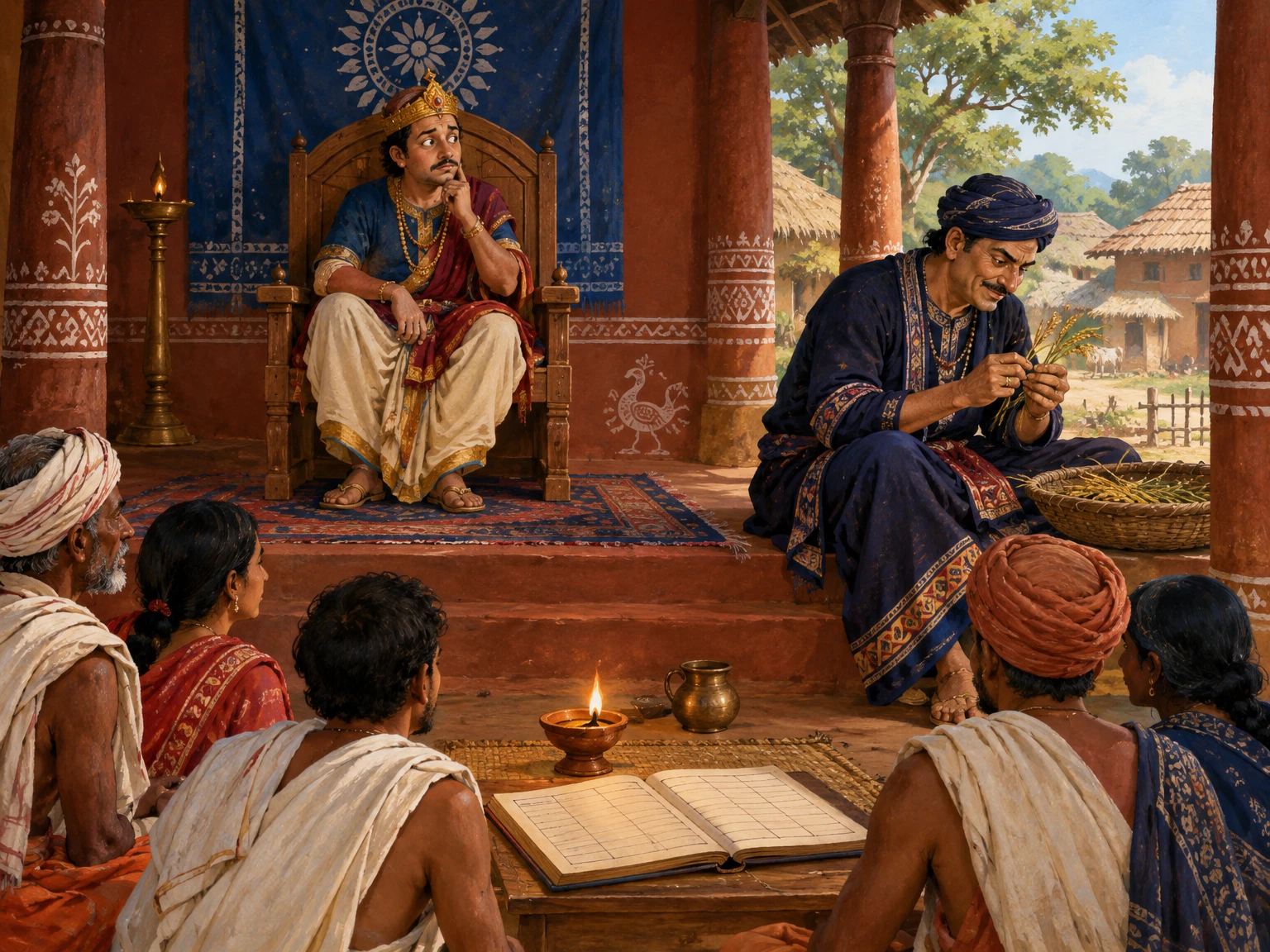
ରାଜା, ମନ୍ତ୍ରୀ ଓ ଜୀବନର ଦର୍ଶନ: ଏକ ଲୋକକଥାର ଆଧ୍ୟାତ୍ମିକ ଓ ସାମାଜିକ ବିଶ୍ଳେଷଣ
The Foolish King and the Narrow Minister: An Odia Folk Tale as a Mirror of Power
Folk stories often carry more than a sequence of amusing events. A compact tale can preserve a community’s questions about authority, judgment, fairness, and the everyday intelligence required to live together. The Odia folk-tale title “Agandia Raja O Pala Chunta Mantri” places two memorable figures side by side: a king whose judgment is unreliable and a minister whose attention is narrow or self-serving. Even before a listener knows every regional version of the story, that pairing invites a useful question: what happens when power and advice fail at the same time?
This essay reads the supplied story as an interpretive lens rather than claiming to reproduce one definitive canonical plot. Oral tales change as they travel: a narrator may sharpen a joke, alter a setting, or give a familiar character a new motive. The central value of the tale is therefore not a single fixed wording. It lies in the durable pattern that its title suggests—a ruler who should see broadly, an adviser who should help him see clearly, and a public that must live with the consequences of their choices.
1. A folk-tale title that already contains a warning
The title works like a miniature stage. A king normally represents public power, the capacity to make decisions that affect many people. A minister is expected to provide counsel, interpret circumstances, and help turn intentions into workable policy. When both roles are marked by foolishness or narrowness, the audience immediately senses a problem. The title does not need a long explanation to establish the comic tension: those entrusted with the largest view may be the least capable of seeing what is in front of them.
That tension is a common strength of folk narrative. Instead of beginning with an abstract lecture on governance, a tale gives listeners recognizable roles and lets their conduct expose a contradiction. The king may possess a throne, attendants, and the right to issue commands, but none of these guarantees wisdom. The minister may hold an impressive title, but a title cannot make a self-interested calculation serve the common good. The story’s first invitation is to distinguish the appearance of authority from the quality of judgment.
The comic label also helps the tale travel. A listener can remember two contrasting figures after hearing the story once. A storyteller can use the pair to introduce a joke, a reversal, or a moral observation. Children may first enjoy the absurdity of a foolish ruler and an unhelpful counsellor; older listeners may notice the institutional criticism beneath it. This double audience is not a flaw. It is how a memorable folk tale can remain available to different ages and circumstances.
2. The king: authority without self-command
The supplied interpretation describes the “Agandia Raja” as a ruler without restraint, foresight, or sound judgment. Read carefully, that description is not merely an insult to one fictional person. It names a condition in which someone with influence reacts to impulse, ego, or immediate appetite rather than examining what a decision will do. The king’s deficiency is therefore not simply that he makes mistakes. All leaders make mistakes. The deeper danger is that he cannot pause, ask what he does not know, or accept that another person might see more clearly.
Self-command matters because public authority magnifies private habits. A person with little power may make an unwise choice that affects only a small circle. A ruler’s whim can become a rule, consume shared resources, or send other people into risk. In a folk tale, the distance between a foolish thought and a public consequence can be compressed into comic scenes. That compression is not a claim about any real ruler; it is a narrative way to show why responsibility must grow alongside authority.
The king’s position also makes the story’s criticism morally interesting. The tale does not need to deny that a king has a formal role. Rather, it asks whether formal rank is enough. A crown is an office, not evidence of discernment. The moral contrast is between what a ruler is entitled to command and what a responsible ruler ought to understand. The audience can laugh at the gap while recognizing that it is not harmless: people below the throne carry the cost of decisions made above them.
3. The minister: advice reduced to private advantage
A minister’s role is powerful precisely because it is less visible than the king’s. Advisers shape what a leader hears, which options appear practical, and whose concerns enter the room. The phrase “Pala Chunta” is interpreted in the supplied material as suggestive of narrow attention, small calculations, or self-interest. In this reading, the minister is not a counterweight to the king’s folly. He deepens it by bringing the perspective of someone who should know better but chooses convenience or gain over honest counsel.
That makes the minister’s failure distinct from the king’s. The ruler may lack judgment; the adviser may understand that the situation is more complicated but still choose not to say so. A good adviser has a duty to make reality harder to ignore, especially when a leader wants easy praise. Flattery feels helpful in the moment because it protects a leader from discomfort. Yet it deprives the leader of the information needed to correct an error. In the tale’s symbolic pair, silence or self-serving advice is not neutral. It becomes part of the decision.
The minister also embodies a problem familiar outside royal courts: people can occupy responsible positions while attending only to the smallest private reward available. A teacher who hides a mistake, an official who protects a favourite, or a manager who reports only good news may reproduce the same pattern at a smaller scale. The story is not saying that every adviser is corrupt or that every official is foolish. It is asking whether counsel remains counsel when it is designed mainly to please or profit.
4. The relationship between ruler and adviser
Power rarely operates alone. A ruler depends on interpreters, administrators, messengers, and people who know the details of daily life. Advice is therefore a relationship, not a decorative speech before a command. The king needs information that can test his assumptions. The minister needs enough independence to tell the king what he may not wish to hear. If either side treats this exchange as theatre, the court can look busy while learning nothing.
The folk-tale pairing makes this mutual dependence easy to see. A ruler who wants only agreement can recruit an adviser who supplies it; an adviser who seeks only favour can encourage a ruler’s worst instincts. Each may excuse the other. The king can say that he followed his minister’s recommendation, while the minister can say that the king made the final decision. The result is a familiar circle of blame in which no one accepts responsibility and the public cannot identify who will repair the harm.
A healthier relationship requires more than personal courage. It needs habits that make honest counsel possible: accurate records, time to consider alternatives, access to people affected by a decision, and permission to revise a plan when evidence changes. In a small household, these habits might mean listening before settling an argument. In an institution, they may require transparent procedures and a clear record of reasons. The tale’s court becomes a useful metaphor because it puts those ordinary disciplines into a dramatic setting.
5. The comic surface and the moral underneath
Humour can reveal what solemn language hides. When a powerful person behaves foolishly, the audience may laugh because rank has not prevented an avoidable mistake. The laughter briefly reverses the usual direction of respect: instead of treating the ruler as untouchable, the listeners inspect him. That is one reason comic folk stories can carry social criticism without sounding like a formal accusation. A joke can make a contradiction visible while giving the community a shared way to discuss it.
Comedy also gives the audience a measure of distance. It is easier to examine vanity, greed, and bad judgment when they belong to a story character than when they are attached to someone nearby. But the distance is not an invitation to avoid reflection. The best comic tale lets listeners return from the fictional court with sharper eyes for their own habits. If the king is ridiculous because he refuses correction, the question is not only “Why is he so foolish?” It is also “What kinds of correction do I resist when I feel secure?”
The tale can therefore be enjoyed at more than one level without forcing a single solemn interpretation onto it. A child may enjoy the exaggeration. A family may talk about fairness. A reader interested in politics may notice the role of advisers and accountability. These responses can coexist. Folk literature remains alive partly because it can offer pleasure first and meaning afterward, allowing listeners to discover a lesson rather than receive it as a scolding.
6. Practical intelligence is not the same as cleverness
The supplied text contrasts bookish pride and imagined superiority with practical thinking. That distinction deserves care. Learning, expertise, and formal education are valuable; the tale need not dismiss them. The problem is knowledge that is never tested against circumstances. A person may know impressive terms and still miss what a neighbour needs, how a plan will work, or what a small change will cause. Practical intelligence asks how an idea behaves in the world, not merely how convincing it sounds in a speech.
Nor is cleverness always wisdom. Someone can find a quick way to win an argument, avoid a duty, or secure a personal benefit without understanding the wider consequences. The minister’s narrowness, as interpreted in the source, points toward this danger: calculation can be sharp and still be morally small. Wisdom requires attention to people beyond oneself, a sense of proportion, and willingness to update an opinion when facts change.
In everyday life, practical intelligence often looks modest. It may be noticing that a plan needs another person’s consent, checking whether a resource will last, or asking a worker what obstacle they face before issuing a new instruction. Such actions rarely look heroic. They are valuable because they connect intention to reality. A folk tale’s exaggeration helps us see the absence of this connection: the ruler and adviser may have authority or cunning, yet the community needs something more grounded.
7. Ego, ignorance, and the refusal to learn
Ignorance by itself is not a permanent moral failure. Every person begins with incomplete knowledge, and responsible people can admit what they do not know. The more serious danger is ignorance protected by ego. When a person believes that acknowledging a gap will diminish them, they may conceal uncertainty behind a confident order. The king imagined by the source is dangerous not because he lacks all information, but because self-importance may prevent him from seeking it.
Ego can distort the way evidence is received. Praise feels like confirmation; criticism feels like an attack. A leader then learns to reward the people who preserve a flattering picture and avoid those who bring inconvenient facts. Over time, the leader’s information environment becomes less accurate even if everyone around him is speaking constantly. The minister’s role matters here: if counsel is shaped by self-preservation, the ruler’s confidence becomes even less connected to reality.
The counter-habit is intellectual humility. It does not require indecision or self-doubt about every matter. It means being willing to say, “I may be missing something,” and to identify what evidence would change one’s mind. In a family or team, that habit can prevent a small disagreement from becoming a contest over status. In public life, it can reduce the chance that an error becomes policy merely because the person who made it is too proud to revise it.
8. How a bad decision becomes a system
A story about a foolish king can be read as criticism of individual character, but the source also points toward “systemic” failure. This matters because institutions can amplify mistakes or correct them. If every decision depends on one person’s mood, the system has no reliable way to protect people from that mood. If advisers are rewarded for agreement, the institution filters out useful disagreement. If records are missing, the same failed idea can return under a new name.
Systems are not abstract machines separate from people. They are habits, rules, incentives, and relationships repeated until they shape what people expect. A court that punishes candour will not suddenly become honest because it changes the wording of a rule. A workplace that praises speed but ignores consequences will teach employees which numbers matter. The tale’s two figures let us imagine the personal and structural sides together: a careless ruler can be dangerous, and a court that lets carelessness pass without review can make the danger durable.
A practical lesson follows: do not rely on one admirable person to rescue a weak process. Good leaders are important, but durable safeguards help ordinary people raise concerns, verify claims, and correct mistakes. Decisions affecting others should have reasons that can be examined. People responsible for implementation should be able to report what did not work. The folk-tale court is a simplified picture, but it helps readers ask whether their own institutions make learning possible or merely give errors a grander stage.
9. The people outside the court
The supplied analysis calls the king a symbol of social consciousness and notes that subjects experience uncertainty when leadership fails. That observation shifts attention from the ruler’s embarrassment to the public’s burden. A foolish decision may be funny to an audience that watches from a safe distance; it is less funny to the people who must carry it out. The story’s social meaning depends on remembering those who are not seated near power.
In real communities, the people most affected by a decision may also have the least access to the decision-making room. Farmers, workers, children, families with limited means, and people living far from administrative centres may know practical consequences that officials do not see. Listening to them is not a courtesy added after the “real” work. Their knowledge can reveal whether a policy is workable and whether its costs fall unfairly on one group.
Folk storytelling itself can be understood as one way communities preserve observations about authority. A tale can carry a public’s judgement across generations, especially when direct criticism would be difficult or unwelcome. That does not prove that every version was intended as political protest. It does show how a comic story may make space for the listener’s perspective. The king may control the court in the story, but the audience controls how his actions are remembered and interpreted.
10. Accountability without cruelty
Calling a ruler or adviser foolish can become an easy substitute for understanding a failure. Accountability should be more useful than humiliation. It asks what decision was made, what information was available, who was responsible for which part, who was harmed, and what repair is possible. The story’s comic judgement can open the door, but a fair response must then identify actions rather than treating a label as a complete explanation.
This distinction is important because accountability is not revenge. A leader who made an error may need to acknowledge it, correct the decision, compensate people where appropriate, or step aside from a role if trust has been irreparably damaged. An adviser may need to explain why relevant facts were omitted. The right response depends on the nature of the harm and the responsibilities involved. What should not happen is an endless cycle in which everyone blames someone else while the affected community receives no remedy.
Accountability also includes the possibility of learning. A person who admits an error and changes the process may become more reliable than one who never encountered a challenge. This does not erase the harm or remove the need for repair. It recognizes that a just system should both answer for past decisions and reduce the chance of repeating them. The folk-tale pair warns against unexamined power; it can also inspire listeners to imagine a court where responsibility is clear and correction is possible.
11. Speaking truth to power
The supplied material observes that in the imagined kingdom no one has the courage to tell the truth or offer sound judgement. Silence can arise from fear, dependence, fatigue, or the belief that speaking will make no difference. A person may know that a decision is wrong and still calculate that challenging it is too risky. The tale’s warning is strongest when it treats silence not as a mysterious flaw in ordinary people but as a predictable response to a culture that punishes honest speech.
That does not mean every person must confront a powerful figure in the same way. Safety and context matter. Courage can mean asking a question in a meeting, documenting a concern, finding an ally, or using a trustworthy process. A leader has a particular duty to make candour safer because the leader often controls the conditions under which others speak. It is unfair to demand bravery from people while rewarding the person who retaliates against them.
Good listening is a practice, not a slogan. Leaders can ask for disconfirming evidence, hear from people close to the work, and refrain from punishing a messenger for an unwelcome fact. Advisers can distinguish confidence from proof, and communities can value people who correct errors rather than only those who defend authority. A folk story cannot prescribe every procedure, but it can leave a lasting image of what happens when truthful counsel disappears.
12. The ethics of advice
Advice is an ethical act because it can change another person’s choices. A minister’s counsel is not merely a display of intelligence; it is a responsibility to help someone see consequences that may otherwise remain hidden. The adviser should state what is known, what is uncertain, whose interests are affected, and what alternatives exist. Advice that conceals uncertainty or flatters the listener may sound decisive, but decisiveness is not the same as care.
The story’s narrow minister can help readers examine the motives behind their own recommendations. Do we advise a friend in a way that helps them, or in a way that makes them approve of us? Do we tell a colleague what will make the project succeed, or what will protect us if it fails? These questions are uncomfortable because motives are often mixed. A person may care about the outcome and also want recognition. Ethical advice does not require perfect motives; it requires honesty about evidence and attention to the people who will bear the results.
There is also a limit to an adviser’s role. A counsellor should not seize the leader’s responsibility by pretending that the final choice belongs to someone else. Nor should the leader use the adviser as a shield against accountability. Advice contributes to a decision; it does not dissolve ownership of it. A trustworthy relationship makes this division clear: the adviser gives candid counsel, and the decision-maker remains answerable for the choice.
13. A tale for children, families, and classrooms
For young listeners, the story can begin with simple questions. What makes a decision fair? Should a person with an important title always be right? What would a helpful adviser say when a king makes a mistake? These questions invite children to distinguish respect from unquestioning obedience. They can learn that listening to someone does not mean accepting every claim, and that admitting a mistake can be a sign of responsibility rather than weakness.
Adults can keep the discussion grounded by avoiding a forced lesson. Ask children what the characters might have noticed, who was left out of the conversation, and how the problem could be repaired. If a particular oral version contains events not present in the written source, a storyteller can explain that stories differ and invite listeners to compare them. That approach teaches both literary curiosity and respect for the living nature of oral tradition.
In a classroom, the tale can support work across subjects: language and storytelling, ethics, civics, and creative performance. Students might retell the same situation from the perspective of a villager, a messenger, or a careful adviser. They can then ask how the point of view changes what the audience notices. Such an exercise helps them see that stories are not only about what happens. They are also about who is allowed to describe what happened and whose experience is treated as important.
14. The role of oral tradition and regional variation
Odia oral literature belongs to a broad culture of shared narration, memory, performance, and adaptation. Stories may be told in homes, gatherings, classrooms, or public performances; they may appear in dialect, in polished literary language, or through a modern video. A change in wording does not automatically make a version less meaningful. Oral tradition lives because narrators shape stories for listeners while carrying familiar motifs forward.
For that reason, a single essay should not claim to settle every meaning of “Agandia” or “Pala Chunta” for every region, family, or teller. The supplied source offers one interpretation: the first figure suggests a ruler lacking restraint or judgement, and the second a minister whose thinking is narrow or self-interested. That reading is useful, but language can carry local shades of meaning. Readers who know another version may recognize different emphases and should feel free to add them.
Respect for a living tradition involves crediting the storyteller or source when known, avoiding claims of exclusive ownership over a community’s shared heritage, and distinguishing an original analysis from a verbatim retelling. It also means being cautious when translating a phrase: a literal English equivalent may miss its humour or social register. The tale gains depth when readers treat it not as a museum object but as a conversation among narrators, listeners, and changing generations.
15. A modern lens: leadership in workplaces and public life
Although the story uses royal roles, its questions can be applied to modern institutions without pretending that a king is identical to a manager, elected official, or community leader. The useful comparison is limited: people with decision-making power need accurate information, advisers should be honest, and those affected by a decision need avenues to speak. The tale’s pair becomes a reminder to examine these relationships wherever they occur.
In a workplace, a leader may be surrounded by reports that look orderly while frontline staff quietly know that a process fails. In a public office, an official may receive advice that emphasizes what is easy to measure rather than what people need. In a family, one person may insist on deciding everything while another quietly avoids disagreement. The scale differs, but the pattern of unchecked authority and compromised counsel is recognizable. The appropriate response is not to call every flawed leader a tyrant; it is to improve the quality of listening and responsibility.
Modern accountability also benefits from clear evidence. A decision can be documented, assumptions can be stated, and outcomes can be reviewed. These practices do not eliminate human judgement; they make judgement more visible and revisable. A good leader is not one who never needs advice. A good leader is one who uses advice to understand, decides with awareness of consequences, and returns to the affected people to see what happened.
16. The inner court: applying the story to oneself
The source’s conclusion asks readers whether they sometimes become “Agandia” or “Pala Chunta” in their own lives. This inward turn prevents the tale from becoming merely a weapon against people we dislike. Each person holds a small sphere of influence: a parent over a household decision, a teacher over a class, a supervisor over a team, or a friend whose opinion matters. In any such role, we can become impatient, dismissive, or more interested in being right than in understanding.
To ask whether we have become the foolish king is to ask where we act before reflecting. Do we decide for others without hearing them? Do we treat confidence as evidence? Do we demand loyalty instead of asking for honest feedback? To ask whether we have become the narrow minister is to notice when we offer advice mainly to gain favour, protect convenience, or avoid a difficult truth. These are not accusations that every reader must accept; they are prompts for self-examination.
A practical response can be small: pause before issuing a judgement, ask one person affected by the choice what we may be missing, separate facts from assumptions, and remain open to correction. The goal is not to become perfectly wise. The goal is to prevent ordinary imperfections from hardening into a pattern that harms others. The story’s moral value lies partly in its ability to make self-correction imaginable before a mistake becomes too large to ignore.
17. What the story does not require us to believe
A thoughtful reading should avoid turning a folk tale into a rigid political formula. It does not prove that every ruler is foolish, that every minister is selfish, or that ordinary people always possess complete knowledge. It does not require readers to accept one historical origin for the story when the source does not establish one. It does not provide evidence about a specific government or contemporary person. Its power is interpretive: it offers a pattern through which listeners can consider the responsibilities of authority and counsel.
It is equally important not to turn the characters into fixed labels for real people. Calling someone a fool can stop a discussion where it should begin. A more useful question is what decision failed, which information was ignored, and what would make a better decision possible next time. The tale’s language may invite satire, but a responsible article can preserve the satire while avoiding careless accusations against identifiable people or groups.
Finally, the story need not be reduced to a single lesson about leadership. It can also be about self-control, humility, listening, community memory, or the difference between a clever excuse and a wise answer. A reader may find another interpretation in a version heard from a grandparent or storyteller. Such disagreement is compatible with the tale’s continued life. Interpretation should be open enough to respect variation and disciplined enough to distinguish evidence from speculation.
18. A short reflection for readers
Imagine a decision that affects several people. Before making it, the decision-maker pauses and asks three questions: What do I know? What am I assuming? Who will experience the result first? Then the adviser offers the strongest reason against the preferred option, not to undermine the leader but to help test the choice. This modest scene is almost the opposite of the pairing named in the folk-tale title. It shows how a court, a team, or a household might keep authority connected to reality.
The exercise is simple enough for daily use. When we give advice, we can name uncertainty rather than disguise it. When we receive criticism, we can listen for useful information before defending ourselves. When we hold authority, we can invite voices that do not depend on pleasing us. When we see a mistake, we can ask what repair is possible instead of choosing between denial and ridicule. These habits are not grand philosophical theories; they are small practices that make shared life more trustworthy.
Stories endure because they give people a language for noticing such patterns. The king and minister become memorable not because they are the only people who ever make poor choices, but because they make a hidden relationship visible. One person commands; another advises; a wider community lives with the outcome. The tale’s humour lets us recognize the imbalance, while its moral invitation asks us to build relationships in which truth can travel upward and responsibility can travel outward.
Conclusion: wisdom begins where authority accepts correction
“Agandia Raja O Pala Chunta Mantri” remains a vivid pair of images: a ruler whose judgement needs restraint and an adviser whose counsel needs a wider concern. The supplied interpretation connects them to the dangers of ego, short-sightedness, and self-interest. Read as social criticism, the tale asks whether leaders learn from those around them. Read as personal reflection, it asks whether each of us can recognize the habits that make correction difficult.
The most constructive lesson is not simply “choose wise people.” It is to make wisdom easier to practice: listen to affected people, test assumptions, value practical knowledge, permit honest disagreement, and take responsibility for the results of decisions. A community cannot depend entirely on the virtue of one person at the top. It needs relationships and processes that make truth audible and repair possible. The king needs counsel that is more than flattery; the minister needs integrity that is more than cleverness; the people need to matter beyond the moment when their labour or loyalty is required.
That is why the story can be funny and serious at once. Its characters invite laughter, but the laughter leaves a question behind: when we hold influence, do we use it to protect our pride, or to understand what others need? The answer is not supplied by a title or a throne. It is shown in the willingness to reflect, to hear a difficult truth, and to change course when the common good requires it.
Related Odia oral-story video
For listeners who would like to hear an oral storytelling version associated with this tale, see Agandia Rajanku Pala Chunta Mantri – story telling in Odia. The linked video is a third-party narration; this essay is an original interpretive discussion, not a transcript.
Disclaimer
This content is a collection of ancient history,books and various articles and collection of library and news and other post ; all details may not be the same. Readers are requested to verify the information themselves. Readers are not allowed to take any disciplinary action; content is only for educational purposes. If readers do not agree about the contents, they may send a personal comment to my personal email ID: achary.purna@gmail.com.
