
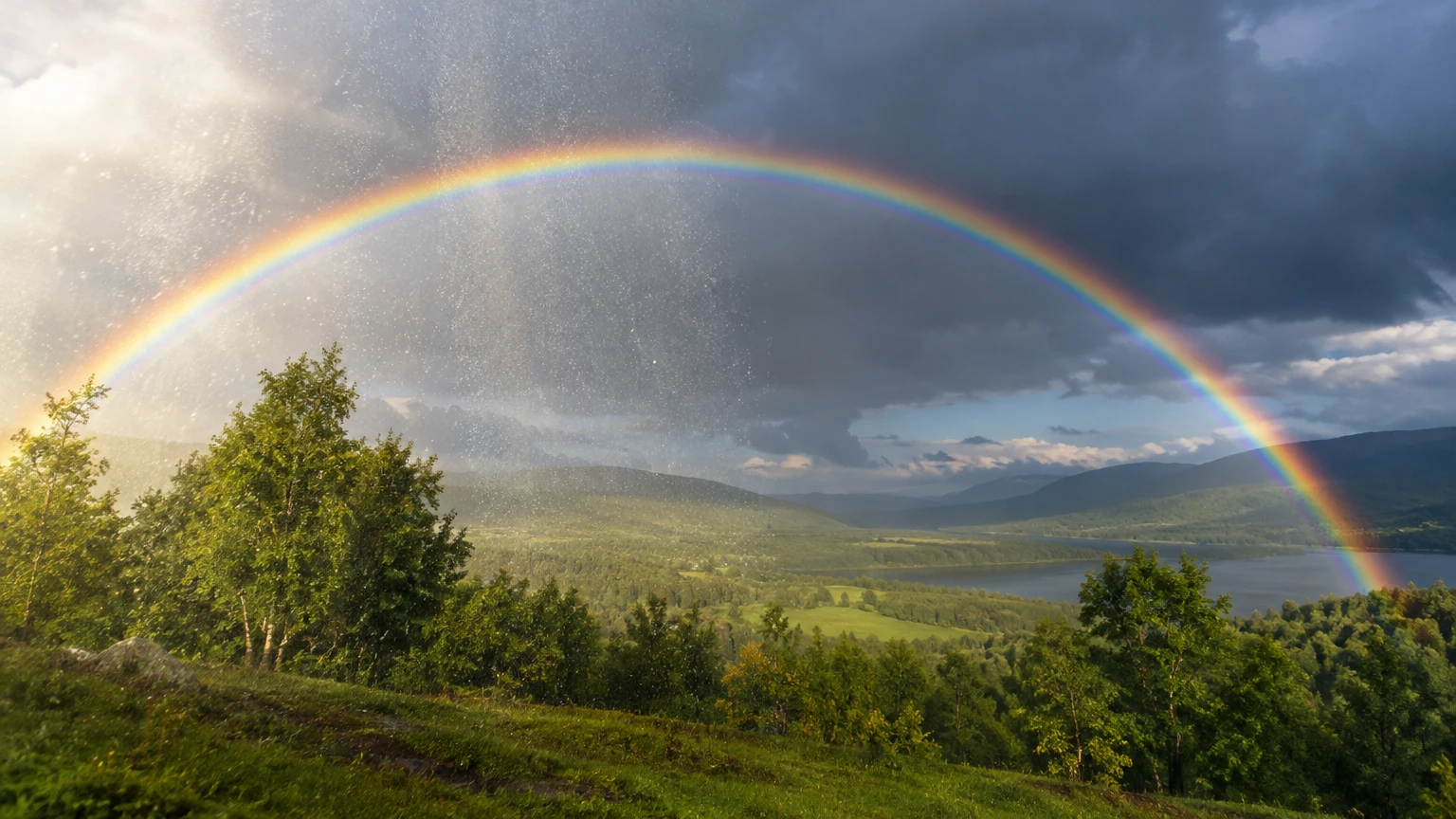
A rainbow seems to hang in the sky like a coloured bridge, but it has no fixed address. Walk toward it and it does not wait in the same patch of air. What you see is a pattern of sunlight returned to your eyes by countless separate water droplets, each in a position that sends a particular part of the light toward you. The bow changes as the observer moves, the Sun shifts, or the droplets drift. Its familiar shape is a meeting point of geometry and optics: a round droplet bends light, separates its colours, reflects some of it inside, and sends it back out.
This account explains the primary and secondary bows, why red and violet change places, why the familiar arc is not the whole circle, and how to look for rainbows safely. The physics is not limited to showers: spray, fountains and waterfalls can supply droplets too. The sources linked below include the U.S. National Oceanic and Atmospheric Administration, the National Weather Service, NASA and an open physics textbook; the descriptions here are an original synthesis rather than a claim that every rainbow looks equally vivid.
One scene, three necessary parts
Start with the simplest arrangement: the Sun behind the observer, water droplets ahead, and an unobstructed path between them. The drops may be rain falling from a cloud, mist near a waterfall, or spray from a garden sprinkler. Direct sunlight enters each drop, changes direction at the curved boundary, travels through the water, and some of it returns toward the observer. The geometry selects which rays can reach an eye at a particular angle. Because there are vast numbers of droplets at many distances, those selected rays make a continuous-looking arc rather than a row of individual points.
Change any part of this arrangement and the bow changes or disappears. A cloud can shade the Sun; a gust can move the spray; a building can block the needed direction; or the observer can turn around so the Sun is in front. The water need not be directly overhead or falling as rain. A useful rule is to look for sunlight behind you and droplets in front, then turn slowly and scan the region opposite the Sun. This rule is a starting point, not a guarantee: the droplet field and light must also be in the right place.
NOAA’s [explanation of rainbow formation](https://www.nesdis.noaa.gov/about/k-12-education/optical-phenomena/what-causes-rainbow) describes this Sun–observer–droplet relationship. The observer is an essential part of the geometry. Two people standing several metres apart do not receive light from precisely the same droplets, even when they think they are looking at the same rainbow. Their bows are similar because the same physical rules apply, but the rays entering their eyes have travelled from different parts of the air.
A round drop bends light
A raindrop looks round from a distance, and its curved surface matters. Light travels at different speeds in air and water. Whenever light crosses their boundary at an angle, its direction changes; this change is called refraction. A ray entering a drop bends toward the normal, an imaginary line drawn perpendicular to the surface at the entry point. When the ray leaves water for air, it bends again. A spherical drop presents many possible entry and exit angles, but only some paths send light back toward an observer in the form of a rainbow.
The direction change is not the same for every colour in sunlight. The refractive index of water varies slightly with wavelength, so red, green, blue and violet rays do not follow identical paths. This wavelength dependence is called dispersion. The colours that began together as white sunlight spread into different directions as they cross the curved drop. A prism can show the same broad principle, although its flat faces and viewing geometry differ from those of a droplet. The [OpenStax account of dispersion and rainbows](https://openstax.org/books/college-physics-ap-courses-2e/pages/25-5-dispersion-the-rainbow-and-prisms) walks through this relationship.
It is tempting to picture a single drop as a tiny projector that paints a whole rainbow onto a distant cloud. That picture is misleading. For a given position of the Sun, observer and drop, the drop sends different wavelengths toward different viewing angles. The observer receives a particular colour from drops lying along a particular direction. Move your head, and the set of drops contributing to a colour changes. Move a drop, and it may cease to send that colour toward you. The visible bow is an angular pattern assembled from many drops, not a coloured object suspended at a fixed distance.
The primary rainbow’s inside reflection
In the familiar primary bow, sunlight is refracted as it enters a drop, reflected once from the inner surface, and refracted again as it exits. The internal reflection redirects the ray back toward the same general side of the sky as the observer. A small fraction of the light follows this path; much of the light travels through, reflects differently, or leaves in directions that do not reach the eye. The rays that do emerge are concentrated in a range of directions. That concentration is why a bow can be bright enough to notice against a cloud even though an individual droplet is tiny.
At the drop’s curved inner boundary, reflection is not a perfectly mirrored bounce for every ray. Some light can pass through the boundary while some reflects. The simplified classroom picture of one internal reflection is still useful for the primary bow’s main ray path. A complete wave-optics account considers interference and a continuum of ray paths, which helps explain finer patterns such as the delicate extra bands sometimes seen just inside a bright primary bow. These details do not alter the practical starting point: refraction, dispersion and internal reflection work together.
The bow is strongest around a preferred angle because nearby rays leave the drop in similar directions. The [National Weather Service’s rainbow guide](https://www.weather.gov/fgz/Rainbow) explains the ray path and the approximate 42-degree red primary angle. That number is measured around the antisolar point—the point directly opposite the Sun in the sky—from the observer’s line of sight. It is not the angle of the bow above the ground, and it is not a fixed distance from the viewer. It describes the direction in which the light arrives.
Why the colours are separated
Sunlight that looks white to us contains a broad mixture of visible wavelengths. Red light has a longer wavelength than violet light. In water, violet is refracted more strongly than red, so the two colours leave a droplet along slightly different directions. The other visible colours occupy directions between them. When light from many drops reaches an observer, those small angular differences build into coloured bands. The boundaries are not hard lines: one colour gradually blends into its neighbours, and the apparent sharpness depends on the brightness of the Sun, droplet conditions, background sky and the observer’s vision.
We often name seven rainbow colours—red, orange, yellow, green, blue, indigo and violet—because a familiar school convention divides the spectrum into those labels. Nature does not draw seven separate stripes with equal widths. The visible spectrum is continuous: wavelengths change smoothly, and the eye and language carve useful names out of a gradual transition. People may name or distinguish the bands differently without disagreeing about the underlying physics. A photograph can also shift colours through exposure, camera processing, screen settings and contrast with clouds.
In the primary bow, red lies on the outside edge and violet on the inside edge. This order follows from their different refraction and the geometry of a single internal reflection. Green, yellow, blue and the other hues fill the arc between. Remembering only that violet bends more than red is not enough to predict every bow; one must also track which surface crossings and reflections the light makes. The primary bow’s arrangement is the combined result of wavelength-dependent bending and the path through the drop.
The angle gives the arc its shape
For the primary rainbow, the bright red rays reach the observer from directions about 42 degrees from the antisolar point; violet is concentrated closer to roughly 40 degrees. The [National Weather Service](https://www.weather.gov/fgz/Rainbow) gives the approximate 42-degree value for red and describes the geometry. Imagine a cone whose point is your eye and whose axis points directly away from the Sun. Droplets intersecting that cone can send the relevant rays to you. The sky’s horizon cuts across the cone, and the visible portion looks like an arc.
The common phrase “the rainbow is a semicircle” is a convenient description of what people see from the ground, not the full geometry. The Earth and nearby landscape usually hide the lower part. From a high viewpoint with droplets below and the Sun behind, an observer can sometimes see much more of the circle. Even then, the circle is tied to that observer’s viewpoint and the available spray. A passenger in an aircraft may see a circular bow in suitable conditions, but a full circle is not promised by altitude alone; sunlight, droplets, viewing direction and unobstructed sightlines still matter.
The Sun’s height affects how much of the circle sits above the horizon. When the Sun is low, more of the bow can rise into view. As the Sun climbs, the antisolar point falls lower on the opposite horizon and less of the primary circle remains visible. The familiar rule that a primary rainbow is not seen when the Sun is more than about 42 degrees above the horizon is a geometric rule of thumb for ordinary ground-level viewing. It describes the primary bow’s position relative to a level horizon, not a claim that drops stop dispersing light at midday. Elevated viewpoints can change what is visible below that horizon.
Secondary bows and a darker interval
Sometimes a fainter, larger arc appears outside the primary one. This secondary rainbow follows a different path through a drop: the light undergoes two internal reflections instead of one. Each reflection and refraction changes the emerging direction and reduces the amount of light that ultimately reaches the observer. That helps explain why the secondary is usually dimmer. Its colours are reversed relative to the primary: red appears on the inner edge and violet on the outer edge. It is often centred on the same antisolar point and is seen at a larger angular radius, roughly 50 to 53 degrees depending on colour and the description used.
The space between the primary and secondary bows often looks darker than the sky just inside or outside them. It is commonly called Alexander’s dark band. The difference is not a painted shadow or a gap where droplets are absent. It arises because the primary and secondary ray paths direct more light into their respective arcs and less into some directions between them. Cloud brightness and background conditions can reduce or exaggerate the contrast, so the dark band may be subtle or hard to see.
A secondary bow is an especially clear reminder that colour order depends on the path, not on a universal rule that red must always be outside. Two reflections reverse the order seen in the primary. In a bright display the outer bow can frame the inner one, with the darker band between. Additional faint interference bands may sometimes sit inside the primary arc, but these are not extra secondary rainbows; they are a separate fine-scale effect from wave interference in the droplets.
Droplet size, brightness and fine structure
Raindrops are not all identical, and their size and distribution influence the appearance of the bow. A mixture of droplet sizes can make the colours broad, soft or washed out. Larger drops often produce more sharply saturated colours in a simple observation, while very fine mist can give a pale, whitish bow called a fogbow. These are tendencies, not a field rule that lets someone infer an exact droplet size by looking. Brightness, the Sun’s elevation, cloud cover, viewing distance and the camera’s exposure all affect what reaches the eye or sensor.
The ideal diagram of a spherical drop is also an approximation. Raindrops are shaped by surface tension, gravity and their movement through air; large falling drops can become flattened rather than perfect spheres. In ordinary rain, the simple spherical model remains a useful way to understand the primary and secondary bows, but a more exact optical description may require the drop’s size and shape. A rainbow photograph can therefore contain subtle variations without breaking the basic explanation.
Some bright primary rainbows show extra narrow bands just inside the violet edge. These are called supernumerary bows. A basic ray diagram with one path per colour cannot explain them well. Light behaves as a wave, and waves from different parts of a droplet can reinforce one another in some directions and cancel in others. Their alternating bright and dim pattern depends on wave interference. The bands are often more visible when droplets are relatively uniform in size; mixed conditions can blur them. Their presence is an invitation to extend the model, not evidence that the ordinary rainbow explanation is wrong.
Rainbows in spray, waterfalls and other settings
Rain is not a special ingredient. What matters is sunlight and many small water droplets in the right geometry. A waterfall can create spray; a fountain can scatter mist; a hose or sprinkler can provide a miniature droplet field. The [OpenStax discussion](https://openstax.org/books/college-physics-ap-courses-2e/pages/25-5-dispersion-the-rainbow-and-prisms) notes that rainbows can appear near waterfalls and fountains as well as in rain. In each case, the observer must have the Sun behind them and the droplets in the opposite direction.
For a garden-sprinkler bow, try viewing from the shadowed side of the spray while sunlight comes from behind you. The arc may appear only in a limited part of the mist, and moving a few steps can make it shift or vanish. Do not stare at the Sun to find it; keep the Sun behind you and use the surrounding scene to orient yourself. Near a waterfall, damp paths, slippery rocks and sudden changes in spray are practical hazards independent of the optics. A good view is never worth stepping beyond a safe barrier or onto unstable ground.
A rainbow from a sprinkler is not a miniature object trapped in the garden. It is the same angular display principle on a smaller scale. If another person stands beside you, their eye receives rays from a slightly different droplet set. If you move, the bow appears to move with you because the geometry is recalculated from your new position. This is why trying to reach the apparent end of a rainbow does not work: the end is not a location that can be approached like a tree or a building.
What a rainbow is—and is not
A rainbow is an optical phenomenon, not a material arch resting on clouds. There is no single distant strip of air where its colours are stored. The droplets contributing to the bow can be near or far, as long as their position and the light path fit the viewing geometry. A rainbow also does not have one identical appearance for everyone in a group. Their bows may overlap almost perfectly from ordinary standing distances, but each observer’s line of sight defines a distinct set of contributing droplets.
It is also not a direct picture of the full sunlight spectrum in exactly the same way as a laboratory spectrometer. It is a directional display made by droplets, shaped by refraction, dispersion and internal reflection. Its angular position, colour width and brightness depend on the illumination and droplet field. A white-looking bow in fine mist is not evidence that water has no dispersion; the colours can be spread and mixed in ways that reduce their contrast to the eye.
Not every coloured ring around a bright object is a rainbow. The mechanism and geometry matter. A halo around the Sun or Moon, a corona near a bright light, and a glory seen around an observer’s shadow in cloud or mist have different optical explanations. Similar colours do not make these phenomena interchangeable. A careful description begins with where the observer, light source and droplets or ice crystals are, then asks which optical path is supported. When the cause is uncertain, it is better to describe what was seen than to attach a confident label based only on colour.
How to observe and describe one
To look for an ordinary bow, first place the Sun behind you without looking directly at it. Look toward rain or spray in front of you, ideally against a darker cloud background. Scan slowly; the bow may occupy only a small part of the sky. If one appears, notice which side is red, whether a second bow is present, and how the sky between them compares with the area inside the primary. Observe from a stable, safe place. Do not stand in traffic, on a cliff edge or on a wet ledge for a better photograph.
Record the conditions as carefully as the colours: approximate time, whether the Sun was low or high, whether droplets came from rain or spray, whether a secondary bow appeared and what blocked the horizon. If taking a photograph, mention that the camera may record a different saturation than the eye. Avoid claiming a specific droplet size or exact angular measurement unless you actually measured it. A careful observation separates what was directly seen from an explanation inferred afterward.
For a simple demonstration, use a fine garden spray outdoors when the Sun is behind the observer. Make small changes in position and note how the visible colours shift. The aim is not to “catch” the rainbow, but to see how the observer’s position selects different droplets. Never aim water at electrical equipment or people, and follow local restrictions on water use. A classroom prism can demonstrate dispersion under controlled conditions, while a sprinkler or waterfall illustrates how a droplet field creates an arc in the sky. These are related demonstrations, not identical geometries.
A short history of the explanation
People have described rainbows in stories, art and observation for a long time. A scientific explanation required more than naming the colours: it had to account for why an arc appears opposite the Sun, why its colours have an order, and why a second bow reverses that order. The history is not a simple tale in which one person discovered everything at once. Optical work accumulated across languages and eras, with experiments and mathematical descriptions refining earlier accounts.
The OpenStax physics text notes the work of the Persian scholar Kamāl al-Dīn al-Fārisī and the German scholar Theodoric of Freiberg in explaining rainbow paths through experiments with water-filled spheres. Earlier optical scholarship, including Ibn al-Haytham’s work, forms part of the wider history of studying vision and light. These historical references should not be stretched into claims that a single experiment settled every modern question. The simple ray model explains the major arcs; later wave optics accounts for finer effects such as supernumerary bands.
Historical credit is strongest when it is specific: identify what a source attributes to a named scholar, distinguish an experiment from a later interpretation, and avoid turning a broad history into a contest over who “invented” the rainbow. Natural phenomena do not belong to a single culture, and the scientific account can coexist with the fact that communities have given the bow different meanings. Those meanings are cultural interpretations; they are not substitutes for evidence about the physical mechanism.
Why the sky around it matters
A rainbow depends on sunlight, but the rest of the sky shapes how visible it is. A dark cloud behind the droplets can make colours stand out. A bright, evenly lit background may reduce contrast. If cloud covers the Sun, direct illumination may disappear; if the shower moves, the droplets may no longer occupy the needed direction. The bow can change quickly because its ingredients are moving, even though the underlying optical rules remain stable.
Scattering in the atmosphere also affects the light before it reaches a drop and after it leaves. Air molecules scatter shorter visible wavelengths more strongly than longer ones under ordinary clear-sky conditions, contributing to the blue appearance of much of the daytime sky. Aerosols and larger particles can scatter light differently. NASA’s [overview of light properties](https://pace.oceansciences.org/prop_of_light.cgi) and UCAR’s [explanation of the sky’s appearance](https://scied.ucar.edu/learning-zone/atmosphere/appearance-sky) describe scattering and wavelength relationships. These effects concern the surrounding illumination and sky colour; the primary rainbow’s ordered arc still requires the droplet refraction-and-reflection path.
Photography adds another layer. A phone may darken clouds, boost saturation, combine several exposures or apply tone mapping. A camera sensor, lens, screen and human eye do not respond identically to all wavelengths. A vivid image can be an honest record of a scene yet not a perfect measure of how bright each colour appeared to the observer. When comparing photographs, consider the camera and lighting as part of the observation rather than treating pixels as a neutral copy of nature.
Questions that help test the model
Ask first: where is the Sun relative to the observer? For the ordinary primary bow, it should be behind the observer, with the bow on the opposite side. Next ask: where are the droplets? They must occupy the directions from which the selected rays can reach the eye. Then ask: which colour is outside? In the primary, red is usually outside and violet inside; in the secondary, the order reverses. Each answer is a small test of the geometry, not a memorized slogan.
Another useful question is whether the visible arc has a physical endpoint. Its ends usually appear to meet a horizon, hill or cloud because the observer’s view is blocked or the droplet field runs out. The coloured rays are not attached to those visible endpoints. If the observer changes position, the apparent arc’s relation to the landscape changes too. A photo can freeze one viewpoint, but it does not turn that view into a universal map of a fixed rainbow location.
Finally, ask what evidence would distinguish one phenomenon from another. A concentric bow with reversed colours supports a secondary rainbow explanation. A circular pattern around the antisolar point with the observer’s shadow near its centre may be a glory, not a conventional rainbow. A pale white bow in mist can be a fogbow. These names describe different patterns and optical conditions. If there is not enough evidence to identify the effect, state the visible features and leave the classification open.
Putting the pieces together
The full explanation can be held in a short chain. Sunlight contains many visible wavelengths. A rounded water droplet refracts incoming light; because water’s refractive index varies with wavelength, the colours separate. A primary-bow ray reflects once inside the droplet and refracts again as it exits. The resulting light leaves in a concentrated range of directions. Many droplets send different colours toward the observer from different positions, building a bow centred on the antisolar point. The red edge lies outside the violet edge in the primary. A second internal reflection produces a fainter secondary bow with reversed colours and a larger angular radius.
This model is powerful precisely because it makes testable predictions: the Sun should be behind you; the bow should move with your viewpoint; the primary’s colours should have a particular order; and the secondary should reverse that order. It is also deliberately an approximation. Wave interference explains finer bands, real droplets vary in size and shape, and clouds alter the light reaching the scene. A model can be useful without accounting for every detail. When a rainbow is pale, incomplete or surrounded by unusual patterns, the next step is not to discard optics but to ask which conditions differ from the ideal diagram.
Rainbows are fleeting, but the questions they raise are durable. Why does white light separate? Why does the observer matter? What does a second reflection change? By following rays through a drop and matching the result to the sky, a familiar sight becomes a compact lesson in geometry, wavelength and observation. The bow is not a thing one can walk to; it is a real pattern of light, renewed moment by moment for each person who sees it.
Sources
- NOAA NESDIS, “What Causes a Rainbow?” — https://www.nesdis.noaa.gov/about/k-12-education/optical-phenomena/what-causes-rainbow
- OpenStax, College Physics for AP Courses 2e, “25.5 Dispersion: The Rainbow and Prisms” — https://openstax.org/books/college-physics-ap-courses-2e/pages/25-5-dispersion-the-rainbow-and-prisms
- National Weather Service, Flagstaff, “How Do Rainbows Form?” — https://www.weather.gov/fgz/Rainbow
- NASA PACE, “Section I: Light Properties” — https://pace.oceansciences.org/prop_of_light.cgi
- UCAR Center for Science Education, “The Appearance of the Sky” — https://scied.ucar.edu/learning-zone/atmosphere/appearance-sky
This content is a collection of ancient history,books and various articles and collection of library and news and other post ; all details may not be the same. Readers are requested to verify the information themselves. Readers are not allowed to take any disciplinary action; content is only for educational purposes. If readers do not agree about the contents, they may send a personal comment to my personal email ID: achary.purna@gmail.com
